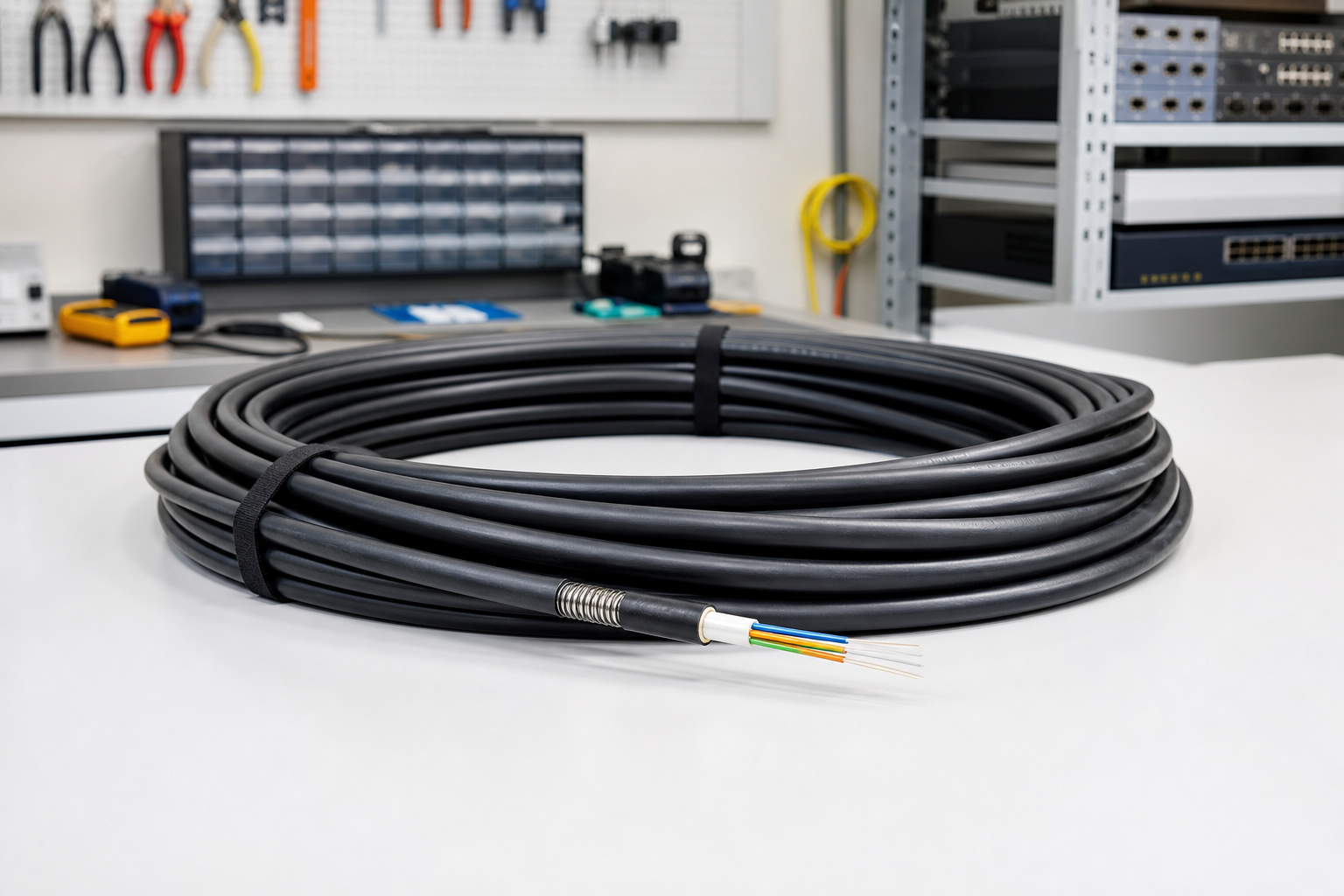
Armoured fiber cable is one of the most important cable types for reliable fiber optic installations in Kenya. Standard fiber optic cable is fast, light, and efficient, but many Kenyan projects are not installed in perfectly protected indoor spaces. Cables may pass through underground ducts, open trenches, ceiling spaces, perimeter walls, road crossings, utility chambers, factories, school compounds, apartment blocks, and outdoor CCTV routes. In those environments, a normal cable can be damaged by rodents, construction work, crushing, water, sharp bends, or accidental cuts.
Armoured fiber cable solves this problem by adding a strong protective layer around the optical fibers. The result is a cable that still carries data using light, but with much better physical protection for outdoor, underground, industrial, and high-risk installations. For businesses, estates, schools, hospitals, warehouses, ISPs, CCTV contractors, and homeowners building long-lasting networks, choosing the right armoured fiber cable is not a minor technical detail. It is a major part of network reliability.
This guide explains what armoured fiber cable is, how it works, where it is used in Kenya, the different types available, installation best practices, pricing factors, and how to choose the right supplier or installer. It is written for Kenyan buyers who want a practical explanation before purchasing cable, requesting a quotation, or approving a fiber installation project.
What Is Armoured Fiber Cable?
Armoured fiber cable is a fiber optic cable with an extra protective layer designed to resist physical damage. The armour is usually made from corrugated steel tape, steel wire, aluminium, or a non-metallic strength material depending on the cable design and application. This armour surrounds the inner fiber structure and helps protect the cable from crushing, cuts, rodent bites, pulling stress, and environmental exposure.
Inside the cable, the actual optical fibers are still very thin strands of glass or plastic. These fibers transmit information as pulses of light rather than electrical current. That is why fiber optic networks can support high speeds, long distances, low latency, and stable performance compared to older copper-based networks. If you want a broader foundation on how fiber connectivity works locally, read this guide on fiber optic internet in Kenya.
The difference between ordinary fiber cable and armoured fiber cable is not the data transmission method. Both use optical fibers. The difference is the protection around those fibers. Armoured cable is built for routes where the cable may be exposed to impact, pressure, moisture, rodents, or human interference.
Why Armoured Fiber Cable Matters in Kenya
Kenya's demand for fiber connectivity has grown quickly in Nairobi, Mombasa, Kisumu, Nakuru, Eldoret, Thika, Kitengela, Athi River, Machakos, Kiambu, and many other towns. Homes need stable internet for streaming and remote work. Offices need cloud services and video meetings. Schools need e-learning platforms. Factories need connected machines and CCTV. Estates need gate systems, intercoms, access control, and shared internet infrastructure.
However, the physical environment can be harsh. A cable may be buried near a road that will be excavated later. It may pass through a manhole that floods during heavy rain. It may run along a perimeter wall where rodents or vandalism are a risk. It may connect several buildings in a compound where vehicles, stones, and construction materials can crush exposed cable. These are common Kenyan installation realities, not rare exceptions.
Armoured fiber cable is valuable because it reduces the risk of damage in these conditions. It does not remove the need for proper trenching, ducting, route marking, splicing, and testing, but it gives the network a stronger physical backbone. For critical links, that extra protection can prevent expensive downtime.
How Armoured Fiber Cable Is Built
A typical armoured fiber cable has several layers, each with a specific job. At the centre are the optical fiber cores. These are the glass strands that carry the light signal. Around the fibers are buffer tubes or tight buffer coatings that protect and organize the strands. Many outdoor cables also include water-blocking gel or dry water-blocking tape to stop moisture from spreading through the cable.
Strength members are then added to support pulling tension during installation. These may include aramid yarn, fiberglass rods, or other materials. The armour layer sits outside the core structure and provides mechanical protection. Finally, the outer jacket protects the cable from weather, abrasion, sunlight, and general handling.
Common jacket materials include polyethylene for outdoor cable, PVC for some indoor environments, and LSZH where low-smoke, zero-halogen performance is needed. The correct jacket depends on whether the cable will be installed indoors, outdoors, underground, in ducts, in risers, or in industrial areas.
Main Types of Armoured Fiber Cable in Kenya
There is no single armoured fiber cable that fits every project. The right choice depends on cable route, installation environment, distance, core count, and budget. Below are the common types buyers and installers encounter in Kenya.
Single Armoured Fiber Cable
Single armoured fiber cable has one armour layer, usually corrugated steel tape or aluminium. It is suitable for many outdoor and duct installations where moderate protection is required. It is commonly used in office parks, residential estates, apartment buildings, CCTV routes, and building-to-building links.
Single armoured cable is often easier to handle than double armoured cable because it is lighter and more flexible. For many Kenyan commercial and residential projects, it provides a good balance between protection and cost.
Double Armoured Fiber Cable
Double armoured fiber cable has two armour layers for stronger mechanical protection. It is used in harsher routes where the cable may face heavy pressure, rocky soil, repeated construction activity, or higher risk of vandalism. Double armoured cable is common in industrial sites, utility routes, long outdoor runs, farms, warehouses, and critical infrastructure projects.
It costs more and can be harder to install, but the additional durability is useful when cable replacement would be expensive or disruptive.
Direct Burial Armoured Fiber Cable
Direct burial armoured fiber cable is designed for underground installation. It normally includes a strong outdoor jacket, water-blocking protection, and an armour layer that can withstand soil pressure and ground movement. It is useful for connecting buildings across compounds, schools, factories, estates, farms, and remote sites.
Even when a cable is rated for direct burial, good installers often still use ducts, sleeves, warning tape, and route markers, especially at road crossings or areas likely to be excavated later. The cable may be strong, but a marked and protected route is still easier to maintain.
Aerial Armoured Fiber Cable
Aerial armoured fiber cable is installed overhead on poles. It may be self-supporting or supported by a messenger wire. Aerial fiber is useful where underground trenching is expensive, impossible, or too slow. Many Kenyan last-mile networks use aerial fiber in residential estates and peri-urban areas.
Aerial routes must be planned carefully. The installer should consider sag, wind load, pole strength, road clearance, UV exposure, and the risk of accidental damage from vehicles, ladders, or construction activity.
Indoor Armoured Fiber Patch Cables
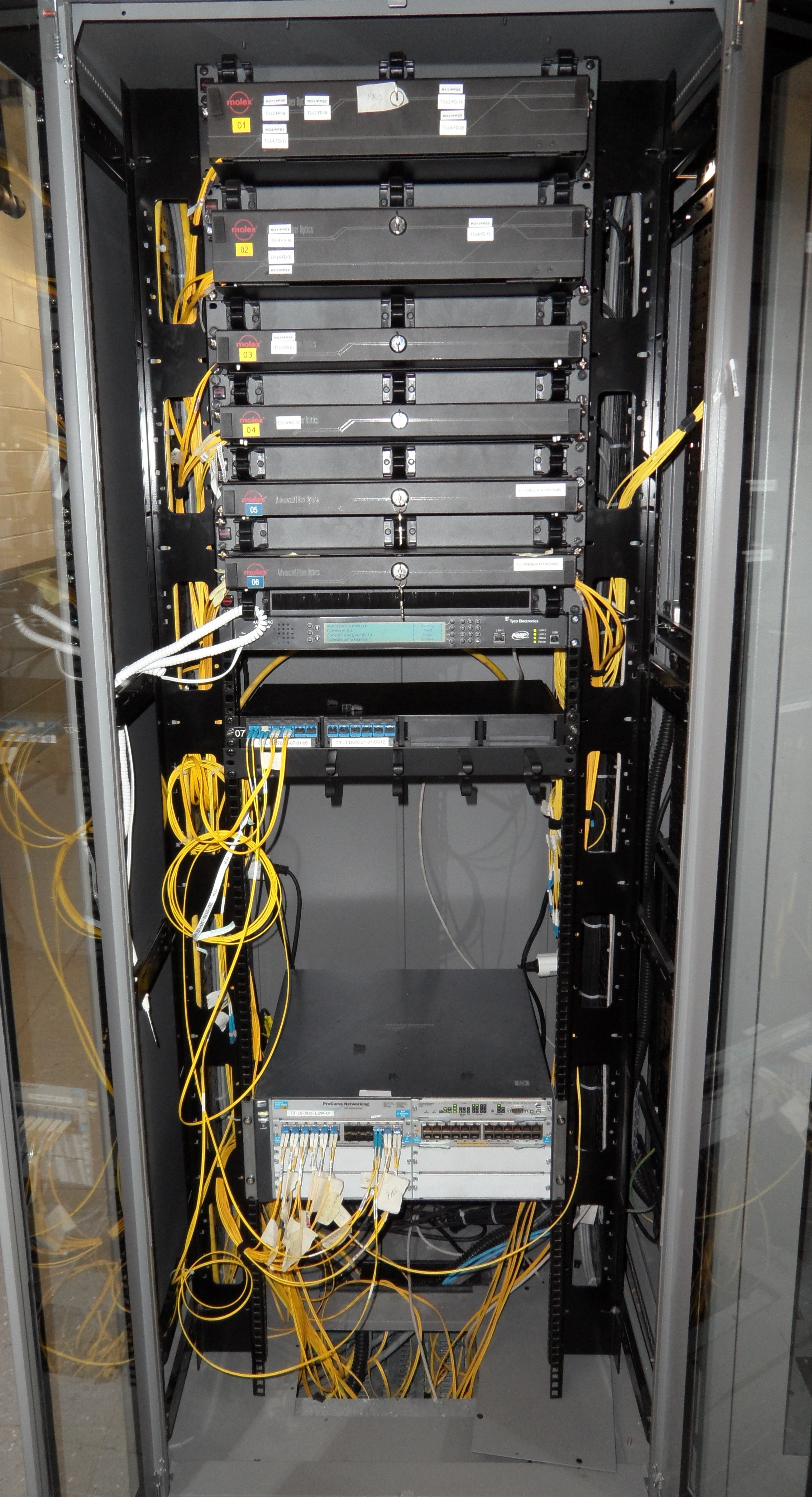
Armoured fiber is also used indoors. Short armoured patch cords are useful in server rooms, data cabinets, CCTV rooms, and network racks where cables are frequently handled. They reduce the chance of damage during maintenance and help protect patching in busy environments.
For structured cabling and professional rack work, armoured patch cords may be paired with optical distribution frames, patch panels, SFP modules, media converters, and switches.
Single-Mode vs Multimode Armoured Fiber Cable
When buying armoured fiber cable in Kenya, you also need to decide between single-mode and multimode fiber. This choice affects distance, speed, optics, and future upgrade potential.
Single-mode armoured fiber cable is the most common choice for outdoor, long-distance, and ISP-style installations. It supports longer distances and higher bandwidth using laser-based optics. For building-to-building links, estates, campus networks, FTTH backbones, and most outdoor projects, single-mode is usually the better long-term option.
Multimode armoured fiber cable is mostly used for shorter links inside buildings, data centers, or server rooms. It can work well over short distances, but it is less suitable for long outdoor runs. If your project connects several buildings or may need future bandwidth upgrades, single-mode is normally the safer recommendation.
For a deeper comparison of fiber types, existing local resources such as single-mode fiber cable in Kenya and multimode fiber cable in Kenya can help you understand where each cable type fits.
Where Armoured Fiber Cable Is Used in Kenya
Armoured fiber cable is used in many real projects across Kenya. It is common in ISP networks, office compounds, school campuses, apartment blocks, factories, warehouses, gated communities, hospitals, hotels, farms, CCTV systems, and government or utility networks.
In residential estates, it may connect a provider's distribution point to multiple homes or blocks. In offices, it may link network rooms across floors or buildings. In factories, it may carry data between production areas, stores, gates, and administration offices. In CCTV installations, it may connect distant camera clusters back to the control room.
For most professional fiber optic network installation in Kenya, armoured cable is considered whenever the route leaves a protected indoor environment. It is especially important where cable repairs would interrupt business operations or security monitoring.
Benefits of Armoured Fiber Cable
Better Physical Protection
The most obvious benefit is protection. The armour layer helps protect the fibers from crushing, cuts, rodent bites, sharp stones, and accidental impact. This matters in ceilings, ducts, manholes, trenches, warehouses, and outdoor routes.
Lower Long-Term Maintenance Cost
Armoured cable is more expensive than standard cable, but it can reduce the cost of repairs over the life of the network. If a cable route is difficult to access, crosses a road, or supports a critical business system, one avoided outage can justify the extra upfront cost.
Better Outdoor Reliability
Outdoor-rated armoured cable is designed to handle environmental exposure better than indoor cable. It can resist moisture, sunlight, abrasion, and general handling when specified correctly.
Improved Network Uptime
For businesses, schools, hotels, hospitals, and security systems, downtime is not just inconvenient. It can affect revenue, safety, learning, customer service, and operations. Armoured fiber cable helps reduce avoidable physical faults.
Support for Future Expansion
Armoured fiber cable is available in multiple core counts, such as 2-core, 4-core, 6-core, 8-core, 12-core, 24-core, 48-core, and higher. Installing spare cores during the first project makes future expansion easier and cheaper.
Armoured Fiber Cable for CCTV Systems
CCTV is one of the strongest use cases for armoured fiber cable in Kenya. Large homes, schools, factories, apartment blocks, warehouses, petrol stations, farms, hotels, and commercial compounds often need cameras installed far from the main network room. Copper Ethernet cable is generally limited to around 100 meters, while fiber can support much longer runs.
Armoured fiber cable is ideal for CCTV backbones because camera routes often pass through outdoor areas, perimeter walls, gates, parking zones, and exposed conduits. A damaged cable can disconnect an entire cluster of cameras, creating a serious security gap. Using armoured cable reduces that risk.
A typical CCTV fiber setup may include armoured fiber cable, outdoor splice closures, fiber termination boxes, SFP switches, media converters, PoE switches near camera clusters, UPS backup, and proper surge protection. The exact design depends on the number of cameras, distances, power availability, and whether the system uses IP cameras or hybrid equipment.
Armoured Fiber Cable for Businesses
Businesses use armoured fiber cable to connect departments, floors, buildings, warehouses, branches, access control systems, VoIP phones, Wi-Fi access points, point-of-sale systems, cloud applications, and CCTV systems. In an office park or industrial compound, fiber becomes the backbone that carries traffic between different network zones.
Business installations should be planned with redundancy in mind. Spare fiber cores, labelled patch panels, documented routes, and alternative paths can make troubleshooting much faster. For critical sites, the network may also combine fiber with backup connectivity such as 4G, 5G, satellite, or a second ISP. Providers such as Amazon Internet Kenya can be compared for backup connectivity options where business continuity is important.
Armoured Fiber Cable for Homes and Estates
Home users may not always think about armoured fiber cable, but it can be useful in larger homes, villas, maisonettes, and private compounds. If fiber must run from a gate, utility pole, external wall, or detached office into the house, armoured cable gives the link better protection.
In gated estates and apartment blocks, armoured fiber is often used for distribution routes between blocks, guard houses, data cabinets, and provider termination points. It can support internet, CCTV, access control, intercoms, and shared Wi-Fi infrastructure.
For FTTH projects, the last drop cable may be lighter than a backbone cable, but armoured options are still valuable where the route is exposed. You can also review how fiber to the home in Kenya works to understand where customer drop cables fit into the wider network.
Installation Best Practices
Armoured cable is strong, but it can still fail if installed poorly. Good installation is just as important as good cable selection. Before work begins, the installer should carry out a route survey. The survey should identify the cable path, existing ducts, poles, walls, manholes, road crossings, electrical routes, drainage risks, and future construction risks.
Underground routes should be deep enough, protected where necessary, and marked with warning tape. Road crossings should use stronger ducting or sleeves. Outdoor enclosures should be sealed properly. Cable entries into buildings should prevent water ingress. Aerial routes should maintain proper clearance and tension.
Installers must also respect bend radius and pulling tension. Fiber cable should not be forced around tight corners or pulled aggressively. The armour protects the cable from external damage, but the glass fibers inside can still be harmed by excessive bending or tension.
Permanent links should be fusion spliced where appropriate. Good fiber optic fusion splicing in Kenya produces low-loss joints that are more reliable than rough mechanical joins. After installation, the link should be tested using a power meter, light source, and, for critical links, OTDR equipment. Professional OTDR testing services in Kenya help locate bends, breaks, bad splices, and unexpected losses along the route.

Choosing the Right Core Count
Core count is one of the most important buying decisions. A 2-core cable may be enough for one simple point-to-point link, but it leaves little room for redundancy or future growth. A 4-core, 6-core, or 12-core cable often gives better flexibility for a modest increase in cost. Larger campuses, estates, CCTV networks, and business sites may need 24-core, 48-core, or higher.
Spare cores can be used for backup links, new buildings, extra cameras, separate VLANs, future tenants, or a second service provider. Since trenching and labour can cost more than the cable itself, installing a slightly higher core count at the beginning is often a smart decision.
Armoured Fiber Cable Price in Kenya
The price of armoured fiber cable in Kenya varies depending on fiber type, core count, armour type, jacket material, brand, length, and supplier. Single-mode cable is common and cost-effective for long outdoor runs. Multimode cable may cost more depending on grade and application. Double armoured and steel wire armoured cables usually cost more than standard single armoured designs.
The cable itself is only one part of the total project cost. You should also budget for trenching, ducts, poles, splice closures, termination boxes, pigtails, patch cords, ODFs, SFP modules, media converters, switches, labour, fusion splicing, testing, and documentation. A low cable price does not always mean a low project cost.
When comparing quotations, ask whether the price includes installation, accessories, testing, and warranty. Also confirm whether the cable is suitable for the route: direct burial, duct, aerial, indoor, outdoor, or industrial. Using the wrong cable can cost more later than buying the right cable from the start.
Armoured Fiber Cable vs Standard Fiber Cable
Standard fiber cable is lighter, cheaper, and easier to handle. It is suitable for protected indoor routes, patch panels, server rooms, cabinets, and conduits where physical risk is low. Armoured fiber cable is heavier and more expensive, but it is much better for exposed or harsh environments.
Use standard fiber cable where the cable is fully indoors, protected by trays or conduits, easy to access, and unlikely to be crushed or damaged. Use armoured fiber cable where the cable runs outdoors, underground, through ducts, across compounds, along perimeter walls, through ceilings with rodents, or in areas with construction activity.
For most Kenyan outdoor and underground installations, armoured cable is the more practical long-term choice. The additional cost is usually small compared to the disruption caused by a damaged backbone link.
Supplier and Installer Checklist
Before buying armoured fiber cable, confirm the cable specification in writing. Ask for fiber type, core count, armour type, jacket material, application rating, drum length, and warranty. If the supplier is also installing the cable, ask about route survey, splicing method, testing equipment, documentation, and after-sales support.
A good installer should provide a clear route plan, recommend the correct cable, protect high-risk sections, label both ends, document core usage, and test the link before handover. For advanced routing, VLANs, load balancing, and business network control, equipment suppliers such as MikroTik Kenya can provide routers and network hardware that work alongside the fiber backbone.
Common Mistakes to Avoid
- Buying indoor fiber cable for an outdoor or underground route.
- Choosing too few cores and leaving no room for expansion.
- Burying cable too shallow or without warning tape.
- Ignoring bend radius limits during installation.
- Pulling the cable too hard through ducts or corners.
- Leaving splice closures exposed to water or impact.
- Using low-quality pigtails, connectors, or patch panels.
- Failing to label cores and termination points.
- Skipping power meter or OTDR testing after installation.
- Choosing the cheapest installer without checking experience.
Armoured Fiber Cable and Backup Internet
Fiber is usually the best fixed connectivity option where infrastructure is available, but some Kenyan sites still use satellite or mobile internet as backup. Remote farms, lodges, conservancies, and rural schools may use satellite where fiber is not yet available. For readers comparing alternatives, resources from satellite internet installers and Starlink Kenya installers can help explain satellite setup requirements.
For urban and peri-urban sites, armoured fiber cable remains the stronger backbone where a physical fiber route is available. Satellite and mobile links are useful for redundancy, but they do not replace a well-installed protected fiber network for high-capacity daily operations.
Frequently Asked Questions
What is armoured fiber cable used for in Kenya?
It is used for outdoor, underground, aerial, CCTV, business, estate, campus, and industrial fiber links where the cable needs extra protection from physical damage, rodents, moisture, or tampering.
Is armoured fiber cable better than normal fiber cable?
It is better for exposed or harsh environments because it has a protective armour layer. Normal fiber cable is still suitable for protected indoor routes and short patching inside cabinets or server rooms.
Can armoured fiber cable be buried directly?
Some armoured fiber cables are designed for direct burial, but the exact specification matters. Even with direct burial cable, ducts, warning tape, proper trench depth, and route marking are often recommended.
Which is better for outdoor use: single-mode or multimode?
Single-mode is usually better for outdoor and long-distance installations because it supports longer links and future bandwidth upgrades. Multimode is more common for short indoor links.
How many cores should I buy?
Choose more cores than you currently need. A 4-core, 6-core, or 12-core cable gives better flexibility than a minimal 2-core cable, especially for CCTV, estates, and business networks.
Does armoured fiber cable need conduit?
Not always, but conduit is recommended in many Kenyan installations, especially at road crossings, walls, construction zones, and areas likely to be disturbed later.
Final Thoughts
Armoured fiber cable is a practical investment for reliable fiber optic installations in Kenya. It protects the delicate optical fibers from real-world risks while preserving the speed, low latency, and scalability that make fiber the preferred backbone for modern networks. Whether you are connecting a home, office, school, factory, estate, CCTV system, or rural site, the right cable specification will reduce failures and improve long-term performance.
The best results come from combining the right cable with professional installation: proper route planning, correct core count, safe pulling, clean splicing, sealed closures, labelled terminations, and proper testing. If the cable route is outdoor, underground, exposed, or business-critical, armoured fiber cable is usually the right choice for Kenya.