SFP Modules Price in Kenya
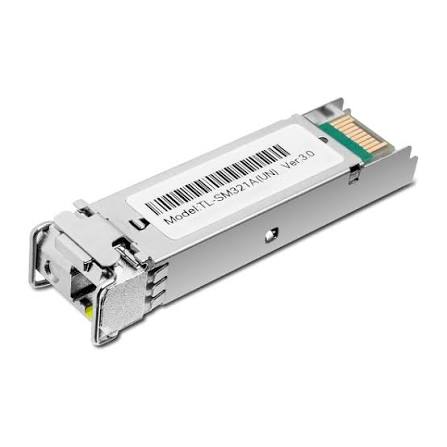
TP-Link TL-SM321A Gigabit WDM Bi-Directional SFP Module 20KM Price in Kenya
KSh 2,732.00
1 available
Continue shoppingTP-Link TL-SM321A Gigabit WDM Bi-Directional SFP Module 20KM Price in Kenya
The TP-Link TL-SM321A is a 1000Base-BX WDM Bi-Directional SFP module designed to carry Gigabit Ethernet over a single strand of single-mode fibre.
Unlike conventional duplex SFP modules that normally require two fibre cores—one for transmit and one for receive—the TL-SM321A uses Wavelength Division Multiplexing (WDM) to transmit and receive on different wavelengths through the same fibre.
Current TP-Link versions of the TL-SM321A provide a 1.25Gbps optical data rate, Tx 1550nm / Rx 1310nm wavelengths, 9/125µm single-mode fibre support, LC simplex connectivity and transmission distances up to 20km.
The TL-SM321A is normally paired with the complementary TL-SM321B, which transmits at 1310nm and receives at 1550nm. This creates a full-duplex Gigabit Ethernet connection using only one fibre strand.
TP-Link TL-SM321A Specifications
| Specification | Details |
|---|---|
| Model | TP-Link TL-SM321A / SM321A |
| Module Type | WDM Bi-Directional SFP |
| Ethernet Standard | 1000Base-BX |
| Standards | IEEE 802.3z |
| Data Rate | 1.25Gbps |
| Ethernet Speed | 1Gbps |
| TL-SM321A Tx Wavelength | 1550nm |
| TL-SM321A Rx Wavelength | 1310nm |
| Complementary Module | TL-SM321B |
| Fibre Type | Single Mode |
| Fibre Size | 9/125µm |
| Maximum Distance | Up to 20KM on current versions |
| Connector | LC Simplex |
| Number of Fibre Strands | 1 |
| Technology | WDM / BiDi |
| DDM | Yes |
| SFP-MSA | Supported |
| Hot-Swappable | Yes |
| Power Supply | 3.3V |
| Maximum Laser Output | -3dBm on current SM321A datasheet |
| Dimensions | Approx. 55.4 × 13.7 × 12.9mm on current version |
| Operating Temperature | 0°C to 70°C |
| Storage Temperature | -40°C to 85°C |
| Operating Humidity | 10%–90% RH, non-condensing |
| Applications | ISP, enterprise, CCTV, campus and building fibre links |
TP-Link's current SM321A documentation confirms 20km reach, 1.25Gbps, 1550nm Tx, 1310nm Rx, LC simplex, DDM, SFP-MSA and hot-swappable operation.
What Is the TP-Link TL-SM321A?
The TL-SM321A is a compact optical transceiver designed for compatible Gigabit SFP ports.
It converts electrical Ethernet signals into optical signals and transmits them over single-mode fibre.
A typical connection looks like:
Switch A → TL-SM321A → Single Fibre → TL-SM321B → Switch B
Because the A and B modules use complementary wavelengths, both directions of traffic can travel simultaneously through the same fibre strand.
What Does WDM Mean?
WDM stands for:
Wavelength Division Multiplexing
WDM allows multiple optical wavelengths to travel through one fibre.
In the case of the TL-SM321A/TL-SM321B pair:
TL-SM321A:
Tx: 1550nm
Rx: 1310nm
TL-SM321B:
Tx: 1310nm
Rx: 1550nm
This complementary arrangement allows both modules to communicate through a single optical fibre.
What Is a Bi-Directional SFP?
A Bi-Directional or BiDi SFP transmits and receives data using one fibre strand.
A conventional optical module often requires:
Fibre 1 → Tx
Fibre 2 → Rx
A BiDi module instead uses:
One Fibre → Tx + Rx using different wavelengths
This is especially useful for fibre networks where available cores are limited.
1000Base-BX Gigabit Ethernet
The TL-SM321A follows the 1000Base-BX concept for Gigabit Ethernet communication over single-fibre WDM links.
TP-Link describes the current module as a 1000Base-BX WDM Bi-Directional SFP Module.
It is suitable for:
Gigabit Ethernet
Switch uplinks
Media converters
Point-to-point fibre
ISP access networks
Enterprise fibre
Campus networks
1.25Gbps Data Rate
The TL-SM321A has a specified optical data rate of:
1.25Gbps
This provides the optical signalling required for standard Gigabit Ethernet operation.
1550nm Transmit Wavelength
The TL-SM321A transmits at:
1550nm
This optical signal travels from the TL-SM321A toward the complementary module.
The remote module must therefore be capable of receiving at 1550nm.
1310nm Receive Wavelength
The TL-SM321A receives at:
1310nm
Its complementary TL-SM321B transmits at 1310nm, allowing traffic to flow in the opposite direction over the same fibre.
TL-SM321A and TL-SM321B Pairing
The TL-SM321A should normally be paired with:
TP-Link TL-SM321B
The wavelength relationship is:
| Module | Transmit | Receive |
|---|---|---|
| TL-SM321A | 1550nm | 1310nm |
| TL-SM321B | 1310nm | 1550nm |
This complementary arrangement is essential.
Using two TL-SM321A modules at opposite ends would normally not establish a link because both ends would transmit on the same wavelength and listen on the same receive wavelength.
One Fibre Strand for Gigabit Ethernet
One of the biggest advantages of the TL-SM321A is that it uses:
1 Fibre Strand
instead of the two strands normally required by duplex optical modules.
This makes it valuable when:
Fibre cores are limited
Spare cores need to be preserved
Existing fibre capacity must be expanded
Cable replacement would be expensive
Long-distance links need to use one existing fibre
Up to 20KM Transmission
Current TP-Link versions specify a maximum fibre distance of:
20 kilometres
over:
9/125µm single-mode fibre.
The actual achievable distance depends on the optical condition of the link, including:
Fibre attenuation
Connector losses
Splice losses
Patch panels
Fibre bends
Connector cleanliness
Engineering margin
Older 10KM TL-SM321A Versions
Some older TL-SM321A versions were specified for:
10km
rather than 20km. TP-Link's older V2 documentation, for example, lists a maximum distance of 10km.
Therefore, always verify the hardware revision.
TL-SM321A Distance by Generation
| Product Version | Typical Published Reach |
|---|---|
| Older TL-SM321A Versions | 10km |
| Current TL-SM321A / SM321A Versions | 20km |
For a network route longer than 10km, make sure the supplied module is specifically the 20km-rated version.
LC Simplex Connector
Current TP-Link SM321A versions use:
LC Simplex
Because the module uses WDM BiDi technology, only one LC fibre connection is required.
This differs from TL-SM311LS, which normally uses an LC duplex interface with two fibre strands.
LC Simplex vs LC Duplex
| Feature | TL-SM321A | Conventional Duplex SFP |
|---|---|---|
| Connector | LC Simplex | LC Duplex |
| Fibre Strands | 1 | 2 |
| Tx/Rx | Different wavelengths | Separate fibres |
| BiDi | Yes | No |
| WDM | Yes | Normally No |
Watch TP-Link TL-SM321A Video
https://youtu.be/PfqJLzF3l6U
The TP-Link TL-SM321A is particularly useful where an existing single-mode fibre cable has limited spare cores. Instead of allocating two cores for each Gigabit Ethernet connection, its WDM BiDi architecture allows one fibre strand to carry traffic in both directions.
A matched TL-SM321A and TL-SM321B pair can therefore help increase the number of Ethernet links that can operate over an existing fibre cable. This is particularly valuable for ISPs, campuses, estates and CCTV installations where installing additional fibre would involve significant civil or cabling work.
Current versions also provide DDM support, allowing compatible equipment to report useful diagnostic information such as transmit and receive optical power. This can simplify troubleshooting when dealing with long-distance fibre links.
Digital Diagnostic Monitoring – DDM
The TL-SM321A supports:
DDM – Digital Diagnostic Monitoring
TP-Link states that DDM provides real-time monitoring of transceiver operating parameters.
Depending on the networking device, technicians may be able to monitor:
Transmit optical power
Receive optical power
Module temperature
Module current
Operating status
This is valuable when troubleshooting:
Low received power
Fibre attenuation
Dirty connectors
High-loss splices
Intermittent fibre links
SFP-MSA Compatibility
The TL-SM321A complies with the Small Form-factor Pluggable Multi-Source Agreement, commonly called:
SFP-MSA
TP-Link confirms SFP-MSA compatibility on current modules.
However, the networking device should still be checked for vendor-specific SFP compatibility.
Hot-Swappable Design
The TL-SM321A supports hot-swappable operation.
This means a compatible module can be inserted or replaced without replacing the entire switch, router or media converter.
TP-Link identifies the module as hot-swappable in its current documentation.
TP-Link TL-SM321A for TP-Link Switches
The TL-SM321A can be installed in compatible TP-Link switches with Gigabit SFP slots.
Typical applications include:
Core switch uplinks
Distribution switches
Building links
Remote cabinets
Campus links
CCTV networks
Older TP-Link documentation lists compatibility with several T-series switch families as well as the MC220L media converter.
TL-SM321A with TP-Link MC220L
The TP-Link MC220L is a Gigabit media converter with an SFP interface.
Older TP-Link documentation specifically lists MC220L compatibility with TL-SM321A.
A typical setup is:
RJ45 Ethernet
↓
TP-Link MC220L
↓
TL-SM321A
↓
Single Fibre
↓
TL-SM321B
↓
Remote SFP Device
TL-SM321A for Building-to-Building Fibre
The module is suitable for connecting buildings over single-mode fibre.
Example:
Office Building A
↓
Switch + TL-SM321A
↓
Single Fibre Core
↓
Switch + TL-SM321B
↓
Office Building B
This can be particularly useful where only one fibre core is available between the buildings.
TL-SM321A for ISP Networks
ISPs can use BiDi SFPs for:
POP connections
Distribution switches
Tower uplinks
Enterprise customer links
Estate fibre networks
Access networks
Remote network cabinets
The ability to transmit Gigabit Ethernet through one core can substantially improve fibre-core utilization.
TL-SM321A for CCTV Networks
The TL-SM321A can be used to transport aggregated CCTV traffic.
Example:
IP Cameras → PoE Switch → TL-SM321A → Single Fibre → TL-SM321B → Core Switch → NVR
This can be useful for:
Estates
Schools
Industrial facilities
Hospitals
Warehouses
Hotels
Large office compounds
TL-SM321A for Campus Networks
WDM BiDi modules are useful for connecting buildings throughout a large campus.
Suitable environments include:
Universities
Schools
Hospitals
Government campuses
Factories
Business parks
Residential estates
TL-SM321A vs TL-SM321B
The two modules are designed to complement one another.
| Specification | TL-SM321A | TL-SM321B |
|---|---|---|
| Speed | 1.25Gbps | 1.25Gbps |
| Fibre | Single Mode | Single Mode |
| Connector | LC Simplex | LC Simplex |
| Tx Wavelength | 1550nm | 1310nm |
| Rx Wavelength | 1310nm | 1550nm |
| Current Reach | Up to 20km | Up to 20km |
| Technology | WDM BiDi | WDM BiDi |
TP-Link's combined A/B datasheet confirms these complementary wavelengths.
TL-SM321A vs TL-SM311LS
Both are Gigabit single-mode SFP modules, but they use fibre differently.
| Feature | TL-SM321A | TL-SM311LS |
|---|---|---|
| Technology | WDM BiDi | Conventional Duplex |
| Fibre Type | Single Mode | Single Mode |
| Fibre Strands | 1 | 2 |
| Connector | LC Simplex | LC Duplex |
| Tx | 1550nm | 1310nm |
| Rx | 1310nm | 1310nm conventional duplex |
| Current Max Reach | Up to 20km | Up to 20km |
| Matched Complementary Module | TL-SM321B | Same-type duplex module |
| Best Advantage | Saves fibre cores | Standard duplex architecture |
TL-SM321A vs TL-SM311LM
| Feature | TL-SM321A | TL-SM311LM |
|---|---|---|
| Fibre | Single Mode | Multimode |
| Wavelengths | 1550/1310nm | 850nm |
| Fibre Strands | 1 | 2 |
| Maximum Distance | Up to 20km | Up to 550m |
| Connector | LC Simplex | LC Duplex |
| Best Use | Long-distance single-fibre links | Short multimode links |
TL-SM321A vs Standard 1G 20KM SFP
| Feature | TL-SM321A | Standard 20KM Duplex SFP |
|---|---|---|
| Speed | 1Gbps | 1Gbps |
| Fibre | Single Mode | Single Mode |
| Fibre Cores | 1 | 2 |
| Connector | LC Simplex | LC Duplex |
| Wavelength Scheme | WDM BiDi | Conventional |
| Pairing | A/B complementary modules | Usually same module each end |
TL-SM321A vs 10G BiDi SFP+
The TL-SM321A is a Gigabit module.
It should not be confused with a 10Gbps SFP+ BiDi module.
| Feature | TL-SM321A | 10G BiDi SFP+ |
|---|---|---|
| Speed | 1Gbps | 10Gbps |
| Form Factor | SFP | SFP+ |
| Fibre Strands | 1 | 1 |
| BiDi | Yes | Yes |
| Typical Application | Gigabit access | High-capacity uplink |
Why Use BiDi Instead of Duplex Fibre?
The main advantage is:
Fibre Core Conservation
Suppose an existing cable has 12 fibre cores.
Using conventional duplex links:
12 cores ÷ 2 = 6 duplex links
Using BiDi:
12 cores = potentially 12 single-fibre links
Actual network design depends on topology and equipment, but this illustrates why BiDi is useful for fibre-scarce routes.
Optical Budget and 20KM Links
The 20km rating assumes that total link loss remains within the transceiver's optical budget.
Loss can come from:
Fibre attenuation
Fusion splices
Connectors
Patch cords
Fibre adapters
Dirty ferrules
Macrobends
Damaged fibre
A 20km-rated module does not guarantee that every 20km fibre route will work without testing.
Fibre Cleaning
LC connectors should be cleaned before insertion.
Even microscopic contamination can increase optical loss.
Common symptoms include:
Link not coming up
Low Rx power
Intermittent connection
Packet loss
Link flapping
Testing TL-SM321A Links
Optical Power Meter
An Optical Power Meter can measure received signal power.
OTDR
An OTDR can help identify:
Fibre length
Breaks
Splice loss
Connector loss
Reflection
Macrobends
VFL
A Visual Fault Locator can help identify visible fibre faults and continuity on shorter routes.
Operating Temperature
TP-Link specifies the current TL-SM321A for:
0°C to 70°C operating temperature
with storage temperatures from approximately:
-40°C to 85°C.
TL-SM321A Dimensions
TP-Link's current SM321A V4 datasheet specifies approximate dimensions of:
55.4 × 13.7 × 12.9mm.
Earlier V3 versions are listed at approximately 55.4 × 14.6 × 12.9mm, so minor mechanical specification differences exist between revisions.
Maximum Laser Output
TP-Link's current SM321A datasheet specifies a maximum laser output of:
0.501mW (-3dBm).
This specification relates to the current version and should not automatically be applied to every older hardware revision.
TP-Link TL-SM321A Price in Kenya
Current Kenyan listings show different prices depending on supplier.
A current Senetic Kenya listing shows:
KES 3,632.85 net
and approximately:
KES 4,214.11 gross.
Another Kenyan supplier currently lists the TL-SM321A at approximately:
KES 2,789.10.
Microless Kenya currently shows an example around:
KES 5,979, although delivery and import charges may apply.
Approximate TP-Link TL-SM321A Prices in Kenya
| Current Market Example | Approx. Price |
|---|---|
| Adishnet Listing | KES 2,789 |
| Senetic Net Price | KES 3,633 |
| Senetic Gross Price | KES 4,214 |
| Microless Kenya Listing | KES 5,979 |
These are third-party market references rather than fixed Fiber Optics Kenya prices, and they may change with stock, VAT, import costs and hardware revision.
Contact Fiber Optics Kenya for the current TP-Link TL-SM321A price and availability.
What Affects TL-SM321A Price in Kenya?
Pricing varies according to:
Hardware revision
10km or 20km version
Supplier
Warranty
VAT
Import charges
Stock availability
Quantity ordered
Whether TL-SM321B is included separately
Remember that a working link normally requires the complementary module at the opposite end.
Is TL-SM321B Included with TL-SM321A?
Usually, the TL-SM321A is sold as an individual module rather than automatically including the TL-SM321B.
The remote end therefore needs the appropriate complementary module.
Always confirm whether the quoted price is:
One Module
or
A Complete A+B Pair
before purchasing.
How to Choose the Correct TL-SM321A
Before ordering, confirm:
Your switch or media converter has a compatible 1G SFP port.
The fibre is 9/125µm single mode.
You require a single-fibre BiDi link.
The opposite end has the complementary TL-SM321B.
The route is within the module's rated distance.
The module is the required 20km hardware version.
The termination is LC simplex.
Your networking equipment supports the SFP.
The fibre's total optical loss is within specification.
Recommended Accessories
| Accessory | Application |
|---|---|
| TP-Link TL-SM321A | 1550nm Tx / 1310nm Rx endpoint |
| TP-Link TL-SM321B | Complementary BiDi endpoint |
| LC-LC Simplex SM Patch Cord | BiDi connection |
| LC-SC Simplex SM Patch Cord | Mixed termination |
| OS2 Single-Mode Fibre | Long-distance fibre |
| TP-Link MC220L | Copper-to-SFP conversion |
| Fibre ODF | Fibre termination |
| Fibre Patch Panel | Optical distribution |
| LC Adapters | Fibre interconnection |
| OTDR | Fibre fault testing |
| Optical Power Meter | Optical power testing |
| Fibre Cleaning Kit | Connector maintenance |
Frequently Asked Questions About TP-Link TL-SM321A
What is the TP-Link TL-SM321A?
It is a 1000Base-BX Gigabit WDM Bi-Directional SFP module.
What speed does TL-SM321A support?
It has a 1.25Gbps optical data rate for Gigabit Ethernet.
Is TL-SM321A a 1G SFP?
Yes.
What fibre does it use?
9/125µm single-mode fibre.
How many fibre strands does it need?
One.
Is TL-SM321A BiDi?
Yes.
What does BiDi mean?
Bidirectional transmission over a single fibre strand.
What does WDM mean?
Wavelength Division Multiplexing.
What wavelength does TL-SM321A transmit?
1550nm.
What wavelength does TL-SM321A receive?
1310nm.
Which module pairs with TL-SM321A?
TL-SM321B.
What wavelength does TL-SM321B transmit?
1310nm.
What wavelength does TL-SM321B receive?
1550nm.
Can I connect TL-SM321A to another TL-SM321A?
Normally no. A complementary A/B wavelength pair is required.
Can I connect TL-SM321A to TL-SM321B?
Yes. They are designed as complementary modules.
What is the maximum distance?
Current models support up to 20km.
Why do some listings say 10km?
Older TL-SM321A hardware versions were rated for 10km.
Should I check the hardware version?
Yes.
What connector does it use?
Current versions use LC simplex.
Does it use LC duplex?
No. Current versions use one LC simplex interface.
Does it require two fibre cores?
No.
Can it save fibre cores?
Yes. This is one of the main benefits of BiDi technology.
Does it support DDM?
Yes.
What is DDM?
Digital Diagnostic Monitoring.
Does it support SFP-MSA?
Yes.
Is it hot-swappable?
Yes.
What voltage does it use?
3.3V.
Can it work with TP-Link switches?
Yes, with compatible Gigabit SFP ports.
Can it work with TP-Link MC220L?
Yes. TP-Link's product documentation lists MC220L compatibility.
Can it work with other manufacturers' switches?
Potentially, provided the device accepts the transceiver. Verify vendor compatibility first.
Is it suitable for ISP networks?
Yes.
Is it suitable for CCTV?
Yes.
Is it suitable for enterprise networks?
Yes.
Is it suitable for campus networks?
Yes.
Can it connect buildings?
Yes.
Can it work over 5km?
Yes, assuming received optical power remains within specification.
Can it work over 10km?
Yes for the current 20km-rated version.
Can it work over 15km?
Potentially, subject to fibre loss and optical budget.
Can it work over 20km?
Current versions are rated up to 20km, subject to link conditions.
Can it work over 40km?
No. Use a suitably rated 40km BiDi pair.
Is TL-SM321A the same as TL-SM311LS?
No.
What is the difference between TL-SM321A and TL-SM311LS?
TL-SM321A uses one fibre with WDM BiDi, while TL-SM311LS normally uses two fibres in a duplex connection.
What is the difference between TL-SM321A and TL-SM311LM?
TL-SM321A uses long-distance single-mode fibre, while TL-SM311LM uses short-distance 850nm multimode fibre.
Is TL-SM321A a 10G SFP?
No. It is a Gigabit SFP.
Can I use it for 10Gbps?
No.
Is this an SFP+ module?
No. It is an SFP module.
Can I use one BiDi module with a duplex SFP?
Not normally. The wavelengths and optical interfaces must match.
Can I use an LC-LC simplex patch cord?
Yes.
Can I use LC-SC simplex fibre?
Yes, where the remote termination is SC and the fibre/polish type is compatible.
Should the patch cord be single mode?
Yes.
Is OS2 fibre suitable?
Yes.
Should I clean the fibre connector?
Yes.
Can a dirty LC connector prevent the link from working?
Yes.
Can I test the link with an Optical Power Meter?
Yes.
Can an OTDR test the fibre?
Yes.
What is the operating temperature?
0°C to 70°C on current versions.
What is the storage temperature?
Current versions are specified for approximately -40°C to 85°C.
What are the dimensions?
The current SM321A datasheet lists approximately 55.4 × 13.7 × 12.9mm.
What is the TL-SM321A price in Kenya?
Current market examples range from approximately KES 2,789 to KES 5,979, depending on supplier, tax, import cost and availability.
How much is TL-SM321A at Senetic Kenya?
The current listing shows approximately KES 3,632.85 net or KES 4,214.11 gross.
Is TL-SM321B sold separately?
Usually yes. Confirm the package contents with the supplier.
Do you supply TL-SM321A and TL-SM321B pairs?
Yes, subject to stock availability.
Do you supply 1G BiDi SFP modules?
Yes.
Do you supply 20KM SFP modules?
Yes.
Do you supply 40KM BiDi modules?
Yes.
Do you supply single-mode fibre patch cords?
Yes.
Do you supply media converters?
Yes.
Do you supply Optical Power Meters?
Yes.
Do you supply OTDRs?
Yes.
Can ISPs order SFP modules in bulk?
Yes. Bulk supply is suitable for ISPs, enterprises, CCTV integrators, campuses and fibre contractors.
Do you deliver outside Nairobi?
Yes. Fiber Optics Kenya supplies fibre optic equipment throughout Kenya.
Why Buy TP-Link TL-SM321A from Fiber Optics Kenya?
| Fiber Optics Kenya Solution | Application |
|---|---|
| TP-Link TL-SM321A | 1550/1310nm BiDi endpoint |
| TP-Link TL-SM321B | Complementary BiDi endpoint |
| 1G 20KM BiDi Modules | Long-distance single-fibre links |
| 1G 40KM BiDi Modules | Extended-distance links |
| TL-SM311LS | Duplex single-mode fibre |
| TL-SM311LM | Multimode fibre links |
| LC Simplex Patch Cords | BiDi fibre connections |
| OS2 Fibre Cable | Long-distance single-mode networks |
| Media Converters | Copper-to-fibre conversion |
| ODFs and Patch Panels | Fibre termination |
| Optical Power Meters | Optical-level testing |
| OTDRs | Fibre troubleshooting |
| Fibre Cleaning Equipment | Connector maintenance |
| Bulk Supply | ISP and enterprise projects |
| Nationwide Delivery | Supply throughout Kenya |
Contact Fiber Optics Kenya
Fiber Optics Kenya
Lyric House, 7th Floor Room S9
Kimathi Street, Nairobi
Phone: +254 704 991 492
Email: info@fibreopticskenya.co.ke
The TP-Link TL-SM321A Gigabit WDM Bi-Directional SFP Module is designed for reliable Gigabit Ethernet transmission through one single-mode fibre strand. Current versions provide 1.25Gbps, Tx1550nm/Rx1310nm operation, LC simplex connectivity, DDM, hot-swappable installation and transmission distances up to 20km.
Its most important advantage is fibre efficiency. When paired with the complementary TL-SM321B, the two modules carry upstream and downstream traffic using different wavelengths over the same fibre, reducing the number of fibre cores required for each Ethernet link.
Current Kenyan market examples place the TL-SM321A at roughly KES 2,789–5,979, depending on supplier, VAT, import charges and hardware revision.
Contact Fiber Optics Kenya for the current TP-Link TL-SM321A price in Kenya, TL-SM321A/TL-SM321B pairs, 20KM and 40KM BiDi SFP modules, LC simplex patch cords, media converters, fibre testing equipment, bulk ISP orders and nationwide delivery.