Fusion Splicer Accessories Price in Kenya
Signal Fire AI-9 Fusion Splicing Machine Price in Kenya
KSh 100,000.00
1 available
Continue shoppingSignal Fire AI-9 Fusion Splicing Machine Price in Kenya

The Signal Fire AI-9 Fusion Splicing Machine is a professional 6-motor core-alignment fibre fusion splicer designed for FTTH installations, ISP fibre networks, telecommunications infrastructure, backbone fibre, CCTV networks and fibre maintenance projects.
The AI-9 combines fast automatic fibre alignment with approximately 5-second splicing and 15-second heating, helping technicians complete large fibre installations efficiently. It also integrates an Optical Power Meter (OPM) and 15mW Visual Fault Locator (VFL), reducing the number of separate testing tools required in the field.
Its 7800mAh lithium battery is rated for approximately 260 combined splice-and-heat cycles under specified conditions, while the rugged construction is intended for field environments involving dust, changing temperatures and high-altitude installations.
Signal Fire AI-9 Key Specifications
| Specification | Details |
|---|---|
| Brand | Signal Fire |
| Model | AI-9 |
| Product Type | Fibre Fusion Splicer |
| Alignment | Core / Cladding Alignment |
| Motor System | 6 Motors |
| Splicing Time | Approx. 5 Seconds |
| Heating Time | Approx. 15 Seconds |
| Display | 5-inch Colour Screen |
| Magnification | Up to 320× Single Axis |
| Battery | 7800mAh Lithium |
| Splice + Heat Cycles | Approx. 260 |
| Built-in VFL | Yes |
| VFL Power | 15mW |
| Built-in OPM | Yes |
| OPM Measurement Range | -50 to +26 dBm on current specification |
| Fibre Alignment Accuracy | 0.1 μm |
| SM Typical Splice Loss | Approx. 0.02 dB |
| MM Typical Splice Loss | Approx. 0.01 dB |
| DS/NZDS Typical Loss | Approx. 0.04 dB |
| Fibre Holder | 3-in-1 Universal Holder |
| Splicing Modes | Automatic / Semi-Automatic |
| Operating Temperature | Approx. -15°C to +50°C |
| Operating Altitude | Up to 5,000 m |
| Machine Weight | Approx. 2.08–2.10 kg with battery |
| Applications | FTTH, ISP, Telecom, CCTV, Backbone Fibre |
These specifications align with Signal Fire's current AI-9 documentation, including the six-motor system, core alignment, 5-second splice cycle, 15-second heating and integrated testing functions.
6-Motor Core Alignment Technology
The AI-9 uses six motors with automatic focusing for core alignment.
This system precisely positions the two optical fibres before the electric arc fuses them together.
Core alignment is especially valuable for:
ISP backbone networks
FTTH distribution
ODF termination
Fibre closures
Data centres
Enterprise fibre
Long-distance fibre links
High-capacity telecom networks
Signal Fire specifies fibre alignment accuracy of approximately 0.1 μm for the AI-9.
Core Alignment vs Cladding Alignment
| Feature | AI-9 Core Alignment | Basic Cladding Alignment |
|---|---|---|
| Alignment Reference | Fibre Core | Outer Cladding |
| Motor System | 6 Motors | Usually Fewer |
| Precision | High | Moderate to High |
| Typical Splice Loss | Very Low | Generally Higher |
| FTTH | Excellent | Good |
| Backbone Fibre | Excellent | Less Preferred |
| Professional ISP Use | Excellent | Good |
| Cost | Higher | Lower |
5-Second Fibre Splicing
One of the strongest features of the Signal Fire AI-9 is its speed.
Signal Fire specifies a typical fusion cycle of approximately 5 seconds.
This becomes particularly valuable when technicians need to splice:
12-core fibre
24-core fibre
48-core fibre
96-core fibre
144-core fibre
Large ODFs
Multiple FAT boxes
High-capacity fibre closures
The faster each splice is completed, the more productive an installation team can be during large fibre projects.
15-Second Heating
Once the fibre has been fused, the exposed glass joint needs protection.
The technician slides a fibre splice protection sleeve over the completed splice and places it into the AI-9's heater.
Typical heating time is approximately 15 seconds.
The sleeve protects the splice against:
Bending
Pulling
Moisture
Dust
Accidental handling
Mechanical damage
Low Fibre Splice Loss
Signal Fire publishes the following typical loss figures for the AI-9:
| Fibre Type | Typical Splice Loss |
|---|---|
| Single Mode (SM) | 0.02 dB |
| Multimode (MM) | 0.01 dB |
| DS Fibre | 0.04 dB |
| NZDS Fibre | 0.04 dB |
Actual field loss will depend on fibre preparation, cleave quality, contamination, electrodes, arc calibration and fibre compatibility.
Supported Fibre Types
The Signal Fire AI-9 can splice a broad range of optical fibres.
| Fibre Standard | Fibre Type |
|---|---|
| G.651 | Multimode |
| G.652 | Standard Single Mode |
| G.653 | Dispersion Shifted |
| G.654 | Cut-Off Shifted Fibre |
| G.655 | Non-Zero Dispersion Shifted |
| G.657 | Bend-Insensitive Fibre |
This flexibility makes the machine suitable for both conventional telecommunications fibre and modern FTTH networks.
3-in-1 Universal Fibre Holder

The AI-9 includes a 3-in-1 fibre holder designed to accommodate multiple fibre formats without repeatedly changing holders.
It can be used with:
Bare fibre
Single-mode fibre
Multimode fibre
FTTH drop cable
Pigtails
Jumper fibre
Multi-core fibre cable
This is particularly convenient for technicians who may work on backbone fibre in the morning and FTTH subscriber drops later in the same day.
Built-In Optical Power Meter
Another important feature is the integrated Optical Power Meter.
Signal Fire lists multiple supported wavelengths, including:
850 / 980 / 1270 / 1300 / 1310 / 1490 / 1550 / 1577 / 1625 / 1650 nm
with a published measurement range of approximately -50 to +26 dBm on its current AI-9 specification.
The OPM can help technicians check:
Optical power
Link attenuation
Receiver power
Fibre signal levels
Connection losses
FTTH troubleshooting
Built-In 15mW VFL
The AI-9 also incorporates a 15mW Visual Fault Locator with continuous and 2 Hz flashing modes.
A VFL can assist in identifying:
Fibre breaks
Sharp bends
Broken pigtails
Connector problems
Fibre continuity
Incorrect fibre routes
Short-distance faults
This makes the AI-9 more than simply a fibre joining machine.
7800mAh Battery
The Signal Fire AI-9 uses a 7800mAh lithium battery.
According to Signal Fire, charging can take up to approximately 3.5 hours, and the battery can support around 260 continuous splice-and-heating cycles under specified conditions.
This makes the machine useful for technicians working:
On utility poles
In rural locations
Inside fibre chambers
At construction sites
On road projects
During network outages
In locations without reliable mains electricity
5-Inch Colour Display
The AI-9 includes a high-resolution 5-inch display.
Signal Fire specifies:
320× magnification for a single X or Y axis
200× magnification for simultaneous X/Y display
The screen allows technicians to examine the fibre before and after fusion.
This can help identify:
Poor cleaves
Contamination
Fibre misalignment
Core position
Fibre defects
Poor splice results
Automatic and Semi-Automatic Splicing
The AI-9 supports:
Automatic splicing
Semi-automatic splicing
Conventional fusion
High-precision fusion
Automatic operation is convenient for repetitive FTTH work, while additional control can be useful for experienced technicians handling specialized fibre.
Automatic Arc Calibration
Environmental conditions can affect fusion quality.
The AI-9 provides real-time control and calibration of its fusion arc.
Arc calibration is particularly important when technicians move between locations with different:
Temperatures
Humidity
Altitudes
Fibre types
Electrode conditions
Rugged Field Design
The AI-9 is designed for field deployment rather than laboratory-only use.
Current documentation describes the unit as:
Waterproof
Dustproof
Fall-resistant
and specifies operation from approximately -15°C to +50°C, below 95% relative humidity without condensation and at elevations up to 5,000 metres.
Signal Fire AI-9 Size and Weight
| Specification | Approximate Measurement |
|---|---|
| Machine Width | 198 mm |
| Height | 122 mm |
| Depth | 135 mm |
| Weight with Battery | 2.10 kg |
| Weight without Battery | 1.68 kg |
| Toolbox Weight with Equipment | 6.95 kg |
How to Use the Signal Fire AI-9
A standard fibre-splicing procedure follows these steps:
Place a splice protection sleeve over one fibre.
Strip the fibre coating.
Clean the bare fibre.
Cleave the fibre using a precision cleaver.
Place both fibres into the AI-9 holders.
Close the windproof cover.
Allow the machine to focus and align the fibres.
Start the fusion cycle.
Check the estimated splice loss.
Carefully remove the fibre.
Position the protection sleeve over the joint.
Place it in the heater.
Allow the sleeve to shrink.
Let the completed splice cool.
Store the protected splice in the splice tray.
Watch Signal Fire AI-9 Fusion Splicing Machine
Fiber optic splicing with the Signal Fire AI-9 fusion splicer
The video demonstrates fibre optic splicing using the Signal Fire AI-9, giving technicians and buyers a practical look at how the machine is used during actual fibre preparation and fusion work.
For professional installers, the combination of six-motor core alignment, rapid fusion and heating, integrated OPM/VFL and a large field battery makes the AI-9 particularly useful where technicians need to complete many fibre joints efficiently. Signal Fire positions the AI-9 for FTTH as well as medium- and long-distance fibre construction.
Fiber Optics Kenya can supply the AI-9 as part of a broader fibre installation setup alongside cleavers, fibre strippers, splice sleeves, OPMs, VFLs, OTDRs, pigtails, patch cords, ODFs, FAT boxes and fibre closures.
Applications of Signal Fire AI-9
FTTH Installations
The AI-9 is ideal for splicing G.657 FTTH drop fibre during residential and commercial installations.
ISP Fibre Networks
ISPs can use the machine for distribution, backbone and subscriber fibre networks.
ODF Installation
It can splice incoming fibre cables onto SC/APC or SC/UPC pigtails inside an ODF.
FAT Box Installation
The machine can be used to prepare fibre distribution points for FTTH subscribers.
Fibre Closures
Suitable for splicing 12, 24, 48, 96 and 144-core fibre cables inside appropriate closures.
Backbone Fibre Networks
The core-alignment system makes the AI-9 suitable for fibre links where low splice losses are important.
CCTV Fibre Networks
It can be used for fibre links connecting CCTV cameras, switches and control rooms.
Data Centres
Suitable for fibre termination, expansion and maintenance.
Enterprise Networks
Useful for campuses, factories, hotels, schools, hospitals and corporate fibre infrastructure.
Emergency Fibre Repairs
The battery-powered design allows technicians to perform fibre repairs where mains electricity is unavailable.
Typical FTTH Splicing Workflow
| Stage | Equipment |
|---|---|
| Cable Preparation | Cable Stripper |
| Fibre Stripping | Miller / Fibre Stripper |
| Cleaning | IPA + Fibre Wipes |
| Precision Cutting | Fibre Cleaver |
| Alignment | Signal Fire AI-9 |
| Fusion | AI-9 Electric Arc |
| Protection | Splice Protection Sleeve |
| Heating | AI-9 Heater |
| Power Testing | OPM |
| Fault Testing | VFL / OTDR |
| Splice Storage | ODF / FAT / Closure |
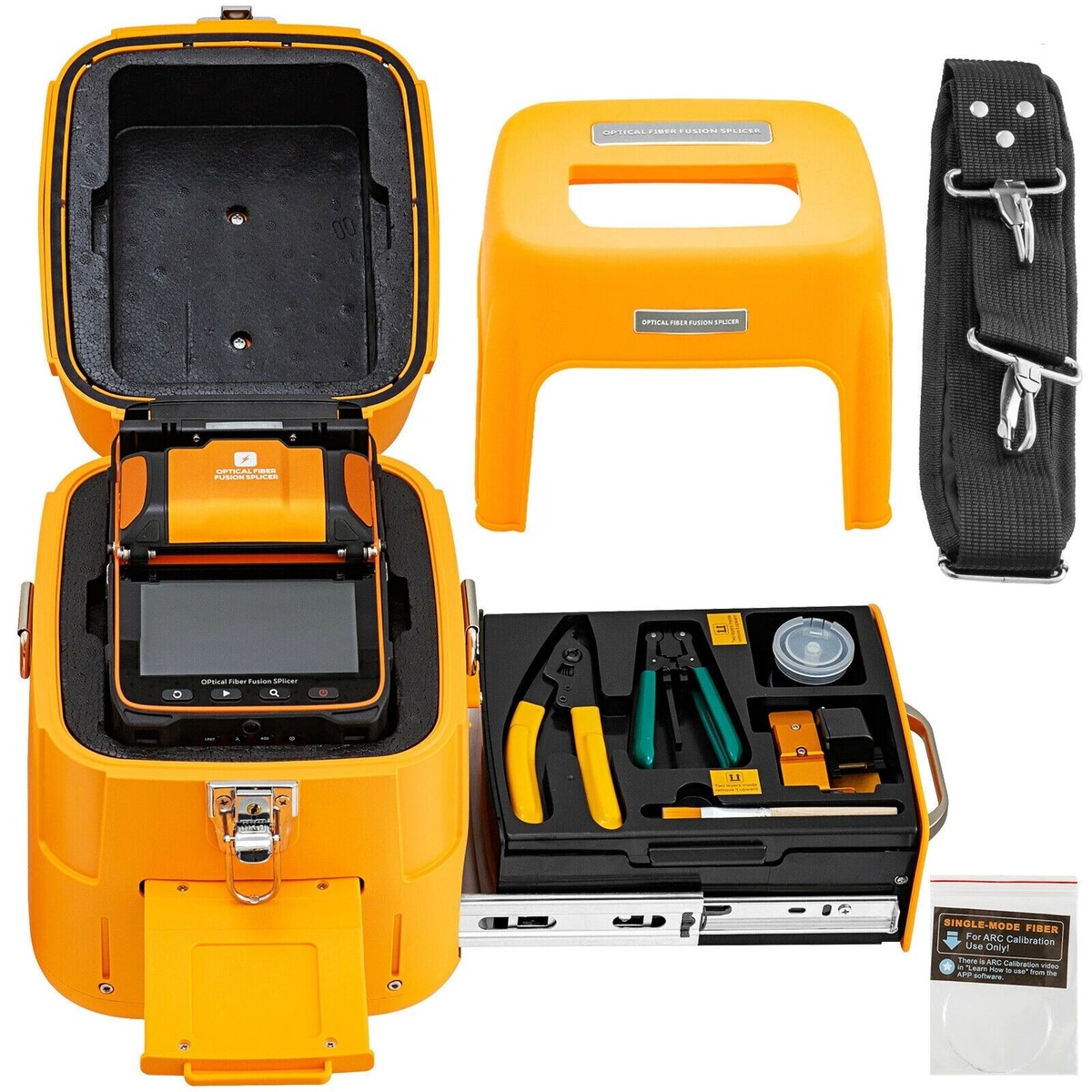
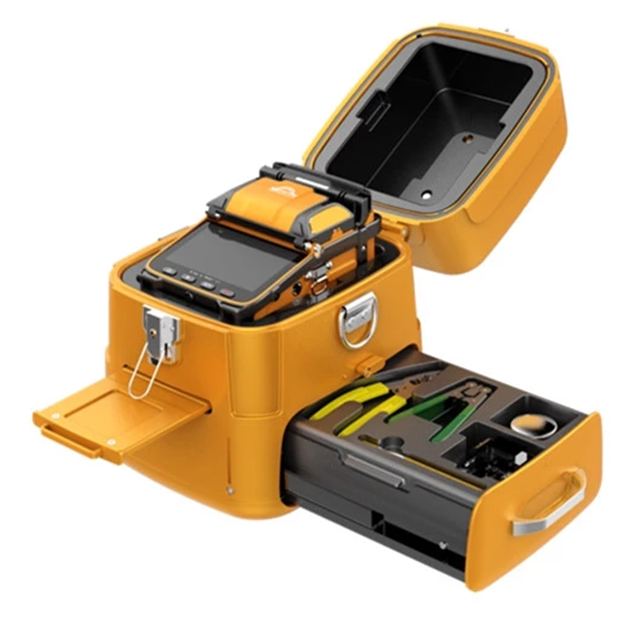
Signal Fire AI-9 Package Contents
A complete AI-9 kit may include:
| Item | Purpose |
|---|---|
| AI-9 Fusion Splicer | Fibre fusion |
| Precision Fibre Cleaver | Accurate cleaving |
| Fibre Stripper | Coating removal |
| Wire Stripping Pliers | Cable preparation |
| Spare Electrodes | Arc maintenance |
| Hex Key | Maintenance |
| Power Adapter | Charging |
| Alcohol Bottle | Fibre cleaning |
| Cleaning Brush | Machine maintenance |
| Carrying Case / Toolbox | Storage and transport |
| User Manual | Operation guidance |
Signal Fire's documentation lists a cleaver, spare electrode, stripping tools, power adapter, alcohol bottle, brush and other accessories as part of the toolbox configuration.
Recommended Accessories
| Accessory | Purpose |
|---|---|
| Precision Fibre Cleaver | Creates clean fibre end faces |
| Miller Stripper | Removes fibre coating |
| Drop Cable Stripper | FTTH preparation |
| Splice Sleeves | Protects completed fusion joints |
| Spare Electrodes | Maintains fusion performance |
| IPA Cleaning Alcohol | Cleans bare fibre |
| Lint-Free Wipes | Fibre cleaning |
| Optical Power Meter | Signal testing |
| Visual Fault Locator | Fault tracing |
| PON Power Meter | FTTH/PON testing |
| OTDR | Fibre fault location |
| Launch Cable | OTDR testing |
| Fibre Identifier | Live fibre identification |
Signal Fire AI-9 vs Basic Fusion Splicer
| Feature | Signal Fire AI-9 | Basic Splicer |
|---|---|---|
| Motor System | 6 Motors | Usually 4 |
| Core Alignment | Yes | Model Dependent |
| Splicing Time | ~5 sec | Usually Longer |
| Heating Time | ~15 sec | Usually Longer |
| Built-In OPM | Yes | Often No |
| Built-In VFL | Yes | Sometimes |
| Battery | 7800mAh | Usually Smaller |
| Field Deployment | Excellent | Good |
| Professional ISP Use | Excellent | Model Dependent |
Signal Fire AI-9 Fusion Splicing Machine Price in Kenya

The Signal Fire AI-9 price in Kenya can vary according to the package configuration, accessories, warranty and supplier.
Factors affecting the price include:
Whether a precision cleaver is included
Number of spare electrodes
Fibre stripping tools
Carrying toolbox
Battery
Warranty
Calibration
Additional fibre tools
Quantity ordered
For reference, one Kenyan retailer currently lists an AI-9 package at KES 80,000, reduced from KES 85,000. Pricing can change, so this should be treated as a market reference rather than a fixed price.
Why Buy Signal Fire AI-9 from Fiber Optics Kenya?
| Fiber Optics Kenya Solution | Benefit |
|---|---|
| Signal Fire AI-9 | Professional core-alignment splicing |
| Fusion Splicer Kits | Complete technician setup |
| Precision Cleavers | Accurate fibre preparation |
| Fibre Strippers | Professional stripping |
| Spare Electrodes | Splicer maintenance |
| Splice Sleeves | Fibre joint protection |
| Optical Power Meters | Optical testing |
| VFLs | Fault detection |
| PON Power Meters | PON testing |
| OTDRs | Fibre diagnostics |
| Fibre Cables | Complete network construction |
| Pigtails | ODF termination |
| Patch Cords | Fibre interconnection |
| ODFs | Fibre management |
| FAT Boxes | FTTH distribution |
| Fibre Closures | Splice protection |
| Bulk Supply | ISP and contractor projects |
| Nationwide Delivery | Supply across Kenya |
Frequently Asked Questions About Signal Fire AI-9
What is the Signal Fire AI-9?
The Signal Fire AI-9 is a six-motor core-alignment optical fibre fusion splicer designed for professional fibre installation and maintenance.
How many motors does the AI-9 have?
It uses six motors for automatic fibre alignment.
Is Signal Fire AI-9 a core-alignment splicer?
Yes. Signal Fire identifies it as a core-alignment fusion splicer.
How fast does the AI-9 splice?
Typical splicing time is approximately 5 seconds.
How long does heating take?
Approximately 15 seconds under normal settings.
What is the typical single-mode splice loss?
Signal Fire specifies approximately 0.02 dB for single-mode fibre.
Can it splice multimode fibre?
Yes. The AI-9 supports both single-mode and multimode fibre.
Can it splice G.657 FTTH fibre?
Yes. G.657 bend-insensitive fibre is supported.
Can it splice bare fibre?
Yes.
Can it splice pigtails?
Yes.
Can it splice FTTH drop cable?
Yes. The universal holder is designed for common fibre formats, including drop cable.
Does Signal Fire AI-9 have an Optical Power Meter?
Yes. An OPM is built into the machine.
Does the AI-9 have a VFL?
Yes.
What is the AI-9 VFL power?
Signal Fire specifies 15mW.
What battery does the AI-9 use?
It uses a 7800mAh lithium battery.
How many splices can AI-9 perform per charge?
Signal Fire specifies approximately 260 combined fusion-and-heating cycles under stated conditions.
How long does the battery take to charge?
Signal Fire lists charging time of up to approximately 3.5 hours.
What screen size does the AI-9 have?
It has a 5-inch colour display.
What is the maximum magnification?
Current Signal Fire specifications list up to approximately 320× for a single X or Y axis.
Does AI-9 have automatic focusing?
Yes. Its six-motor system supports automatic focusing and alignment.
Does it support automatic splicing?
Yes. Both automatic and semi-automatic operation are supported.
Does AI-9 support Bluetooth?
Current documentation lists Bluetooth 4.2 connectivity.
Can the AI-9 store splice records?
Yes. Current documentation lists internal record storage and export capabilities.
Can Signal Fire AI-9 be used outdoors?
Yes. It is designed for professional field work.
Is the AI-9 waterproof?
Signal Fire documentation describes the machine as having waterproof, dustproof and fall-resistant protection.
Can it work at high altitude?
The specified operating altitude is up to approximately 5,000 metres.
What operating temperatures does it support?
Approximately -15°C to +50°C.
Is Signal Fire AI-9 suitable for FTTH?
Yes. FTTH installation is one of its primary applications.
Is it suitable for ISP fibre networks?
Yes. It is suitable for subscriber distribution, ODFs, FAT boxes, fibre closures and backbone work.
Can I use it for 96-core fibre?
Yes. Individual fibres from a 96-core cable can be fusion-spliced sequentially and organized in suitable splice trays.
Can I use it for 144-core fibre?
Yes, provided the associated closure or ODF has adequate splice capacity.
Can it splice fibre inside an ODF?
Yes.
Can it be used for FAT boxes?
Yes.
Can it be used for fibre closures?
Yes.
Does the machine come with a fibre cleaver?
Complete AI-9 kits commonly include a precision cleaver, but confirm the package contents before purchase.
Does it come with spare electrodes?
Common complete kits include spare electrodes.
Do I need splice protection sleeves?
Yes. Protection sleeves should be installed over completed fusion joints.
How do I get low splice loss?
Use properly cleaned fibre, a good precision cleaver, clean V-grooves, correctly maintained electrodes and appropriate arc calibration.
Should I clean the fibre before splicing?
Yes. Contamination can significantly reduce splice quality.
How often should I replace electrodes?
Replacement depends on arc count and electrode condition. Follow the machine's maintenance guidance.
Can I use AI-9 for emergency fibre repairs?
Yes. Its rechargeable battery makes it useful for field repairs where mains electricity may not be immediately available.
What is the Signal Fire AI-9 price in Kenya?
Prices vary by supplier and kit contents. One current Kenyan listing shows KES 80,000, but request a current quotation before purchasing.
Do you supply Signal Fire AI-9 Fusion Splicing Machines?
Yes. Fiber Optics Kenya can supply Signal Fire AI-9 fusion splicers and associated fibre installation tools.
Do you supply fibre cleavers?
Yes.
Do you supply spare electrodes?
Yes.
Do you supply fibre splice sleeves?
Yes.
Do you supply OTDRs?
Yes.
Do you supply Optical Power Meters and VFLs?
Yes.
Do you deliver outside Nairobi?
Yes. Fiber Optics Kenya supplies fibre optic equipment throughout Kenya.
Contact Fiber Optics Kenya
Fiber Optics Kenya
Lyric House, 7th Floor Room S9
Kimathi Street, Nairobi
Phone: +254 704 991 492
Email: info@fibreopticskenya.co.ke
The Signal Fire AI-9 Fusion Splicing Machine is a professional solution for FTTH installers, ISPs, telecom engineers and fibre contractors who need fast, accurate and portable fibre splicing. Its six-motor core-alignment system, approximately 5-second fusion cycle, 15-second heating, integrated OPM, 15mW VFL, 5-inch display and 7800mAh battery provide a comprehensive tool for both fibre installation and troubleshooting.
Its support for G.651, G.652, G.653, G.654, G.655 and G.657 fibres also allows technicians to use the same machine across FTTH subscriber installations, ODFs, FAT boxes, fibre closures and larger telecommunications projects.
Contact Fiber Optics Kenya for Signal Fire AI-9 Fusion Splicing Machine prices in Kenya, complete fusion splicer kits, fibre cleavers, spare electrodes, splice sleeves, OPMs, VFLs, OTDRs, fibre installation tools, bulk orders and nationwide delivery.