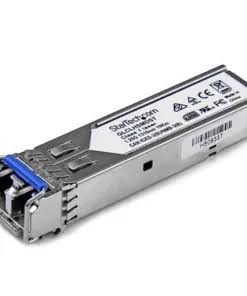
SFP Modules Price in Kenya
SFP Module 1G 40KM Pair Price in Kenya
KSh 2,000.00
1 available
Continue shoppingSFP Module 1G 40KM Pair Price in Kenya
The SFP Module 1G 40KM Pair is a matched pair of long-distance optical transceivers designed to provide Gigabit Ethernet connectivity over single-mode fibre for distances of up to 40 kilometres.
Unlike ordinary duplex SFP modules that normally require two fibre strands—one for transmitting and another for receiving—BiDi SFP modules can send and receive data over a single fibre strand by using different optical wavelengths in each direction.
A common 40km pair may use:
Module A: Tx 1310nm / Rx 1550nm
Module B: Tx 1550nm / Rx 1310nm
A manufacturer specification for a 1.25Gbps 40km BiDi pair confirms this complementary 1310/1550nm configuration, single-LC connectivity, single-mode fibre operation and transmission distances up to 40km.
Other 40km SFP pairs are also available using 1310nm/1490nm wavelength combinations, so the exact Tx/Rx wavelengths should always be checked before installation.
SFP Module 1G 40KM Pair Specifications
| Specification | Typical Details |
|---|---|
| Product Name | SFP Module 1G 40KM Pair |
| Module Type | BiDi SFP Transceiver Pair |
| Data Rate | 1.25Gbps |
| Ethernet Speed | 1 Gigabit |
| Maximum Distance | Up to 40km |
| Fibre Type | Single-Mode Fibre |
| Common Fibre Size | 9/125µm |
| Common Connector | Simplex LC |
| Alternative Connector | SC on some models |
| Module A | Tx 1310nm / Rx 1550nm |
| Module B | Tx 1550nm / Rx 1310nm |
| Alternative Pair | 1310nm / 1490nm |
| Fibre Strands Required | 1 for BiDi models |
| Hot-Pluggable | Yes |
| DOM / DDM | Available on many models |
| Typical Operating Temp. | 0°C to 70°C commercial |
| Applications | Switches, Routers, Media Converters, ISP Networks |
| Network Type | Gigabit Ethernet |
| Typical Standard Family | 1000BASE-BX / long-reach BiDi |
A current 40km 1.25Gbps BiDi specification lists single LC connectors, 40km SMF transmission, -5 to 0dBm Tx power, receiver sensitivity below approximately -22dBm, optional DDM and a 0°C to 70°C commercial operating range. Exact values depend on the manufacturer.
What Is an SFP Module?
SFP stands for Small Form-factor Pluggable.
It is a compact optical transceiver that plugs into an SFP slot on networking equipment such as:
Ethernet switches
Routers
Media converters
Fibre access equipment
Industrial Ethernet switches
MikroTik routers and switches
Ubiquiti switches
Cisco switches
OLT uplink equipment
The SFP converts electrical network signals into optical signals for transmission through fibre and converts incoming optical signals back into electrical data.
What Does 1G Mean?
The 1G designation means the module is intended for Gigabit-class Ethernet links.
The optical line rate of many Gigabit Ethernet SFPs is approximately:
1.25Gbps
Cisco's Gigabit SFP specifications identify 1000BASE optical modules as Gigabit Ethernet interfaces, while commercial 40km SFP products commonly specify a maximum optical transfer rate of 1.25Gbps.
What Does 40KM Mean?
The 40KM rating means the optical module is engineered for links of up to approximately 40 kilometres over suitable single-mode fibre, assuming the total optical loss stays within the module's optical budget.
Cisco, for example, specifies its 1000BASE-EX single-mode SFP for distances up to 40,000 metres, and its 1000BASE-BX40 BiDi modules are also rated for up to 40km.
A 40km rating does not mean every installed fibre route will automatically achieve 40km.
Actual usable distance depends on:
Fibre attenuation
Connector losses
Splice losses
Patch-panel losses
Fibre quality
Module optical power
Receiver sensitivity
Dirty connectors
Macrobends
Safety margin
Why Is the SFP Sold as a Pair?
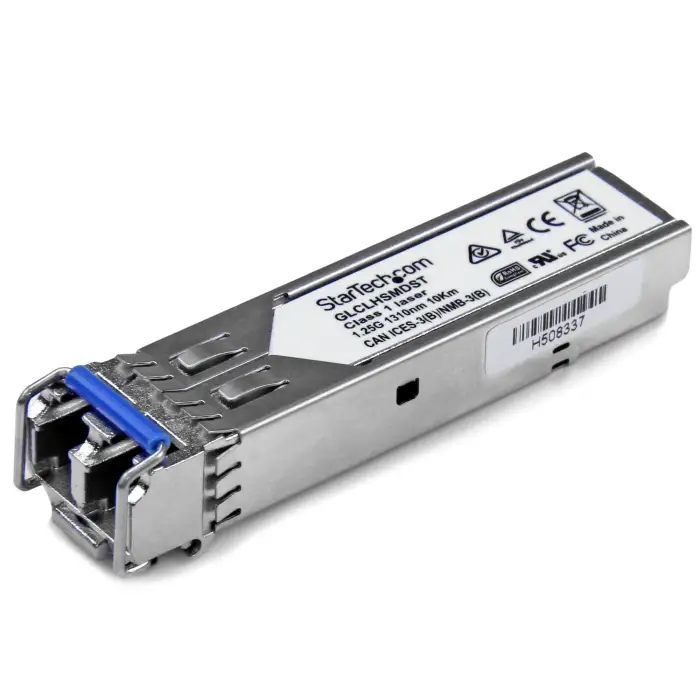
A BiDi link requires complementary SFP modules.
For example:
SFP A
Transmit: 1310nm
Receive: 1550nm
SFP B
Transmit: 1550nm
Receive: 1310nm
The 1310nm signal transmitted by the first SFP is received at 1310nm by the second SFP.
Likewise, the 1550nm signal transmitted by the second module is received by the first.
A matched 40km pair is therefore installed as:
Switch A → 1310/1550 SFP → Single Fibre → 1550/1310 SFP → Switch B
The two ends must use complementary wavelengths.
How BiDi SFP Technology Works
BiDi means:
Bidirectional
A BiDi SFP contains optical wavelength-separation components that allow transmit and receive signals to travel simultaneously through the same strand of single-mode fibre.
In a common 40km pair:
Direction 1: 1310nm
Direction 2: 1550nm
The module separates these wavelengths internally.
This allows:
One Fibre Strand = Full-Duplex Gigabit Connection
rather than needing a traditional two-strand duplex fibre connection.
1310nm / 1550nm 40KM SFP Pair
One widely available 40km configuration is:
| End A | End B |
|---|---|
| Tx 1310nm | Rx 1310nm |
| Rx 1550nm | Tx 1550nm |
A current manufacturer specification identifies matching models:
ABL35-24-40: Tx1310 / Rx1550
ABL53-24-40: Tx1550 / Rx1310
Both support 1.25Gbps, 40km, single-mode fibre and BiDi operation.
1310nm / 1490nm 40KM SFP Pair
Another available configuration uses:
SFP A: Tx1310 / Rx1490
SFP B: Tx1490 / Rx1310
Netlink currently lists 1.25G 40km single-mode SFP pairs in 1310+1490nm configurations with LC or SC connectors.
Therefore, never replace only one side of a BiDi pair without checking its wavelength.
LC Simplex Connector
Many 1G 40km BiDi modules use a single LC connector.
This differs from an ordinary duplex LC SFP.
Duplex SFP
Uses:
LC Tx + LC Rx
and normally requires two fibre strands.
BiDi SFP
Uses:
One Simplex LC port
and carries Tx and Rx signals over one fibre strand.
SC Connector Versions
Some 1.25G 40km SFP pairs are also available with SC connectors.
Netlink currently lists a 1.25G 40km 1310+1490 SC single-mode SFP pair in addition to LC versions.
Check the installed patch cord before ordering.
Single-Mode Fibre Requirement
A 40km SFP is designed primarily for single-mode fibre.
Typical fibre:
9/125µm Single Mode
Common cable standards include:
OS1
OS2
G.652
G.657 where compatible
Cisco's 40km Gigabit Ethernet optical specifications use single-mode fibre for 1000BASE-EX and BX40 links.
Watch SFP Module 1G 40KM Pair Video
https://youtu.be/WqTNdUatOho
The 1G 40KM SFP pair is particularly useful for ISP and enterprise networks where two locations must be interconnected over long distances. A single-mode fibre link can provide stable Gigabit Ethernet connectivity without relying on copper Ethernet repeaters along the route.
BiDi models provide an additional advantage because both transmission directions can use one fibre strand. This is valuable where fibre capacity is limited or where leasing additional fibre cores would increase project costs.
Before installation, confirm that the two SFP modules form a matched wavelength pair. Installing two modules with identical Tx/Rx wavelengths may prevent the link from coming up even if both modules are individually functional.
Digital Optical Monitoring – DOM/DDM
Many long-distance SFP modules support:
DOM – Digital Optical Monitoring
or
DDM – Digital Diagnostic Monitoring
This can allow a compatible switch or router to display information such as:
Optical Tx power
Optical Rx power
Module temperature
Supply voltage
Laser bias current
A number of current 40km 1.25G SFP products support DDM/DOM or make it available as an option.
Why DOM Is Useful
DOM is particularly useful on long fibre routes because technicians can determine whether:
Optical receive power is too low
Connectors need cleaning
Fibre loss has increased
A splice is degrading
The module is overheating
Optical power is approaching its threshold
This simplifies troubleshooting.
Hot-Pluggable SFP Design
SFP modules are designed to be hot-pluggable.
This means a compatible module can generally be inserted or removed from an SFP cage without replacing the entire switch or router.
However, network maintenance procedures should still be followed when replacing live optical modules.
SFP Module 1G 40KM for MikroTik
The modules can be used with many MikroTik devices that provide compatible 1G SFP slots, subject to module coding and compatibility.
Possible devices include:
MikroTik routers
MikroTik switches
CRS series
CCR models with compatible SFP cages
Media converters
Always confirm the specific MikroTik model supports the required SFP type and speed.
SFP Module 1G 40KM for Ubiquiti
Compatible third-party or vendor-coded SFPs can also be used with many Ubiquiti devices that provide Gigabit SFP ports.
Ubiquiti itself sells BiDi single-mode SFP pairs; its current 1G BiDi pair illustrates the same complementary-wavelength principle, with one module transmitting 1310nm and receiving 1550nm and the other doing the reverse. That particular Ubiquiti kit is rated for 3km rather than 40km.
SFP Module 1G 40KM for Cisco
Cisco publishes 40km Gigabit Ethernet modules including:
1000BASE-EX
GLC-BX40-U
GLC-BX40-D variants
Cisco's BX40 products demonstrate that long-distance single-strand Gigabit Ethernet can operate up to approximately 40km over single-mode fibre.
For Cisco equipment, module coding and platform compatibility should be checked before purchase.
SFP Module for Media Converters
A 1G 40km SFP pair can also be used with compatible Gigabit SFP media converters.
Typical setup:
Ethernet LAN
↓
Gigabit Media Converter + SFP A
↓
Single-Mode Fibre – up to 40km
↓
SFP B + Gigabit Media Converter
↓
Remote Ethernet LAN
This is useful when existing equipment has only RJ45 Ethernet ports.
SFP Module for Switch-to-Switch Links

A common application is:
Network Switch A
↓
40KM SFP A
↓
Single Fibre
↓
40KM SFP B
↓
Network Switch B
This is commonly used to connect buildings, campuses and remote POP locations.
Applications of 1G 40KM SFP Modules
ISP Backbone Links
Suitable for connecting:
ISP POPs
Towers
Distribution nodes
Remote offices
Aggregation switches
Campus Networks
Useful for connecting buildings separated by kilometres of fibre.
Enterprise Networks
Suitable for long-distance branch or facility interconnection.
CCTV Networks
Can transport aggregated CCTV traffic between remote sites and control rooms.
Government Networks
Suitable for metropolitan and institutional fibre infrastructure.
School and University Networks
Useful for connecting campuses and remote facilities.
Industrial Networks
Can provide Gigabit fibre connectivity between industrial sites where compatible equipment is installed.
1G 40KM vs 1G 20KM SFP
| Feature | 20KM SFP | 40KM SFP |
|---|---|---|
| Speed | 1Gbps | 1Gbps |
| Optical Line Rate | ~1.25Gbps | ~1.25Gbps |
| Maximum Rated Reach | 20km | 40km |
| Single-Mode Fibre | Yes | Yes |
| Long-Distance Links | Good | Better |
| Optical Budget | Lower | Generally Higher |
1G 40KM vs 1G 80KM SFP
| Feature | 40KM | 80KM |
|---|---|---|
| Speed | 1Gbps | 1Gbps |
| Distance | Up to 40km | Up to 80km |
| SM Fibre | Yes | Yes |
| Optical Power | High | Higher |
| Cost | Lower | Usually Higher |
Do not automatically use an 80km SFP on a very short link because excessive optical receive power can potentially overload the receiver.
BiDi vs Duplex SFP
| Feature | BiDi SFP | Duplex SFP |
|---|---|---|
| Fibre Strands | 1 | 2 |
| Connector | Usually Simplex LC | Duplex LC |
| Tx/Rx Wavelengths | Different | Often Same |
| Matched Pair Needed | Yes | Usually Same Model Both Ends |
| Fibre Utilization | Excellent | Standard |
| 40km Available | Yes | Yes |
1G SFP vs 10G SFP+
| Feature | 1G SFP | 10G SFP+ |
|---|---|---|
| Network Speed | 1Gbps | 10Gbps |
| Form Factor | SFP | SFP+ |
| Typical Use | Access / Distribution | High-Capacity Backbone |
| Cost | Lower | Higher |
| 40KM Options | Yes | Yes |
A 1G SFP should not automatically be assumed interchangeable with a 10G SFP+ module even if the physical cages look similar.
40KM Optical Link Budget
A 40km rating assumes the complete optical path stays inside the module's supported loss budget.
For example, one current 1.25G 40km BiDi specification lists approximately:
Tx Power: -5 to 0dBm
Receiver Sensitivity: below -22dBm
for its particular model.
Actual project calculations should account for:
Fibre Loss + Connector Loss + Splice Loss + Engineering Margin
Approximate Fibre Loss
A typical single-mode fibre route will introduce attenuation over distance.
Additional losses occur at:
Mechanical splices
Fusion splices
Adapters
Patch panels
Connectors
Splitters
Damaged fibre sections
The link should therefore be tested before commissioning.
Test a 40KM Fibre Link with an OTDR
An OTDR can help measure:
Fibre length
Splice loss
Connector loss
Reflection
Break locations
Overall attenuation
For a 40km SFP installation, an OTDR capable of testing beyond the full route length is recommended.
Use an Optical Power Meter
An Optical Power Meter can also help verify the actual optical power arriving at the remote SFP.
This is particularly useful if:
Link does not come up
Link keeps dropping
Rx power is marginal
Fibre route has many joints
Clean Fibre Connectors Before Installation
Dirty fibre connectors are one of the most common sources of optical loss.
Before installing a long-distance SFP link:
Inspect connectors.
Clean LC/SC connectors.
Clean adapters where necessary.
Confirm fibre polarity/wavelength pairing.
Test optical loss.
Insert the SFP modules.
SFP Module 1G 40KM Pair Price in Kenya
A current Kenyan retailer has a dedicated listing for an SFP Module 1G 40KM Pair, confirming that this long-distance pair is available in the Kenyan networking market, although its indexed listing currently does not expose a reliable public selling price.
Kenyan suppliers also stock other 1.25Gbps 40km single-mode SFP modules, including CWDM models with LC connectors and DOM support.
Because the price depends heavily on the wavelength pair, connector, compatibility coding and brand, contact Fiber Optics Kenya for the current SFP Module 1G 40KM Pair price in Kenya.
What Affects SFP Module 1G 40KM Price?
Price varies according to:
Manufacturer
1310/1490 vs 1310/1550 pairing
LC vs SC connector
DOM/DDM support
Commercial vs industrial temperature
Switch compatibility
Vendor coding
Optical power budget
Warranty
Quantity ordered
Recommended Accessories
| Accessory | Purpose |
|---|---|
| 1G 40KM SFP Pair | Long-distance optical transmission |
| OS2 Single-Mode Fibre | Fibre transmission medium |
| LC Simplex Patch Cord | Connect BiDi SFP |
| SC Patch Cord | For SC-type models |
| LC Adapter | Fibre connection |
| Fibre Patch Panel | Fibre termination |
| ODF | Fibre distribution |
| Media Converter | Ethernet-to-SFP conversion |
| Optical Power Meter | Measure received power |
| VFL | Basic continuity testing |
| OTDR | Fibre fault and loss testing |
| Fibre Cleaning Kit | Connector maintenance |
Frequently Asked Questions About SFP Module 1G 40KM Pair
What is an SFP Module 1G 40KM Pair?
It is a pair of optical transceivers designed to provide Gigabit fibre connectivity over distances of up to approximately 40km.
Why are there two SFP modules?
One module is installed at each end of the fibre link.
What speed does it support?
Gigabit Ethernet, with a typical optical line rate of approximately 1.25Gbps.
What fibre does it use?
Single-mode fibre.
Can it work over multimode fibre?
It is designed primarily for single-mode fibre and should be deployed using the fibre type specified by the manufacturer.
How far can it transmit?
Up to approximately 40km under suitable optical-loss conditions.
Does it always reach exactly 40km?
No. Actual reach depends on the total optical link loss.
What does BiDi mean?
Bidirectional transmission over a single fibre strand.
How many fibre cores does BiDi require?
Only one fibre strand for a point-to-point link.
Does a normal duplex SFP need two fibres?
Usually yes.
What wavelengths does a 40km BiDi pair use?
Common combinations include 1310/1550nm and 1310/1490nm.
Can I use two Tx1310/Rx1550 modules together?
No. A BiDi link normally requires complementary modules.
What is the matching module for Tx1310/Rx1550?
Typically Tx1550/Rx1310.
Is 1310/1490 also available?
Yes.
Which connector does it use?
Simplex LC is common.
Are SC versions available?
Yes.
What does Simplex LC mean?
It means the SFP uses one LC fibre connector rather than a duplex LC pair.
Does it support DOM?
Many models do; confirm the specific module.
What is DOM?
Digital Optical Monitoring.
What can DOM show?
Depending on the module and switch, it may show Tx power, Rx power, temperature, voltage and laser bias.
Is the SFP hot-pluggable?
Yes, SFP transceivers are designed as hot-pluggable modules.
Can it work with MikroTik?
Yes, if the particular SFP and MikroTik device are compatible.
Can it work with Cisco?
Compatible or Cisco-coded versions are available.
Can it work with Ubiquiti?
Many compatible modules work with Ubiquiti SFP ports, but compatibility should be confirmed before ordering.
Can it work with TP-Link switches?
Potentially yes, where the switch supports compatible 1G SFP modules.
Can it work with a media converter?
Yes, if the converter has a compatible Gigabit SFP slot.
Can it connect two switches?
Yes.
Can it connect two buildings?
Yes, provided single-mode fibre runs between the buildings.
Can it connect ISP POPs?
Yes.
Is it suitable for CCTV networks?
Yes, particularly for long-distance aggregated fibre links.
Can it be used for FTTH?
It can be used for point-to-point network uplinks, but it is not an ONU/ONT replacement for a GPON subscriber connection.
Can it connect directly to an ONU?
Only if the ONU has an appropriate Ethernet/SFP interface and the network design supports it. It is not the same as a GPON optical module.
Is this a GPON SFP?
Not necessarily. A 1G Ethernet BiDi SFP and a GPON OLT/ONU transceiver serve different purposes.
Can I use an LC/APC patch cord?
Only if the module specifically uses APC. Most standard SFP LC ports are UPC, so verify the connector type first.
Is LC/UPC common?
Yes.
Can a dirty connector stop the link?
Yes. Connector contamination can introduce enough loss to prevent long-distance links from operating correctly.
Should I test the fibre first?
Yes.
Which tool should I use?
An optical power meter and OTDR are particularly useful.
Can an OTDR test a 40km route?
Yes, provided the OTDR has sufficient dynamic range and distance capability.
Should I check the optical budget?
Yes, especially for long-distance links.
Can I use a 40km SFP on a 1km link?
Possibly, but receiver overload and the module's minimum link-loss requirements should be checked.
Is an attenuator sometimes required?
Yes, on some high-power long-range modules used over very short fibre links.
What is the difference between 20km and 40km SFPs?
The 40km module generally provides a larger optical budget and is designed for longer fibre routes.
What is the difference between 40km and 80km?
The 80km module is engineered for a considerably larger optical budget.
Is 1G SFP the same as 10G SFP+?
No.
Can I install a 10G SFP+ instead?
Only if the equipment and link are specifically designed to support it.
Is the SFP pair sold together?
Yes, when described as a pair you should receive two complementary modules.
What happens if one module fails?
You may replace it with a module having the correct speed, reach, connector, compatibility and complementary Tx/Rx wavelength.
Should I buy another identical SFP to replace one side?
Not necessarily. For BiDi, check the Tx and Rx wavelengths carefully.
What is the SFP Module 1G 40KM Pair price in Kenya?
The exact price depends on the brand, wavelength pair, connector, DOM support and switch compatibility. A Kenyan retailer currently lists the product category but does not expose a dependable indexed selling price.
Do you supply 1G 40KM SFP pairs?
Yes, subject to stock availability.
Do you supply 20KM SFP modules?
Yes, subject to availability.
Do you supply 80KM SFP modules?
Yes, subject to availability.
Do you supply LC simplex patch cords?
Yes.
Do you supply single-mode fibre cable?
Yes.
Do you supply media converters?
Yes.
Do you supply OTDRs?
Yes.
Do you supply optical power meters?
Yes.
Can ISPs order SFP modules in bulk?
Yes. Bulk supply is suitable for ISPs, enterprises, telecom contractors, CCTV integrators and fibre network installers.
Do you deliver outside Nairobi?
Yes. Fiber Optics Kenya supplies fibre optic networking products throughout Kenya.
Why Buy SFP Module 1G 40KM Pair from Fiber Optics Kenya?
| Fiber Optics Kenya Solution | Application |
|---|---|
| 1G 40KM SFP Pair | Long-distance Gigabit link |
| 20KM SFP Modules | Medium-distance links |
| 80KM SFP Modules | Very long-distance links |
| Single-Mode Fibre | Optical transmission |
| LC Simplex Patch Cords | BiDi connectivity |
| Media Converters | Copper-to-fibre conversion |
| Fibre Patch Panels | Fibre termination |
| ODFs | Fibre distribution |
| OTDRs | Fibre testing |
| Optical Power Meters | Optical power measurement |
| VFLs | Basic fibre fault checking |
| Fibre Cleaning Kits | Connector maintenance |
| Bulk Supply | ISP and enterprise projects |
| Nationwide Delivery | Supply throughout Kenya |
Contact Fiber Optics Kenya
Fiber Optics Kenya
Lyric House, 7th Floor Room S9
Kimathi Street, Nairobi
Phone: +254 704 991 492
Email: info@fibreopticskenya.co.ke
The SFP Module 1G 40KM Pair provides a cost-effective solution for establishing long-distance Gigabit Ethernet connections between switches, routers, media converters and other compatible networking equipment.
Typical 40km BiDi pairs operate at approximately 1.25Gbps over single-mode fibre, with complementary wavelength combinations such as Tx1310/Rx1550nm and Tx1550/Rx1310nm. Other versions use 1310/1490nm, so matching the correct module at each end is essential.
The biggest advantage of a BiDi pair is that it can provide full-duplex Gigabit communication over one fibre strand, making it particularly attractive for ISP backbones, campus networks, enterprise links, CCTV networks and situations where available fibre cores are limited.
For reliable 40km operation, the entire optical path—including fibre attenuation, connectors, splices and engineering margin—must remain inside the SFP's optical budget.
Contact Fiber Optics Kenya for current SFP Module 1G 40KM Pair prices in Kenya, 20KM and 80KM SFP modules, single-mode fibre patch cords, media converters, OTDRs, optical power meters, bulk ISP orders and nationwide delivery.