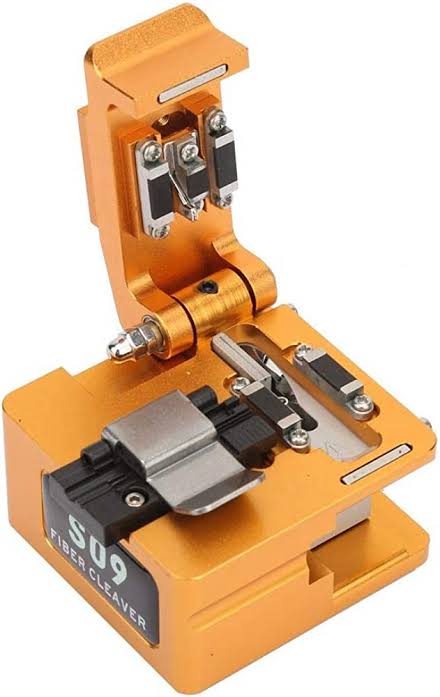
Fibre Cleavers Price in Kenya
S09 Fibre Cleaver Price in Kenya
KSh 5,500.00
1 available
Continue shoppingS09 Fibre Cleaver Price in Kenya

The S09 Fibre Cleaver is a high-precision optical fibre cutting tool designed to prepare fibre ends before fusion splicing, mechanical splicing and fibre connector termination. It is commonly paired with fusion splicers such as the Signal Fire AI-9 and is suitable for FTTH installers, ISPs, fibre contractors, telecom technicians and network maintenance teams.
A properly cleaved fibre is critical to achieving a low-loss fusion splice. The S09 is designed to produce a flat, consistent fibre end face with an average cleaving angle of less than 0.8° according to its standard specification. It supports 125 μm cladding and common 250 μm, 900 μm and 3.0 mm fibre formats.
The S09 also supports single-core and 2–12-core ribbon fibre, making it useful beyond basic FTTH subscriber installations. Its compact magnesium-alloy construction, universal fibre clamp and integrated fibre recovery box make it practical for field technicians who need a portable cleaver for everyday fibre work.
S09 Fibre Cleaver Key Specifications
| Specification | Details |
|---|---|
| Product Name | S09 Fibre Cleaver |
| Product Type | High-Precision Optical Fibre Cleaver |
| Fibre Cladding Diameter | 125 μm |
| Single Fibre Coating | 250–900 μm |
| 3.0 mm Fibre Cable | Supported |
| Ribbon Fibre | 2–12 Core |
| Single Fibre Cleave Length | 8–20 mm |
| Ribbon Fibre Cleave Length | 10 mm |
| Average Cleave Angle | <0.8° |
| Blade Positions | 16 |
| Rated Blade Life | Up to 36,000 cleaves |
| Fibre Clamp | Universal |
| Ribbon Clamp | Replaceable |
| Fibre Scrap Collector | Yes |
| Operation | Manual |
| Dimensions | Approx. 59 × 60 × 51 mm |
| Weight | Approx. 300 g |
| Applications | FTTH, Fusion Splicing, ISP, Telecom, FTTx |
The standard S09 documentation specifies a rated blade life of approximately 36,000 cleaves across 16 blade positions, although actual blade life depends on maintenance, fibre condition and correct blade adjustment.
What Is an S09 Fibre Cleaver?
A fibre cleaver is used to create a precise end face on stripped optical fibre before the fibre is inserted into a fusion splicer.
The typical workflow is:
Strip → Clean → Cleave → Align → Fusion Splice → Protect
The cleaver is therefore one of the most important tools in the fibre-splicing process.
Even an expensive fusion splicer cannot consistently produce good joints if the fibres entering it have poor cleave angles, chips or contaminated end faces.
Why Fibre Cleaving Is Important
Optical fibre consists of extremely thin glass. Before two fibres can be fusion-spliced, their end faces must be cut as close to perpendicular as possible.
A poor cleave can result in:
High splice loss
Fusion failure
Fibre misalignment
Air gaps
Core deformation
Weak joints
Splicer errors
Repeated splicing attempts
The S09's specified average cleave angle of less than 0.8° is intended to provide a clean end face suitable for professional fusion-splicing applications.
S09 Cleave Angle
| Cleave Condition | Expected Result |
|---|---|
| Clean, Near-Perpendicular Cleave | Better fusion |
| Large Cleave Angle | Higher potential splice loss |
| Chipped Fibre | Poor splice |
| Dirty Fibre | Increased loss |
| Cracked Fibre | Unreliable joint |
The cleaver should therefore be kept clean and correctly adjusted.
16-Position Fibre Cleaver Blade
The S09 uses a blade with 16 cutting positions.
Rather than replacing the complete blade as soon as one section becomes worn, the technician can rotate it to a fresh cutting position.
This extends blade service life and reduces maintenance costs.
Standard S09 documentation rates the blade for approximately 36,000 total cleaves when correctly indexed and maintained.
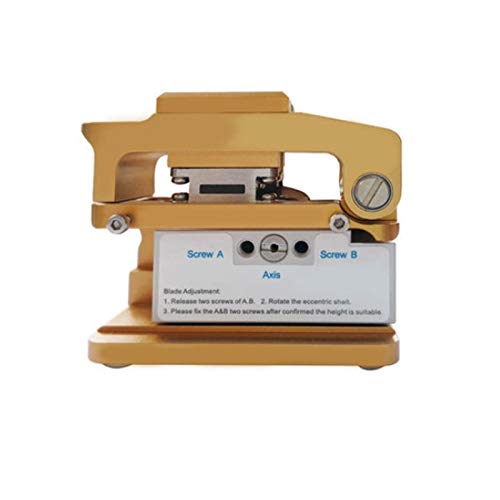
S09 Blade Adjustment
When cleaving quality begins to deteriorate, the blade does not necessarily need immediate replacement.
The blade can be:
Rotated to another position
Repositioned
Height-adjusted
Cleaned
Eventually replaced
The manufacturer documentation specifically provides procedures for adjusting both the blade position and blade height.
This helps extend the useful service life of the cleaver.
Fibre Scrap Collector
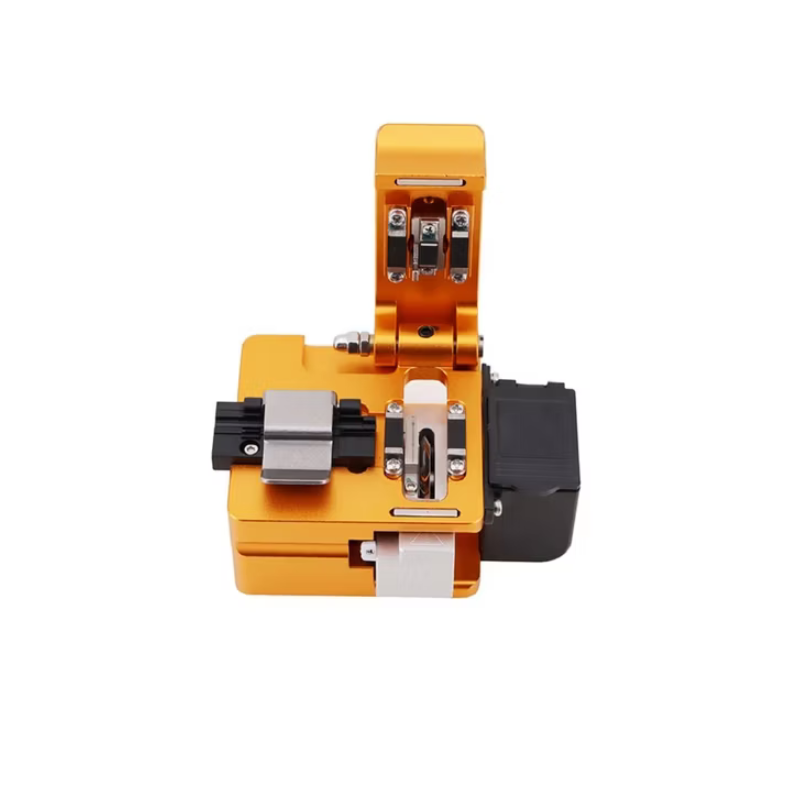
The S09 includes a fibre optic recovery box, sometimes called a fibre scrap collector or dust bin.
This is an important safety feature because cleaved optical fibre fragments are extremely small and sharp.
The collector helps keep discarded glass fragments away from:
Hands
Clothing
Work surfaces
Equipment
Tool bags
Fibre scraps should always be disposed of safely rather than left on the installation site.
Universal Fibre Clamp
The S09 includes a universal clamp for common single-core fibre types.
It can accommodate applications involving:
250 μm coated fibre
900 μm buffered fibre
3.0 mm indoor fibre
Bare prepared fibre
Pigtails
FTTH fibre
Patch-cord preparation
For ribbon fibre, the standard documentation specifies a replaceable ribbon-fibre clamp.
Single-Core Fibre Support
The S09 is particularly useful for everyday single-core fibre installation.
Typical examples include:
FTTH drop cable
SC/APC pigtails
SC/UPC pigtails
Fibre patch cords
ODF termination
FAT box termination
Fibre closures
The standard single-core cleave length is adjustable between approximately 8 and 20 mm.
Ribbon Fibre Support
The S09 can also handle 2–12-core ribbon fibre with the appropriate holder.
For ribbon fibre, the specified cleave length is approximately 10 mm.
This expands its applications to larger fibre installations where ribbon fibre is used to improve installation density and splicing efficiency.
Compact Fibre Cleaver
The S09 is designed as a compact field tool.
| Measurement | Approximate Specification |
|---|---|
| Width | 59 mm |
| Depth | 60 mm |
| Height | 51 mm |
| Weight | 300 g |
At approximately 300 grams, it is easy for fibre technicians to carry alongside a fusion splicer, stripper, optical power meter and other field tools.
Magnesium Alloy Construction
S09 documentation describes the cleaver as using magnesium-alloy construction, providing a combination of strength and relatively low weight.
This is useful for field installations where tools are repeatedly transported between:
Customer premises
Utility poles
Fibre cabinets
Manholes
Data centres
ODF rooms
Telecom sites
S09 Fibre Cleaver with Signal Fire AI-9
The S09 is commonly paired with the Signal Fire AI-9 Fusion Splicer. The S09 manual specifically identifies compatibility with AI-9 and AI-8C fusion splicers.
A typical workflow is:
Fibre Cable → Stripper → Cleaning → S09 Cleaver → Signal Fire AI-9 → Splice Sleeve → Heater
The S09 prepares the fibre end, while the AI-9 performs alignment and electric-arc fusion.
How to Use the S09 Fibre Cleaver
A typical single-fibre procedure is:
Strip the fibre coating.
Clean the exposed glass using an approved fibre-cleaning method.
Open the S09 cover.
Open the fibre clamp.
Position the fibre at the required cleave length.
Ensure the fibre is straight.
Close the clamp.
Close the cleaver cover.
Complete the cleaving action.
Open the cover.
Carefully remove the cleaved fibre.
Insert the prepared fibre into the fusion splicer.
Ensure the discarded fragment enters the recovery box.
The S09 manual specifies an 8–20 mm cleave length for single fibre.
Fibre Preparation Before Cleaving
Proper preparation is essential.
Step 1 – Strip
Remove the required amount of fibre coating with a suitable fibre stripper.
Step 2 – Clean
Clean the exposed fibre thoroughly to remove coating residue and contamination.
Step 3 – Cleave
Place the fibre into the S09 and produce the required end face.
Step 4 – Avoid Touching
Do not touch the cleaned and cleaved glass with your fingers.
Step 5 – Splice
Transfer the fibre directly into the fusion splicer.
Watch S09 Fibre Cleaver Maintenance Video
The S09 is a relatively simple tool mechanically, but regular maintenance has a major influence on cleave quality. Fibre dust, coating residue, glass fragments and incorrect blade positioning can eventually affect the quality of the prepared end face. The supplied maintenance video is therefore particularly relevant for technicians using the cleaver regularly.
Blade adjustment is another important part of S09 maintenance. Separate technical guidance for the S09 explains how technicians can move the blade to a fresh cutting position and adjust its height when cleaving quality deteriorates.
When paired with a fusion splicer such as the Signal Fire AI-9, a properly maintained S09 provides a complete preparation workflow for FTTH drop fibres, pigtails, ODFs, FAT boxes and fibre closures.
Applications of S09 Fibre Cleaver
FTTH Installation
Suitable for preparing subscriber drop fibre before fusion splicing.
Fusion Splicing
Provides the precision cleave required before fibres are placed into a fusion splicer.
ODF Termination
Useful when splicing incoming fibre cable to SC/APC or SC/UPC pigtails.
FAT Box Installation
Can prepare individual subscriber fibres before fusion.
Fibre Closures
Suitable for preparing fibres inside dome and horizontal splice closures.
ISP Fibre Networks
Useful for access, distribution and backbone fibre maintenance.
Telecom Networks
Can be used during construction and repair of telecommunications fibre infrastructure.
Data Centres
Useful for fibre termination and repair work.
CCTV Fibre Networks
Can prepare fibre used for long-distance CCTV transmission links.
Emergency Fibre Repairs
Its compact size makes it convenient for mobile field teams.
S09 Fibre Cleaver vs Basic Fibre Cleaver
| Feature | S09 | Basic Cleaver |
|---|---|---|
| Precision Cleaving | Yes | Varies |
| Specified Angle | <0.8° | Varies |
| Blade Positions | 16 | Often Fewer |
| Rated Blade Life | Up to 36,000 | Usually Lower |
| Fibre Collector | Yes | Model Dependent |
| Single Fibre | Yes | Yes |
| Ribbon Fibre | Up to 12 Core | Often No |
| Adjustable Blade | Yes | Model Dependent |
| Field Use | Excellent | Good |
S09 Fibre Cleaver vs Fibre Scissors
| Feature | S09 Cleaver | Fibre Scissors |
|---|---|---|
| Precision End Face | Yes | No |
| Fusion-Splice Preparation | Yes | No |
| Controlled Cleave Length | Yes | No |
| Low Cleave Angle | Yes | No |
| Cut Kevlar | No | Yes |
| Cut Fibre Jacket | No | Yes |
Fibre scissors and a fibre cleaver serve different purposes.
Kevlar scissors cut cable strength members. The S09 precisely cleaves the glass fibre itself.
S09 Fibre Cleaver vs Fibre Stripper
| Tool | Function |
|---|---|
| Fibre Stripper | Removes fibre coating |
| S09 Cleaver | Precision-cuts exposed glass |
| Fusion Splicer | Joins two fibres |
| Splice Sleeve | Protects completed joint |
A complete fusion-splicing job normally requires all four stages.
When Should the Blade Be Rotated?
Consider moving the blade to a fresh position when you notice:
Increasing cleave angles
Fibre chips
Uneven end faces
Frequent fusion-splicer cleave errors
Repeated bad splices
Visible blade wear
S09 maintenance guidance explains that the blade can be moved to another numbered cutting position when an edge becomes worn.
How to Maintain the S09 Fibre Cleaver
For reliable performance:
Keep the fibre clamp clean.
Remove fibre fragments regularly.
Keep the blade clean.
Do not touch the blade edge.
Empty the scrap collector.
Rotate the blade when the current position becomes worn.
Adjust blade height only when necessary.
Keep the cleaver inside its protective case when not in use.
Avoid dropping the cleaver.
Test cleave quality after making blade adjustments.
S09 Fibre Cleaver Package Contents
A standard S09 package may include:
| Item | Quantity |
|---|---|
| S09 Fibre Cleaver | 1 |
| 16-Position Blade | 1 |
| Fibre Recovery Box | 1 |
| 1.5 mm Hex Wrench | 1 |
| Instruction Manual | 1 |
| Certificate | 1 |
| Storage / Packing Box | 1 |
The standard manual lists these components, although exact package contents should always be confirmed before ordering.
Recommended Tools to Use with S09
| Tool | Purpose |
|---|---|
| Signal Fire AI-9 | Fibre fusion splicing |
| Fibre Stripper | Removes coating |
| Drop Cable Stripper | FTTH cable preparation |
| Kevlar Scissors | Cuts strength members |
| IPA / Fibre Cleaner | Cleans exposed fibre |
| Lint-Free Wipes | Fibre cleaning |
| Splice Sleeves | Protects joints |
| Optical Power Meter | Measures optical power |
| VFL | Finds short-distance faults |
| PON Power Meter | Tests PON signals |
| OTDR | Locates fibre faults |
Frequently Asked Questions
What is the S09 Fibre Cleaver?
The S09 is a precision optical fibre cutting tool used to prepare fibre before fusion or mechanical splicing.
What is the S09 cleave angle?
The standard specification states an average cleave angle of less than 0.8°.
What fibre diameter does it support?
It is designed around standard 125 μm fibre cladding.
Does it support 250 μm fibre?
Yes.
Does it support 900 μm fibre?
Yes.
Can it handle 3.0 mm fibre cable?
Yes, after the cable and fibre are correctly prepared.
Can S09 cleave single-mode fibre?
Yes.
Can it cleave multimode fibre?
The S09 design is suitable for standard 125 μm glass fibres, including appropriate single-mode and multimode applications.
Can S09 cleave FTTH drop fibre?
Yes. It is commonly used for FTTH installations.
Can it cleave pigtails?
Yes.
Can it cleave ribbon fibre?
Yes. The standard specification supports 2–12-core ribbon fibre with the appropriate holder.
What is the cleave length?
For single fibre, approximately 8–20 mm. For ribbon fibre, approximately 10 mm.
How many blade positions does S09 have?
The standard blade has 16 cutting positions.
What is the S09 blade life?
The standard specification rates it for up to approximately 36,000 cleaves. Actual service life depends on maintenance and use.
Can the S09 blade be replaced?
Yes.
Can the blade position be adjusted?
Yes. The blade can be moved to a new cutting position as an edge wears.
Can the blade height be adjusted?
Yes. The S09 provides a blade-height adjustment procedure.
Does S09 collect fibre scraps?
Yes. It includes a fibre recovery box.
Why is the fibre scrap box important?
Small glass fibre fragments are sharp and should be collected and disposed of safely.
Can S09 be used with Signal Fire AI-9?
Yes. S09 documentation specifically identifies compatibility with the AI-9 fusion splicer.
Can I use S09 with other fusion splicers?
Yes. A fibre cleaver is generally independent of the fusion-splicer brand as long as the required fibre preparation dimensions are compatible.
Why is my S09 producing poor cleaves?
Possible causes include a dirty clamp, contaminated fibre, worn blade position, incorrect blade height or improper fibre placement.
Should I touch the cleaved fibre end?
No. Avoid touching the prepared glass end.
Should fibre be cleaned before cleaving?
Yes. The stripped fibre should be properly cleaned before being placed into the cleaver.
Can I use ordinary scissors instead?
No. Ordinary scissors cannot produce the precision end face required for fusion splicing.
Is S09 suitable for professional FTTH installers?
Yes. Its compact design, universal clamp and precision cutting make it suitable for regular FTTH field work.
Is S09 suitable for ISP technicians?
Yes.
Can I use it when splicing inside an ODF?
Yes.
Can I use it for FAT boxes?
Yes.
Can I use it for fibre closures?
Yes.
Does the S09 require electricity?
No. It is a manually operated fibre cleaver.
How much does S09 weigh?
Approximately 300 g according to the standard specification.
What are the dimensions?
Approximately 59 × 60 × 51 mm.
Is the S09 portable?
Yes. Its compact size and low weight make it suitable for field technicians.
Do you supply S09 replacement blades?
Replacement cleaver blades and related fibre-splicing accessories can be supplied depending on stock.
Do you supply Signal Fire AI-9 fusion splicers?
Yes.
Do you supply fibre strippers?
Yes.
Do you supply splice protection sleeves?
Yes.
Do you supply Optical Power Meters?
Yes.
Do you supply VFLs?
Yes.
Do you supply OTDRs?
Yes.
Do you deliver outside Nairobi?
Yes. Fiber Optics Kenya supplies fibre optic equipment throughout Kenya.
Contact Fiber Optics Kenya
Fiber Optics Kenya
Lyric House, 7th Floor Room S9
Kimathi Street, Nairobi
Phone: +254 704 991 492
Email: info@fibreopticskenya.co.ke
The S09 Fibre Cleaver is an essential precision tool for FTTH installers, ISPs, telecom technicians and fibre contractors. Its less-than-0.8° average cleave angle, 8–20 mm single-fibre cutting length, 16-position blade, rated 36,000-cleave blade life, universal fibre clamp and integrated scrap collector make it well suited to professional fibre preparation.
When combined with a fusion splicer such as the Signal Fire AI-9, the S09 provides the precision fibre preparation required for low-loss splicing in ODFs, FAT boxes, fibre closures, FTTH drop cables and larger ISP fibre networks.
Contact Fiber Optics Kenya for S09 Fibre Cleaver prices in Kenya, replacement cleaver blades, Signal Fire fusion splicers, fibre strippers, splice sleeves, optical power meters, VFLs, OTDRs, complete fibre tool kits, bulk orders and nationwide delivery.