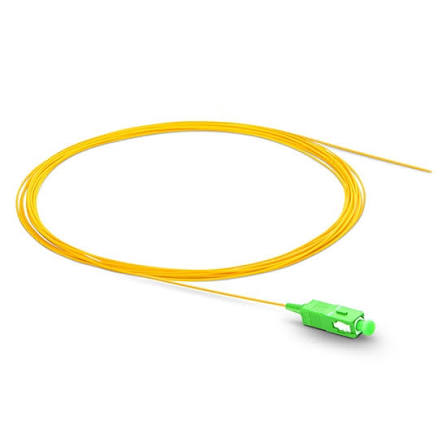
FC Fibre Pigtails Price in Kenya
LC/UPC Single Mode OS2 Pigtail 1m Yellow in Kenya
KSh 55.00
1 available
Continue shoppingLC/UPC Single Mode OS2 Pigtail 1m Yellow in Kenya

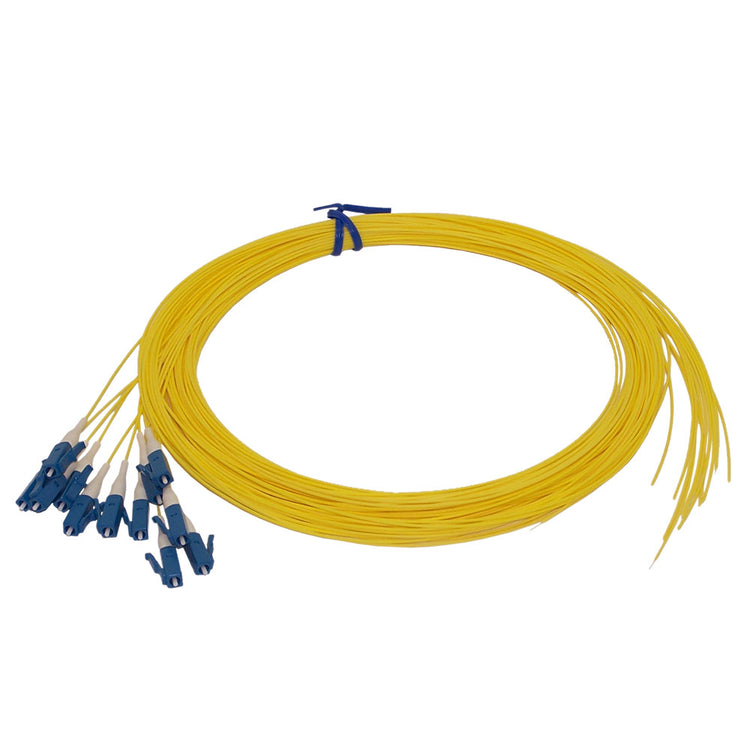
The LC/UPC Single Mode OS2 Pigtail 1m Yellow is a factory-terminated fibre optic lead designed for professional single-mode fibre termination. It features a compact LC/UPC connector on one end and an unterminated fibre end on the other, allowing technicians to fusion-splice the pigtail directly to installed optical fibre inside an ODF, fibre patch panel, splice tray, distribution box or termination enclosure.
A typical version uses OS2 9/125 µm single-mode fibre with a 0.9 mm tight buffer and a yellow outer finish. Exact 1-metre LC/UPC OS2 pigtails are commercially available in G.657A1 bend-insensitive construction, while other professional pigtail families use G.652.D or G.657.A1 fibre. FS also lists an exact LC/UPC-to-unterminated, simplex OS2, 0.9 mm, 1 m pigtail designed for fusion or mechanical splicing.
At Fiber Optics Kenya, the LC/UPC Single Mode OS2 Pigtail 1m Yellow is suitable for telecommunications, enterprise LANs, ISPs, data centres, CCTV fibre networks and fibre backbone termination. Customers can also source matching LC/UPC adapters, ODFs, patch panels, splice sleeves, fibre trays, patch cords, SFP modules and optical testing equipment for complete fibre installations.
Key Product Specifications
| Specification | Details |
|---|---|
| Product Name | LC/UPC Single Mode OS2 Pigtail 1m Yellow |
| Product Type | Fibre Optic Pigtail |
| Connector Type | LC/UPC |
| Connector Polish | UPC |
| Typical Connector Colour | Blue |
| Cable / Buffer Colour | Yellow |
| Cable Length | 1 Metre |
| Fibre Mode | Single Mode |
| Fibre Category | OS2 |
| Typical Fibre Size | 9/125 µm |
| Common Fibre Types | G.652.D / G.657.A1 |
| Configuration | Simplex |
| Fibre Count | 1 |
| Connectorized Ends | 1 |
| Opposite End | Unterminated / Bare Fibre |
| Typical Buffer Diameter | 0.9 mm / 900 µm |
| Typical Jacket Type | LSZH / OFNR / PVC depending on model |
| Common Wavelengths | 1310 nm / 1550 nm |
| Installation Method | Fusion or mechanical splicing |
| Primary Applications | ODF, patch panel, telecom, LAN, ISP |
| Professional Installation | Available |
| Delivery | Available throughout Kenya |
A current 1 m G.657A1 LC/UPC product is specified as single-mode OS2, 9/125 µm, simplex, 0.9 mm tight-buffered and yellow, closely matching this product description.
What Is an LC/UPC Fibre Pigtail?
A fibre pigtail is different from a conventional patch cord because only one end has a connector.
| Feature | LC/UPC Fibre Pigtail |
|---|---|
| Connectorized End | LC/UPC |
| Other End | Bare / Unterminated fibre |
| Fibre Count | 1 |
| Typical Fibre Mode | Single Mode |
| Typical Fibre Grade | OS2 |
| Typical Fibre Size | 9/125 µm |
| Primary Purpose | Fibre termination |
| Installation Method | Fusion splicing |
| Typical Location | ODF, patch panel, splice tray, fibre box |
The bare end is normally fusion-spliced onto the installed fibre, while the LC/UPC connector is inserted into an LC/UPC adapter or compatible device.
What Does LC/UPC Single Mode OS2 Mean?
| Term | Meaning |
|---|---|
| LC | Small-form-factor fibre optic connector |
| UPC | Ultra Physical Contact |
| LC/UPC | LC connector with UPC-polished ferrule |
| Single Mode | Fibre designed primarily for one propagation mode |
| OS2 | Single-mode fibre category |
| 9/125 | Approx. 9 µm core and 125 µm cladding |
| Pigtail | Connector on one end and bare fibre on the other |
| 1m | One-metre cable length |
| Yellow | Common colour identification for single-mode fibre |
LC/UPC Connector Features
LC is particularly useful where space and port density matter.
| LC/UPC Feature | Benefit |
|---|---|
| Small Form Factor | High-density termination |
| Approx. 1.25 mm Ferrule | Compact precision interface |
| Latch Mechanism | Secure connection |
| UPC Polish | Low-reflection interface |
| Blue Connector Housing | Easy identification |
| ODF Compatibility | Excellent |
| Patch Panel Compatibility | Excellent |
| SFP Compatibility | Excellent |
| Data Centre Use | Excellent |
A current 1 m LC/UPC OS2 pigtail uses a 1.25 mm ferrule and UPC-polished LC interface, together with G.657A1 fibre.
Why Is the Pigtail Yellow?

Yellow is the common identification colour for single-mode OS2 fibre.
| Colour / Feature | Meaning |
|---|---|
| Yellow Fibre | Common single-mode identification |
| Blue LC Connector | UPC polish |
| Green Connector | Usually APC rather than UPC |
| Aqua Cable | Commonly OM3 multimode |
| Violet Cable | Often associated with OM4 |
CommScope's current single-mode LC/UPC pigtail portfolio lists yellow construction with G.652.D or G.657.A1 fibre.
OS2 Single Mode Fibre Characteristics
| Characteristic | Typical Description |
|---|---|
| Fibre Category | OS2 |
| Mode | Single Mode |
| Core Diameter | Approx. 9 µm |
| Cladding Diameter | 125 µm |
| Typical Colour | Yellow |
| Common Wavelength | 1310 nm |
| Common Wavelength | 1550 nm |
| Optical Attenuation | Low |
| Long-Distance Performance | Excellent |
| Enterprise LAN | Excellent |
| ISP Networks | Excellent |
| Telecommunications | Excellent |
| Data Centre Interconnects | Excellent |
Corning categorises its LC UPC simplex pigtails as single-mode OS2 and lists applications including FTTP, in-building networks, LANs and central-office environments.
G.652D vs G.657A1 Fibre
| Feature | G.652D | G.657A1 |
|---|---|---|
| Fibre Mode | Single Mode | Single Mode |
| Typical Size | 9/125 µm | 9/125 µm |
| Long-Distance Performance | Excellent | Excellent |
| Bending Performance | Standard | Improved |
| Patch Panel Use | Excellent | Excellent |
| ODF Use | Excellent | Excellent |
| Compact Routing | Good | Better |
| FTTH Use | Good | Excellent |
| Enterprise Backbone | Excellent | Excellent |
Shaxon's exact 1 m yellow LC/UPC OS2 pigtail uses G.657A1 bend-insensitive fibre, while CommScope lists LC/UPC pigtails in both G.652.D and G.657.A1 variants.
Typical Optical Performance
| Optical Parameter | Typical / Representative Description |
|---|---|
| Fibre Mode | Single Mode |
| Fibre Category | OS2 |
| Core / Cladding | 9/125 µm |
| Connector Type | LC/UPC |
| Operating Wavelengths | 1310 / 1550 nm |
| Insertion Loss | Typically low; model dependent |
| Return Loss | High for quality UPC interfaces |
| Transmission Distance | Determined by network optics |
| 1G Ethernet | Supported with compatible optics |
| 10G Ethernet | Supported with compatible optics |
| Higher-Speed Ethernet | Supported according to optical architecture |
One current 1m 9/125 LC/UPC single-mode pigtail specifies ≤0.25 dB insertion loss, demonstrating the low-loss performance available from factory-terminated products.
Typical Mechanical Specifications
| Parameter | Typical / Representative Description |
|---|---|
| Length | 1 m |
| Configuration | Simplex |
| Fibre Count | 1 |
| Connector | LC/UPC |
| Connector Colour | Blue |
| Buffer Colour | Yellow |
| Buffer Diameter | 0.9 mm / 900 µm |
| Cable Type | Tight Buffered |
| Common Jacket | LSZH / OFNR / PVC |
| Ferrule Diameter | Approx. 1.25 mm |
| Installation Method | Fusion or mechanical splicing |
| Environment | Indoor primarily |
FS's exact 1 m product is specified as an LC UPC to unterminated simplex OS2 pigtail with a 0.9 mm buffer, while Corning uses 900 µm tight-buffered construction in its professional pigtail range.
Why Choose a 1 Metre Fibre Pigtail?

A 1m pigtail is long enough for most ODF and fibre-panel termination work while remaining easy to organize inside splice trays.
| Application | Benefit of 1m Length |
|---|---|
| ODF Termination | Easy tray routing |
| Patch Panel | Minimizes excess fibre |
| Splice Tray | Convenient fibre management |
| Distribution Box | Compact installation |
| Network Cabinet | Easy organization |
| Small Enclosure | Less excess fibre |
| Fusion Splicing | Provides practical working length |
Simplex Fibre Pigtail Explained
Simplex means the product contains one optical fibre.
| Simplex Characteristic | Benefit |
|---|---|
| 1 Fibre | Terminate individual cable cores |
| 1 LC Connector | One optical port |
| Bare Fibre Tail | Easy fusion splicing |
| Compact Design | Ideal for crowded ODFs |
| Easy Colour Management | Simplifies fibre identification |
| Scalable | Use several pigtails for multi-core cables |
For example, a 12-core fibre cable can be terminated using twelve individual simplex pigtails or an appropriate pigtail kit.
LC Pigtail vs SC Pigtail
| Feature | LC/UPC Pigtail | SC/UPC Pigtail |
|---|---|---|
| Connector Size | Smaller | Larger |
| Ferrule Diameter | Approx. 1.25 mm | Approx. 2.5 mm |
| High-Density ODF | Excellent | Good |
| SFP Equipment | Excellent | Less common |
| Patch Panels | Excellent | Excellent |
| Port Density | Higher | Lower |
| Telecom Networks | Excellent | Excellent |
LC is especially valuable where many fibre connections need to fit into a limited rack space.
LC/UPC vs LC/APC Pigtail
| Feature | LC/UPC | LC/APC |
|---|---|---|
| Typical Colour | Blue | Green |
| Polish Type | Ultra Physical Contact | Angled Physical Contact |
| Back Reflection | Low | Lower |
| Enterprise LAN | Very Common | Application dependent |
| SFP Connectivity | Very Common | Less common |
| PON Networks | Application dependent | More common where APC specified |
| Direct UPC/APC Mating | Not Recommended | Not Recommended |
Always match the connector polish to the adapter or equipment interface.
Pigtail vs Patch Cord
| Feature | Fibre Pigtail | Fibre Patch Cord |
|---|---|---|
| Connectorized Ends | One | Two |
| Bare End | Yes | No |
| Requires Splicing | Yes | No |
| Primary Function | Permanent fibre termination | Equipment interconnection |
| ODF Use | Excellent | After termination |
| Patch Panel Use | Excellent | Excellent |
| Factory-Polished Connector | One | Two |
| Typical Length | Short | Wide range |
Why Use Fusion-Spliced LC Pigtails?
| Advantage | Benefit |
|---|---|
| Factory-Polished LC Connector | Consistent connector quality |
| Fusion Splice | Low-loss permanent joint |
| Compact LC Interface | High-density fibre distribution |
| Structured ODF Termination | Cleaner network installation |
| Easy Patch Cord Replacement | Permanent fibre stays protected |
| Professional Cable Management | Better organization |
| Scalable Deployment | Suitable for multi-core fibre systems |
Key Benefits of LC/UPC Single Mode OS2 Pigtail 1m Yellow
Compact LC Connector
LC's small form factor makes it ideal for high-density patch panels, ODFs and data-centre fibre systems.
OS2 Single Mode Performance
OS2 fibre provides low-loss transmission suitable for professional optical networks.
1 Metre Length
The 1m format provides enough working length for fusion splicing without creating excessive fibre loops.
900 µm Tight Buffer
The 0.9 mm construction makes the fibre easier to route and organize inside termination equipment.
G.657A1 Options
Bend-insensitive G.657A1 versions are particularly useful in compact ODFs and fibre distribution boxes.
Factory-Terminated UPC Connector
The LC connector is polished under controlled manufacturing conditions before installation.
Easy Identification
Yellow fibre and a blue LC/UPC connector make the fibre mode and connector polish easy for technicians to recognize.
Watch LC/UPC Single Mode OS2 Pigtail 1m Yellow
Watch on YouTube: https://youtu.be/AL2n5GP4Qss
The LC/UPC Single Mode OS2 Pigtail 1m Yellow provides a professional way to terminate individual single-mode fibres using a factory-polished LC connector. Exact 1m versions are available with OS2 9/125 µm G.657A1 fibre, a 0.9 mm tight buffer and yellow construction, making the product especially suitable for ODFs, patch panels and compact fibre-distribution equipment.
The compact LC/UPC interface is particularly valuable where high connector density is required. LC connectors use a smaller ferrule and housing than SC connectors, allowing more optical ports to fit within the same rack or panel space. The pigtail's unterminated end can be fusion-spliced directly onto incoming fibre, creating a permanent connection while retaining a standardized removable LC interface on the front of the ODF or patch panel.
For installers working with enterprise LANs, ISP networks, data centres and telecommunications infrastructure, having the correct pigtail simplifies fibre termination and subsequent patching. Fiber Optics Kenya can supply LC/UPC OS2 pigtails together with LC adapters, fibre ODFs, patch panels, fusion splice sleeves, splice trays, LC patch cords, SFP modules and optical testing equipment, giving customers a complete termination solution from one supplier.
Applications of LC/UPC Single Mode OS2 Pigtail 1m Yellow
1. Optical Distribution Frames
Fusion-splice incoming single-mode fibre to the pigtail and terminate it on an LC/UPC adapter.
2. Fibre Patch Panels
Create structured LC connectorized ports from installed fibre cable.
3. Data Centres
Use LC interfaces for high-density single-mode fibre distribution.
4. Enterprise LANs
Terminate building and campus backbone fibres inside telecommunications rooms.
5. ISP Infrastructure
Use inside fibre ODFs, cabinets and network distribution systems.
6. Telecommunications Networks
Provide standardized LC/UPC termination for professional fibre infrastructure.
7. CCTV Fibre Systems
Terminate single-mode links for compatible optical CCTV equipment.
8. Campus Fibre Networks
Terminate building-to-building or distribution fibres.
9. Server Rooms
Provide compact LC termination inside high-density fibre panels.
10. Fibre Testing and Maintenance
Create standardized LC interfaces for testing and troubleshooting.
Typical ODF Termination Process
| Step | Installation Process |
|---|---|
| 1 | Route incoming fibre cable into the ODF |
| 2 | Remove the outer cable sheath |
| 3 | Separate the required fibre core |
| 4 | Prepare the LC/UPC pigtail bare end |
| 5 | Strip and clean both fibres |
| 6 | Precision-cleave the fibre ends |
| 7 | Fusion-splice the fibres |
| 8 | Protect the splice with a heat-shrink sleeve |
| 9 | Arrange fibre inside the splice tray |
| 10 | Install LC/UPC connector into adapter |
| 11 | Clean the connector end face |
| 12 | Test optical performance |
Recommended Accessories
| Accessory | Purpose |
|---|---|
| LC/UPC Adapter | Connects LC UPC interfaces |
| Fusion Splice Sleeve | Protects fusion splice |
| Fibre Splice Tray | Organizes fibres and pigtails |
| LC Fibre ODF | Provides structured termination |
| LC Patch Panel | High-density rack termination |
| LC/UPC Patch Cord | Connects ODF to active equipment |
| Fibre Distribution Box | Protects fibre terminations |
| Fibre Stripper | Removes fibre coating |
| Precision Cleaver | Prepares fibre for fusion |
| Fusion Splicer | Creates permanent optical splice |
| Single-Mode SFP Module | Provides optical network interface |
| Optical Power Meter | Measures optical power |
| Visual Fault Locator | Helps identify fibre faults |
| OTDR | Tests the completed fibre link |
| LC Connector Cleaner | Cleans LC connector end faces |
Why Buy LC/UPC Single Mode OS2 Pigtail 1m Yellow from Fiber Optics Kenya?
| Why Choose Fiber Optics Kenya? | Customer Benefit |
|---|---|
| LC/UPC Pigtail Options | Professional fibre termination |
| 1m Length | Convenient for ODFs and patch panels |
| OS2 Single Mode Fibre | Suitable for long-distance networks |
| G.657 Options | Improved bend performance |
| LC Adapters & Patch Cords | Matching accessories available |
| ODFs & Patch Panels | Complete termination solutions |
| Fusion Splicing Accessories | Everything needed for installation |
| SFP Modules | Complete active fibre connectivity |
| Technical Guidance | Help selecting compatible products |
| Bulk Supply | Suitable for ISPs and contractors |
| Competitive Pricing | Cost-effective project procurement |
| Nationwide Delivery | Supply throughout Kenya |
Frequently Asked Questions
What is an LC/UPC Single Mode OS2 Pigtail 1m Yellow?
It is a 1-metre single-mode OS2 fibre lead with an LC/UPC connector at one end and unterminated fibre at the other, designed for fibre termination through splicing.
What does OS2 mean?
OS2 is a category of single-mode optical fibre used for low-loss, long-distance transmission.
Is an exact 1m LC/UPC OS2 pigtail available?
Yes. Multiple current products are available as 1m LC/UPC single-mode OS2 pigtails.
What fibre size does it use?
A typical version uses 9/125 µm single-mode fibre.
Why is the fibre yellow?
Yellow is commonly used to identify single-mode OS2 fibre. Current LC/UPC single-mode products use this colour convention.
What colour is the LC/UPC connector?
LC/UPC connectors are commonly blue.
What is the common buffer diameter?
A 0.9 mm / 900 µm buffer is common for LC fibre pigtails.
What fibre type is commonly used?
G.652.D and G.657.A1 are common options, with G.657A1 providing improved bend performance.
What is the advantage of G.657A1?
Its bend-insensitive design makes it particularly useful for compact ODFs, patch panels and fibre boxes.
What is the typical insertion loss?
One representative 1m LC/UPC 9/125 pigtail specifies ≤0.25 dB insertion loss, although actual specifications vary by manufacturer.
Does the pigtail require fusion splicing?
Usually yes. Its unterminated end is specifically intended for fusion or mechanical splicing.
Can it be installed in an ODF?
Yes. ODF and patch-panel fibre termination are core applications for this type of pigtail.
Can it be used in a data centre?
Yes. OS2 LC pigtails are suitable for high-density single-mode fibre termination in data-centre environments.
Can it be used for FTTH?
Yes. Commercial OS2 LC/UPC pigtails are used in FTTH and other single-mode fibre installations.
Is LC smaller than SC?
Yes. LC uses a smaller connector and ferrule format, making it better suited to high-density panels.
Can LC/UPC connect directly to LC/APC?
No. UPC and APC connectors use different end-face geometries and should not be directly mated.
What is the difference between a pigtail and a patch cord?
A pigtail has one connectorized end and one bare fibre end, while a patch cord has connectors on both ends.
Can it connect directly to an SFP?
After the pigtail is terminated through an LC adapter, an appropriate LC patch cord can connect the fibre infrastructure to a compatible SFP module.
Do you supply LC/UPC adapters?
Yes. Fiber Optics Kenya can supply compatible LC/UPC adapters and fibre termination accessories.
Do you supply LC patch cords?
Yes. Matching single-mode LC patch cords can be supplied for connecting terminated fibre to network equipment.
Do you supply ODFs and patch panels?
Yes. Compatible fibre ODFs and patch panels can be supplied for professional fibre termination.
Do you provide fusion splicing and testing?
Yes. Professional fibre installation, fusion splicing, termination and testing support is available.
Do you deliver outside Nairobi?
Yes. Fiber Optics Kenya supplies fibre optic products and accessories throughout Kenya.
Contact Fiber Optics Kenya
Fiber Optics Kenya
Lyric House
7th Floor, Room S9
Kimathi Street
Nairobi
Phone: +254 704 991 492
Email: info@fibreopticskenya.co.ke
The LC/UPC Single Mode OS2 Pigtail 1m Yellow provides a compact and reliable solution for fusion-splice termination in ODFs, patch panels, data centres and telecommunications networks.
Contact Fiber Optics Kenya for competitive pricing, LC fibre accessories, ODFs, bulk orders, professional fibre support and nationwide delivery across Kenya.