Gigabit Media Converters Price in Kenya
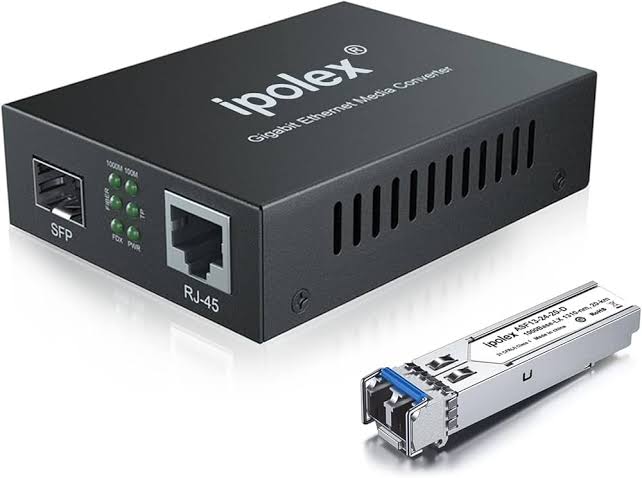
Gigabit Single-Mode Fibre Media Converter 1.25G SC 20KM Price in Kenya
KSh 1,600.00
1 available
Continue shoppingGigabit Single-Mode Fibre Media Converter 1.25G SC 20KM Price in Kenya
The Gigabit Single-Mode Fibre Media Converter 1.25G SC 20KM is designed to convert standard copper Ethernet signals from an RJ45 network connection into single-mode fibre optic transmission, allowing Gigabit Ethernet networks to operate over distances of up to approximately 20 kilometres.
A common version provides one 10/100/1000Mbps RJ45 port and one 1.25G SC optical interface. Kenyan supplier listings for this product class specify Gigabit Ethernet auto-negotiation, single-mode fibre, an SC connector, plug-and-play operation and transmission distances up to 20km.
These media converters are widely used by ISPs, CCTV installers, enterprises, schools, campuses, offices and FTTx network installers where conventional copper Ethernet cannot cover the required distance.
Gigabit Single-Mode Media Converter Technical Specifications
| Specification | Typical Specification |
|---|---|
| Product Type | Gigabit Fibre Media Converter |
| Ethernet Interface | RJ45 |
| Ethernet Speed | 10/100/1000Mbps |
| Optical Data Rate | Up to 1.25Gbps |
| Optical Connector | SC |
| Fibre Type | Single-Mode Fibre |
| Typical Fibre Size | 9/125µm |
| Maximum Distance | Up to 20KM |
| Typical Wavelengths | 1310nm and/or 1550nm depending on model |
| Transmission Mode | Single-fibre BiDi or dual-fibre depending on version |
| Duplex Mode | Full / Half Duplex auto-negotiation on supported versions |
| Auto MDI/MDIX | Commonly supported |
| Installation | Plug and Play |
| LED Indicators | Power, Ethernet link/activity, fibre link/activity and related status depending on model |
| Housing | Typically metal |
| External Power | Commonly DC power adapter |
| Typical Applications | CCTV, ISP, FTTx, campuses, offices, industrial networking |
Because “1.25G SC 20KM” describes a product class rather than one unique manufacturer model, details such as the exact wavelength, number of fibre cores, DC input voltage and LED arrangement can vary. For example, Kenyan listings include both generic SC 20km converters and A/B WDM single-fibre versions using complementary 1310nm and 1550nm wavelengths.
What Is a Gigabit Fibre Media Converter?
A fibre media converter connects:
Copper Ethernet
to:
Fibre Optic Ethernet
without requiring the connected Ethernet device itself to have an optical port.
A normal connection is:
Network Switch / Router
↓
RJ45 Ethernet Cable
↓
Gigabit Media Converter
↓
Single-Mode Fibre
↓
Gigabit Media Converter
↓
RJ45 Ethernet
↓
Remote Switch / NVR / Computer
This makes it possible to extend an Ethernet network far beyond the normal approximately 100m limitation associated with standard twisted-pair Ethernet.
1.25G SC Fibre Interface
The optical side is commonly specified as:
1.25Gbps
because Gigabit Ethernet optical transceivers typically operate at a nominal line rate of approximately 1.25Gbps.
The user-facing Ethernet connection remains:
10/100/1000Mbps RJ45 Ethernet.
A current Kenyan product listing describes this exact combination as a 1.25G SC fibre port with 10/100/1000Mbps copper networking and up to 20km range.
10/100/1000Mbps RJ45 Ethernet
A typical converter automatically supports:
10Mbps Ethernet
100Mbps Fast Ethernet
1000Mbps Gigabit Ethernet
The copper interface can therefore connect equipment such as:
Routers
Network switches
Computers
NVRs
DVRs
Servers
Wireless access network equipment
Kenyan listings for both the generic unit and HTB-GS-03-type single-fibre converter advertise 10/100/1000Mbps auto-negotiation.
Up to 20KM Fibre Transmission
One of the main advantages of this media converter is its:
up to 20KM transmission distance.
Instead of being limited to approximately 100m by conventional Ethernet cabling, single-mode fibre can carry the network connection over many kilometres.
This makes the converter suitable for:
Building-to-building links
CCTV cameras at remote sites
ISP customers
Industrial installations
School campuses
Estates
Warehouses
Factories
Long office compounds
Remote network cabinets
Current Kenyan listings for this product class explicitly specify a 20km single-mode fibre reach.
Single-Mode Fibre
The converter is intended for:
Single-Mode Fibre – SMF
commonly:
9/125µm.
Single-mode fibre is particularly suitable for long-distance networking because it has lower attenuation than multimode fibre.
A current Kenyan listing specifies 9/125µm single-mode fibre, while comparable 20km SC media-converter specifications also use this fibre class.
SC Fibre Connector
The optical interface uses an:
SC fibre connector.
SC connectors are common in:
Fibre media converters
FTTH systems
CCTV fibre networks
Telecom installations
FTTB networks
Depending on the exact converter, the connector may be:
SC/UPC
or another SC configuration.
Always confirm connector polishing before ordering matching patch cords.
Single Fibre vs Dual Fibre Media Converters
This is important when buying a generic SC 20KM media converter.
There are two common configurations.
Single-Fibre BiDi Media Converter
A single-fibre converter uses:
one fibre strand
for transmitting and receiving data.
This is usually achieved through:
WDM – Wavelength Division Multiplexing.
A typical A/B pair might operate as:
Converter A: Tx 1310nm / Rx 1550nm
Converter B: Tx 1550nm / Rx 1310nm
A Kenyan HTB-GS-03-type listing specifically describes an A/B WDM single-fibre 20km converter pair, while other comparable products use the same complementary wavelength arrangement.
Dual-Fibre Media Converter
Other media converters use:
two fibre strands
with one strand for transmission and one for reception.
These may use a conventional optical wavelength such as:
1310nm
on both sides.
Therefore, check whether your converter is:
Single Fibre / Simplex / WDM
or:
Dual Fibre / Duplex
before buying the fibre patch cord.
Watch Gigabit Single-Mode Fibre Media Converter Video
https://youtu.be/Ml7pKpf9ad0
A Gigabit Single-Mode Fibre Media Converter is particularly useful when existing equipment provides only an RJ45 network port but the connection must travel farther than copper Ethernet can reliably support. The converter changes the electrical Ethernet signal into an optical signal for transmission over fibre.
The 20km single-mode range makes these converters practical for ISP access networks, CCTV installations, campuses and enterprise sites where buildings or network devices may be separated by several kilometres. Current Kenyan offerings commonly combine 10/100/1000Mbps Ethernet with an SC single-mode fibre interface.
Installation is generally simple: connect Ethernet, connect the correct fibre, apply power and verify the LEDs. Generic models are typically plug-and-play and support automatic Ethernet speed negotiation.
WDM Bi-Directional Fibre Technology
Single-fibre versions use:
WDM – Wavelength Division Multiplexing.
WDM enables different wavelengths to travel through the same fibre core simultaneously.
For example:
Side A
Tx: 1310nm
Rx: 1550nm
Side B
Tx: 1550nm
Rx: 1310nm
The complementary wavelengths allow full two-way communication using a single fibre strand. Comparable 1.25G SC BiDi products use exactly these A/B wavelength combinations for 20km single-mode links.
Why A and B Converters Must Match
If your converter is a BiDi single-fibre model, you usually need:
A + B
rather than:
A + A
or:
B + B.
For example:
| Converter | Transmit | Receive |
|---|---|---|
| Side A | 1310nm | 1550nm |
| Side B | 1550nm | 1310nm |
The transmit wavelength of one end must match the receive wavelength of the other.
Auto Negotiation
Many Gigabit media converters support automatic Ethernet negotiation.
This allows them to detect supported copper speeds such as:
10Mbps
100Mbps
and:
1000Mbps.
A current Kenyan product page specifies automatic 10/100/1000Mbps operation.
Auto MDI/MDIX
Many generic models also support:
Auto MDI/MDIX.
This allows the RJ45 interface to automatically adapt to the Ethernet cable connection without requiring the installer to select crossover or straight-through wiring manually.
Both current Kenyan and comparable international product specifications list Auto MDI/MDIX functionality for this class.
Full Duplex and Half Duplex
Depending on the model, the Ethernet side may automatically negotiate:
Full Duplex
or:
Half Duplex.
Gigabit Ethernet normally operates full duplex in modern switched networks.
Plug-and-Play Installation
These media converters generally require no software configuration.
Typical installation:
Connect the RJ45 cable.
Connect the SC fibre.
Connect the matching converter at the far end.
Connect the power adapters.
Check LED indicators.
Confirm network connectivity.
A current Kenya product listing describes the device as plug and play with no configuration required.
LED Status Indicators
Typical LED indicators may include:
Power
Fibre Link
Fibre Activity
Ethernet Link
Ethernet Activity
Full Duplex
Speed
Exact LED labels depend on the converter model.
The LEDs are useful when diagnosing whether a problem is on the:
power side
Ethernet side
or:
fibre side.
Metal Housing
Many Gigabit media converters use a:
metal enclosure.
This helps provide:
Physical protection
Heat dissipation
Electromagnetic shielding
Durability
A current Kenyan 1.25G SC 20km converter listing specifically highlights a metal housing.
External Power Adapter
Most standalone media converters require an external DC adapter.
Generic models commonly operate from approximately:
5V DC
although some product variants specify a wider input such as 5V–12V DC. A current Kenyan listing for this generic converter class gives a 5V–12V range, while other comparable standalone units use 5V supplies.
Check the exact label on your unit before replacing the adapter.
Media Converter for CCTV Networks

Fibre media converters are widely used in CCTV installations where cameras or surveillance systems are located far from the control room.
Example:
Remote CCTV Switch
↓
RJ45
↓
Media Converter
↓
20KM Single-Mode Fibre
↓
Media Converter
↓
RJ45
↓
Core Switch / NVR
Advantages include:
Long transmission distance
Immunity to electromagnetic interference
High bandwidth
Electrical isolation between sites
Reduced lightning-related conductive paths between remote buildings
Media Converter for ISPs
ISPs can use these converters for:
Customer fibre connections
POP extensions
FTTB
Enterprise customers
CCTV backhaul
Remote switches
Last-mile Ethernet extension
A current Kenyan supplier specifically markets this 1.25G SC model for ISP and FTTx networks.
Media Converter for FTTx
The converter can be used in selected:
FTTH
FTTB
FTTO
Fibre access
architectures where an Ethernet point-to-point link is required.
It should not be confused with:
GPON ONU/ONT equipment.
A normal Ethernet media converter does not perform GPON authentication or PON protocol termination.
Media Converter for Building-to-Building Networks
Single-mode fibre is often preferable when connecting separate buildings.
Example:
Building A Network Switch
↓
Media Converter
↓
Single-Mode Fibre
↓
Media Converter
↓
Building B Network Switch
This avoids trying to run copper Ethernet over unsuitable long distances.
Media Converter for Campus Networks
Suitable environments include:
Schools
Universities
Hospitals
Factories
Business parks
Government facilities
Hotels
Large residential compounds
Media Converter for Industrial Networks
Fibre provides electrical isolation between distant network points and is resistant to electromagnetic interference.
This makes fibre attractive around:
Motors
Industrial machinery
High-voltage systems
Manufacturing equipment
However, verify environmental temperature ratings before using a standard commercial converter in harsh industrial environments.
Gigabit Media Converter vs Fast Ethernet Media Converter
| Feature | Gigabit Converter | Fast Ethernet Converter |
|---|---|---|
| Maximum Ethernet Speed | 1000Mbps | 100Mbps |
| Typical Optical Rate | 1.25Gbps | 155Mbps-class |
| Best Use | Modern Gigabit networks | Legacy 100Mbps |
| CCTV Capacity | Higher | Lower |
| Network Backbone | Better suited | Limited |
1.25G Media Converter vs TP-Link MC110CS
The TP-Link MC110CS is a 10/100Mbps single-mode SC converter rather than a Gigabit 1000Mbps converter.
A current Kenyan MC110CS listing specifies 10/100Mbps and a 20km SC single-mode fibre link.
Therefore:
1.25G Gigabit converter → up to 1000Mbps Ethernet
while:
MC110CS → up to 100Mbps Ethernet.
Gigabit Media Converter vs SFP Switch
A media converter allows standard RJ45 equipment to use fibre without replacing the switch.
However, if a network switch already provides:
SFP slots
it may be more efficient to install an appropriate SFP directly.
For example:
Switch SFP → Fibre → Switch SFP
removes the need for external media converters and their power adapters.
Media Converter vs Fibre Switch
Choose a media converter when:
Only one fibre connection is required.
Existing equipment needs to be retained.
You need a simple Ethernet-to-fibre extension.
Choose a fibre-capable switch when:
Many fibre links are required.
Centralized management is needed.
Multiple SFP interfaces are required.
The installation is larger.
Single-Fibre vs Dual-Fibre
| Feature | Single Fibre BiDi | Dual Fibre |
|---|---|---|
| Fibre Strands | 1 | 2 |
| Wavelengths | Complementary Tx/Rx | Usually same nominal wavelength |
| Modules | A/B pair | Matching conventional pair |
| Fibre Core Usage | Lower | Higher |
| Best Use | Fibre-core conservation | Conventional duplex installations |
Can It Use OS2 Fibre?
Yes.
OS2 9/125µm single-mode fibre is appropriate for modern long-distance installations.
Can It Use OS1 Fibre?
Potentially, provided:
Fibre is compatible
Optical loss is acceptable
Link distance is within specification
Connectors and splices are in good condition
OS2 is generally preferred for new outside-plant or longer-distance networks.
Can It Use Multimode Fibre?
Not if the converter is specifically designed for:
single-mode fibre.
Use a dedicated multimode media converter for multimode fibre.
Fibre Distance Is Not Guaranteed by Distance Alone
A 20km rating assumes the optical link remains within the equipment's optical power budget.
Actual performance can be affected by:
Fibre attenuation
Connector loss
Splice loss
Dirty connectors
Fibre bends
Poor patch cords
Mechanical damage
Therefore:
20km maximum rating does not mean every 20km fibre route will automatically work.
Fibre Connector Cleaning
Before connecting the SC connector:
Keep dust caps installed until use.
Clean the connector end face.
Avoid touching the ferrule.
Inspect connectors if equipment is available.
Clean adapters where necessary.
Dirty connectors are one of the most common causes of fibre link problems.
Optical Power Meter Testing
An Optical Power Meter – OPM can help measure received optical power.
This can help diagnose:
Excessive attenuation
Bad connectors
Poor splices
Long-distance link problems
OTDR Testing
An OTDR can be used to test the fibre route and locate:
Fibre breaks
High-loss splices
Bad connectors
Excessive bends
Unexpected fibre length
Reflective events
VFL Testing
A Visual Fault Locator can assist with:
Continuity checks
Fibre identification
Visible breaks
Connector identification
A VFL does not replace an optical power meter or OTDR when certifying a 20km link.
Gigabit Single-Mode Media Converter Price in Kenya
The Gigabit Single-Mode Fibre Media Converter 1.25G SC 20KM price in Kenya varies with manufacturer, whether the unit is sold individually or as an A/B pair, power supply, warranty and supplier.
A current Wavetech Kenya listing shows the generic 1.25G SC 20km Gigabit Single-Mode Fibre Media Converter at KES 1,500, discounted from KES 1,600.
Another Kenyan supplier currently lists an HTB-GS-03 A/B 10/100/1000Mbps 20KM single-mode single-fibre media converter at KES 1,999.
Approximate Media Converter Price in Kenya
| Current Kenyan Reference | Approx. Price |
|---|---|
| Generic 1.25G SC 20KM Media Converter | KES 1,500 |
| HTB-GS-03 A/B 20KM Converter | KES 1,999 |
These are third-party Kenyan market references and not fixed Fiber Optics Kenya selling prices.
Contact Fiber Optics Kenya for the current 1.25G SC 20KM media converter price and availability.
What Affects Media Converter Prices in Kenya?
Price may depend on:
Brand
Single-fibre vs dual-fibre
Whether sold individually or as a pair
10/100/1000Mbps capability
Fibre distance
Power adapter
Metal housing
Warranty
Quantity
Supplier
How to Choose the Correct Media Converter
Before ordering, confirm:
Required Ethernet speed: 10/100/1000Mbps.
Fibre type: single mode.
Fibre connector: SC.
Maximum route distance: within 20KM.
Whether the link uses one fibre or two fibres.
If single-fibre, the required A/B wavelength pair.
Connector polishing: SC/UPC or SC/APC.
Power adapter requirement.
Whether you need one converter or a complete pair.
Recommended Accessories
| Accessory | Application |
|---|---|
| Gigabit SC 20KM Media Converter | Ethernet-to-fibre conversion |
| SC/UPC Single-Mode Patch Cord | Fibre connection |
| SC/APC Patch Cord | Where APC interface is specified |
| OS2 Single-Mode Fibre Cable | Long-distance transmission |
| Fibre Optic Pigtails | Cable termination |
| SC Fibre Adapters | Fibre interconnection |
| ODF / Fibre Patch Panel | Structured termination |
| Fibre Splice Closure | Outdoor fibre joints |
| Fusion Splicer | Fibre joining |
| Fibre Cleaver | Fibre preparation |
| Optical Power Meter | Optical testing |
| OTDR | Fibre troubleshooting |
| VFL | Fibre identification |
| RJ45 Patch Cable | Ethernet connection |
Frequently Asked Questions About Gigabit Single-Mode Fibre Media Converters
What is a Gigabit fibre media converter?
It converts Ethernet signals between an RJ45 copper interface and a fibre optic interface.
What does 1.25G mean?
It refers to the nominal optical line rate commonly associated with Gigabit Ethernet.
What Ethernet speed does it support?
Typical models support:
10/100/1000Mbps.
Is 1.25G the same as 1.25GB/s?
No.
1.25G here means approximately:
1.25 gigabits per second
rather than gigabytes per second.
What connector does it use?
The optical side uses an:
SC connector.
What connector is on the Ethernet side?
RJ45.
What fibre does it use?
Single-mode fibre.
What fibre size should I use?
Typically:
9/125µm SMF.
What is the maximum distance?
Up to approximately:
20KM.
Can it work over 1KM?
Yes.
Can it work over 5KM?
Yes.
Can it work over 10KM?
Yes.
Can it work over 20KM?
Yes, where total optical loss remains within the unit's specification.
Can it work beyond 20KM?
Use a longer-range converter designed for 40km, 60km, 80km or another required distance.
Is it single-mode?
Yes.
Can I use multimode fibre?
Not for a converter specified as single-mode.
Can I use OS2 fibre?
Yes.
Does it use one fibre strand?
Some models do.
Single-fibre WDM/BiDi models use one fibre strand.
Do all SC 20KM converters use one fibre?
No. Some use dual fibre, so confirm the exact model.
What wavelengths are used in single-fibre models?
Common A/B pairs use:
1310nm / 1550nm
and:
1550nm / 1310nm.
Can I connect two identical A-side BiDi converters?
Normally no. You need complementary A/B wavelengths.
What does WDM mean?
Wavelength Division Multiplexing.
What does BiDi mean?
Bi-Directional, referring to transmitting and receiving over one fibre strand using different wavelengths.
Does it support Gigabit Ethernet?
Yes.
Can it connect a switch?
Yes.
Can it connect a router?
Yes.
Can it connect an NVR?
Yes.
Can I use it for CCTV?
Yes. CCTV backhaul is a common application.
Can ISPs use it?
Yes.
Can it be used for FTTB?
Yes.
Is it a GPON ONU?
No.
A standard Ethernet media converter does not perform GPON ONU functions.
Can it replace an ONT?
No.
Can I use it for building-to-building networking?
Yes.
Can I connect two offices 10km apart?
Yes, if a suitable single-mode fibre route exists and the optical loss remains within specification.
Does it require power?
Yes. Most standalone converters use an external DC adapter.
Is it PoE?
Not necessarily. Standard versions normally provide Ethernet data only.
PoE media converters are a separate product category.
Does it automatically detect Ethernet speed?
Many models support 10/100/1000 auto-negotiation.
Does it support Auto MDI/MDIX?
Many versions do.
Is it plug and play?
Yes, typical models are plug and play.
Does it need software?
Normally no.
Does it need an IP address?
A basic unmanaged media converter generally does not require one.
Does it change the IP address?
No. It simply converts the physical network medium.
Does it work like a router?
No.
Does it provide Wi-Fi?
No.
Does it amplify Internet speed?
No. It allows an Ethernet connection to travel over fibre; it does not increase the speed provided by the underlying network.
Can a Gigabit converter pass 1000Mbps?
Its Ethernet interface supports Gigabit Ethernet, but actual throughput depends on the connected equipment, protocol overhead and network conditions.
Why are there LEDs?
They help indicate power, fibre link and Ethernet activity.
Why is a metal housing useful?
It improves durability, shielding and heat dissipation.
Can I install it outdoors?
Not directly unless the specific model and enclosure are rated for outdoor use.
A standard indoor converter should be installed inside a suitable weatherproof cabinet where necessary.
Can I install it in a network cabinet?
Yes.
Can it work 24/7?
Many converters are designed for continuous networking applications, but installation temperature and power quality should remain within the manufacturer's limits.
What happens if the fibre Tx and Rx are reversed?
On a dual-fibre system the link will normally remain down until Tx and Rx are correctly crossed.
What happens if the wrong BiDi pair is used?
The link may fail because the wavelengths do not match.
Should I clean the SC connector?
Yes.
Can I test the fibre using an Optical Power Meter?
Yes.
Can I test it using an OTDR?
Yes, for diagnosing the fibre route.
Can I use a VFL?
Yes, for basic continuity and identification.
Is SC/UPC the same as SC/APC?
No.
SC/UPC usually uses a blue connector, while SC/APC generally uses a green angled-polish connector.
Do not assume they are interchangeable.
How many converters do I need?
For a normal RJ45-to-fibre-to-RJ45 point-to-point connection:
two converters are typically required.
Do I need one converter at each end?
Yes, unless the other endpoint already provides a compatible optical Ethernet interface.
Can I connect the converter directly to an SFP switch?
Potentially, provided the switch transceiver's:
Speed
Wavelength
Fibre type
connector
transmission method
match the converter.
What is the price in Kenya?
Current Kenyan examples are approximately KES 1,500 to KES 1,999, depending on model and supplier.
Is this Fiber Optics Kenya's exact price?
No. Those are third-party market references. Contact Fiber Optics Kenya for the current selling price.
Do you supply SC patch cords?
Yes.
Do you supply OS2 single-mode fibre?
Yes.
Do you supply fibre pigtails?
Yes.
Do you supply SC adapters?
Yes.
Do you supply media converter pairs?
Yes, subject to stock and required wavelength configuration.
Do you supply OTDRs and Optical Power Meters?
Yes, subject to availability.
Can businesses and ISPs order in bulk?
Yes. Bulk orders are suitable for ISPs, CCTV companies, enterprises, schools, government installations and network contractors.
Do you deliver outside Nairobi?
Yes. Fiber Optics Kenya supplies fibre optic and networking equipment throughout Kenya.
Why Buy Gigabit Fibre Media Converters from Fiber Optics Kenya?

| Fiber Optics Kenya Solution | Application |
|---|---|
| 1.25G SC 20KM Media Converter | Long-distance Gigabit Ethernet |
| Single-Fibre A/B Media Converters | One-core WDM links |
| Dual-Fibre Media Converters | Conventional duplex links |
| OS2 Fibre Cable | Long-distance fibre backbone |
| SC/UPC Patch Cords | Optical connectivity |
| SC/APC Patch Cords | APC fibre systems |
| SC Adapters | Fibre interconnection |
| Fibre Pigtails | Fibre termination |
| ODFs & Patch Panels | Structured fibre installations |
| Splice Closures | Outdoor fibre joints |
| Fusion Splicers | Fibre joining |
| OTDRs | Fault diagnosis |
| Optical Power Meters | Optical signal testing |
| VFLs | Fibre identification |
| Bulk Supply | ISP, CCTV and enterprise projects |
| Nationwide Delivery | Supply throughout Kenya |
Contact Fiber Optics Kenya
Fiber Optics Kenya
Lyric House, 7th Floor Room S9
Kimathi Street, Nairobi
Phone: +254 704 991 492
Email: info@fibreopticskenya.co.ke
The Gigabit Single-Mode Fibre Media Converter 1.25G SC 20KM provides a simple way to extend 10/100/1000Mbps Ethernet over single-mode fibre for distances of up to approximately 20km. Typical versions combine an RJ45 Ethernet port with a 1.25G SC optical interface, automatic Ethernet negotiation, plug-and-play installation and LED status monitoring.
Single-fibre models use complementary 1310nm/1550nm WDM wavelengths and normally require matching A/B units, while other models can use conventional dual-fibre configurations. The exact wavelength and fibre-core configuration should therefore be confirmed before ordering.
Current Kenyan market references place common generic models at approximately KES 1,500–1,999, although prices vary by supplier, model, configuration and whether the converter is supplied individually or as a pair.
Contact Fiber Optics Kenya for the current Gigabit Single-Mode Fibre Media Converter 1.25G SC 20KM price in Kenya, matching A/B converter pairs, SC patch cords, OS2 fibre cable, fibre testing equipment, bulk orders and nationwide delivery.