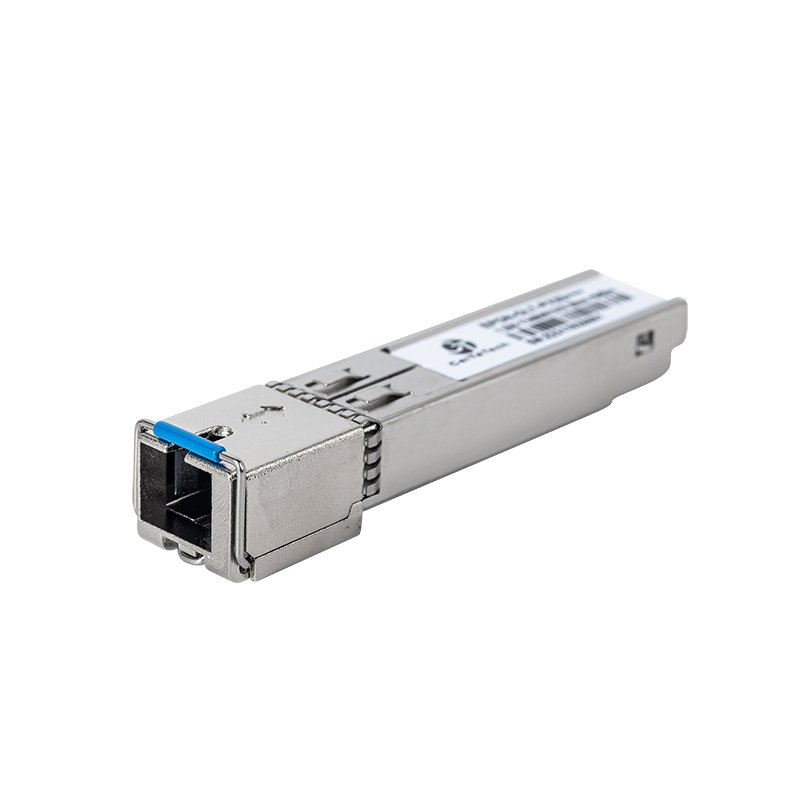
SFP Modules Price in Kenya
EPON OLT PX20+++ Price in Kenya
KSh 3,000.00
1 available
Continue shoppingEPON OLT PX20+++ Price in Kenya
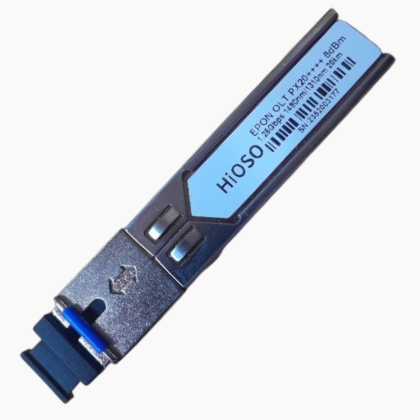
The EPON OLT PX20+++ is a high-power optical transceiver module designed for the PON interface of an EPON Optical Line Terminal (OLT).
It provides the optical connection between an EPON OLT and subscriber ONUs or ONTs through the passive optical distribution network. Typical PX20+++ modules operate at 1.25Gbps, transmit downstream at 1490nm, receive upstream at 1310nm, use single-mode fibre and support transmission distances of up to approximately 20 kilometres.
Unlike a normal Ethernet SFP, the EPON PX20+++ is designed specifically for point-to-multipoint PON networks, where one OLT port can serve multiple subscriber ONUs through passive PLC splitters.
EPON OLT PX20+++ Specifications
| Specification | Typical Details |
|---|---|
| Product Name | EPON OLT PX20+++ |
| Module Type | EPON OLT SFP Transceiver |
| PON Technology | EPON / GEPON |
| Standard | IEEE 802.3ah |
| Form Factor | SFP |
| Data Rate | 1.25Gbps |
| Maximum Reach | Up to 20KM |
| OLT Transmit Wavelength | 1490nm |
| OLT Receive Wavelength | 1310nm |
| Transmitter Type | DFB Laser |
| Receiver Type | APD Burst-Mode Receiver |
| Fibre Type | Single Mode |
| Typical Fibre | 9/125µm |
| Operation | Single-Fibre BiDi |
| Connector | Single SC |
| Optical Class | PX20+++ |
| Common Output Versions | 7dBm / 8dBm / 9dBm depending manufacturer |
| DDM/DDMI | Supported on many models |
| Power Supply | 3.3V |
| Hot-Pluggable | Yes |
| Commercial Temperature | Typically 0°C to 70°C |
| Industrial Versions | Up to -40°C to +85°C |
| Applications | FTTH, FTTB, FTTO, ISP Networks |
A current JFOPT PX20+++ specification lists 1.25Gbps, 1490nm/1310nm operation, 20km reach, 7–9dBm transmit power, -32dBm receiver sensitivity, SC interface, DDM and less than 1W power consumption for that specific model.
What Is EPON OLT PX20+++?
The PX20+++ is the optical transceiver installed in a compatible EPON OLT PON port.
Its job is to convert the OLT's electrical network data into optical signals that travel through the fibre network.
A typical EPON network works like this:
Internet → Router → EPON OLT → PX20+++ SFP → ODF → Fibre → PLC Splitter → FAT → Drop Fibre → EPON ONU → Customer
Downstream data travels from the OLT toward subscribers at approximately 1490nm, while subscriber ONUs transmit upstream toward the OLT at approximately 1310nm.
What Does EPON Mean?
EPON means:
Ethernet Passive Optical Network
It is a fibre access technology based on Ethernet and standardized under IEEE 802.3ah.
EPON is commonly used for:
Fibre to the Home
Fibre to the Building
Fibre to the Office
Estate internet
Apartment networks
Campus networks
ISP last-mile networks
Rural broadband deployments
What Does OLT Mean?
OLT means:
Optical Line Terminal
The OLT is installed on the ISP or service-provider side of the network.
It:
Connects the fibre access network to the ISP backbone
Controls subscriber ONUs
Allocates upstream transmission
Sends downstream traffic
Handles VLANs and subscriber services
Manages the EPON network
The PX20+++ module provides the optical interface used by the OLT to communicate with the optical distribution network.
What Does PX20+++ Mean?
PX20 identifies an EPON optical class designed for access networks with distances up to approximately 20km.
Manufacturers commonly use additional + designations to identify progressively higher optical-output variants.
One current manufacturer family lists:
| EPON Module | Listed Tx Class |
|---|---|
| PX20+ | >3dBm |
| PX20++ | >5dBm |
| PX20+++ | >7dBm |
| Higher PX20+++ Variant | >8dBm |
| Higher PX20+++ Variant | >9dBm |
| Higher PX20+++ Variant | >10dBm |
These naming conventions are not completely uniform across manufacturers, so the actual Tx power, receiver sensitivity and optical budget should always be checked on the supplied module's datasheet.
PX20+++ 7dBm
The 7dBm PX20+++ is one of the common high-output EPON OLT modules.
A current Kenyan HIOSO listing identifies a PX20+++ 7dBm single-mode fibre module for FTTH and ISP deployments at approximately KES 3,900.
A manufacturer example lists:
Tx Power: 7–9dBm
Receiver Sensitivity: approximately -32dBm
Reach: 20km
Connector: SC
Speed: 1.25Gbps.
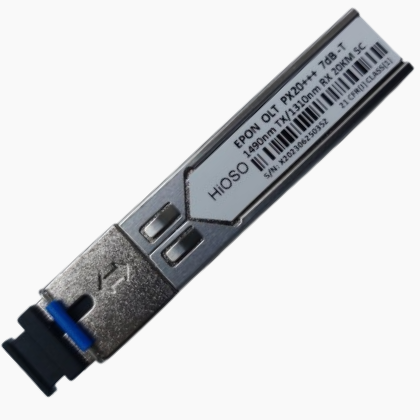
PX20+++ 8dBm
Higher-output variants are also available.
A current HIOSO 8dB EPON module listing specifies:
8dB class
Tx1490nm
Rx1310nm
Up to 20km
SC connector
Single-mode fibre
Hot-swappable SFP form factor
The current listed Kenyan price is approximately KES 4,300.
PX20+++ 9dBm
9dB-class EPON OLT SFP modules are available for more demanding network designs.
A current Kenyan HIOSO listing specifies:
9dB class
1490nm downstream
1310nm upstream
20km reach
SC connector
Single-mode fibre
SFP form factor
Higher output alone does not guarantee better network performance. The complete ODN must still be engineered correctly.
1.25Gbps EPON OLT Module
The typical PX20+++ provides a serial optical rate of approximately:
1.25Gbps
This is standard for many GEPON/EPON OLT applications.
Both Optinet and Miray list 1.25G Tx/Rx operation for their PX20+++ products.
1490nm Downstream Transmission

The OLT transmits downstream optical data using:
1490nm
The direction is:
OLT → Splitter → ONU
This carries subscriber internet traffic toward customer premises.
1310nm Upstream Reception
The subscriber ONU normally sends upstream information at:
1310nm
The direction is:
ONU → Splitter → OLT
The PX20+++ uses a burst-mode receiver because numerous ONUs share the same PON port and transmit during allocated upstream time slots.
DFB Transmitter
Typical PX20+++ modules use a:
1490nm DFB laser transmitter
DFB means:
Distributed Feedback Laser
This type of laser provides the optical output required for long-distance single-mode fibre transmission.
APD Burst Receiver
The receiver commonly uses:
1310nm APD + TIA
APD means:
Avalanche Photodiode
It provides high receiver sensitivity, which is important because upstream ONU signals must pass through:
Long fibre routes
PLC splitters
Connectors
Splices
Distribution boxes
before reaching the OLT.
Current PX20+++ specifications identify 1490nm DFB transmitters combined with 1310nm APD burst receivers.
Single-Fibre BiDi Operation
EPON transmits upstream and downstream traffic through one fibre core.
It works because different wavelengths are used:
1490nm → Downstream
1310nm → Upstream
The wavelength separation takes place inside the module.
This means:
One Fibre Strand = Bidirectional EPON Communication
SC Connector
Most PX20+++ OLT SFP modules use a:
Single SC connector
Current JFOPT, Miray and Optinet specifications all identify single SC connectivity.
Before purchasing, verify whether your deployment requires:
SC/UPC
Another manufacturer-specific connector configuration
Watch EPON OLT PX20+++ Video
https://youtu.be/Yx_iR_o26CE
The EPON PX20+++ module is an essential component in an OLT-based FTTH network. It provides the actual optical interface through which one PON port communicates with multiple subscriber ONUs.
Because EPON uses passive splitters rather than powered switches throughout the outside fibre distribution network, the optical performance of the OLT module becomes particularly important. Every splitter, connector, splice and kilometre of fibre adds loss to the optical path.
PX20+++ modules provide higher optical output than lower PX20 classes, giving network designers more headroom when deploying larger splitter ratios, longer routes or networks with multiple passive components. However, the module should still be selected according to an engineered optical budget rather than choosing the highest possible output.
EPON OLT PX20+++ for FTTH
The PX20+++ is particularly suitable for Fibre to the Home networks.
Typical layout:
ISP Internet
↓
Core Router
↓
EPON OLT
↓
PX20+++ SFP
↓
ODF
↓
Feeder Fibre
↓
PLC Splitter
↓
FAT Box
↓
FTTH Drop Cable
↓
EPON ONU
↓
Wi-Fi Router
EPON OLT PX20+++ for ISPs
The module is suitable for ISPs building:
Estate fibre networks
Apartment FTTH
Rural fibre
Campus internet
Office broadband
Metropolitan access networks
SME broadband
Last-mile fibre networks
EPON OLT PX20+++ for HIOSO
HIOSO is one common EPON equipment brand available in Kenya.
Current Kenyan listings include both HIOSO PX20+++ 7dB modules and complete HIOSO EPON OLT systems.
Compatibility should always be confirmed against the exact OLT model.
EPON OLT PX20+++ for HA7304
The HIOSO HA7304 is a compact four-port EPON OLT.
A current Fiber Optics Kenya listing describes the HA7304 as supporting:
4 PON interfaces
Up to 256 ONUs
Up to 1:64 split per PON
Up to approximately 20km under suitable network conditions
Web, SNMP and CLI management
The OLT requires compatible EPON PON transceivers for optical network connectivity.
PX20+ vs PX20++ vs PX20+++
| Specification | PX20+ | PX20++ | PX20+++ |
|---|---|---|---|
| Typical Speed | 1.25G | 1.25G | 1.25G |
| Tx Wavelength | 1490nm | 1490nm | 1490nm |
| Rx Wavelength | 1310nm | 1310nm | 1310nm |
| Typical Reach | 20km | 20km | 20km |
| Example Tx Class | >3dBm | >5dBm | >7dBm |
| Relative Output | Standard | Higher | Highest of these three |
The exact classifications can differ by manufacturer.
EPON PX20+++ vs Normal 1G SFP
| Feature | EPON PX20+++ | Normal 1G SFP |
|---|---|---|
| Purpose | PON Access Network | Point-to-Point Ethernet |
| Typical Rate | 1.25Gbps | 1.25Gbps |
| Tx Wavelength | 1490nm | Often 1310nm |
| Rx Wavelength | 1310nm | Often 1310nm |
| Upstream Receiver | Burst Mode | Continuous |
| Fibre Cores | 1 | Usually 2 |
| Connector | Usually SC | Usually LC |
| PLC Splitters | Yes | Normally No |
| Connects to ONU | Yes | No |
| Application | EPON OLT | Ethernet Switch/Router |
A conventional Ethernet SFP should therefore not be used as a replacement for a PX20+++ PON module.
EPON PX20+++ vs GPON OLT SFP
| Feature | EPON PX20+++ | GPON OLT Module |
|---|---|---|
| Technology | EPON | GPON |
| Standard | IEEE 802.3ah | ITU-T G.984 family |
| Downstream | 1490nm | Commonly 1490nm |
| Upstream | 1310nm | Commonly 1310nm |
| Subscriber Device | EPON ONU | GPON ONU |
| Interchangeable | No | No |
Similar wavelengths do not make EPON and GPON modules interchangeable.
EPON OLT PX20+++ and PLC Splitters

PON networks use passive optical splitters to distribute one OLT optical interface to several customers.
Common splitter sizes include:
| Splitter | Outputs |
|---|---|
| 1x2 | 2 |
| 1x4 | 4 |
| 1x8 | 8 |
| 1x16 | 16 |
| 1x32 | 32 |
| 1x64 | 64 |
Each increase in split ratio increases optical loss.
EPON PX20+++ with 1x8 Splitter
A 1x8 PLC splitter divides one optical input into eight outputs.
Typical layout:
OLT PX20+++ → 1x8 PLC → 8 Distribution Fibres
This generally leaves significantly more optical margin than very high split ratios.
EPON PX20+++ with 1x16 Splitter
A 1x16 splitter can serve up to sixteen optical branches.
Actual subscriber numbers can differ because networks may use:
Cascaded splitters
Multiple FATs
Spare ports
Different ODN architectures
EPON PX20+++ with 1x32 Splitter
1x32 splitting is widely used in FTTH deployment.
However, the network designer must account for:
Splitter insertion loss
Fibre attenuation
Connector loss
Splice loss
Patch-cord loss
Engineering reserve
Can PX20+++ Support 1x64?
Some EPON platforms support up to 1:64 split ratios.
For example, the current HA7304 specification states up to 64 ONUs per PON interface.
That does not mean every network can operate at 20km with 64 subscribers.
The optical budget must still support the complete ODN.
EPON Optical Budget
The optical budget determines whether sufficient signal reaches both ends of the network.
A simplified calculation is:
Transmitter Output – Total ODN Loss = Received Optical Power
ODN loss includes:
Fibre attenuation
PLC splitter loss
Connectors
Adapters
Fusion splices
Mechanical splices
Patch cords
The resulting received power must remain within the receiver's specified operating range.
Why Higher PX20+++ Power Helps
A stronger OLT transmitter can provide additional headroom for:
Larger splitter ratios
Longer feeder routes
Multiple connectors
Cascaded distribution points
Higher splice counts
Future network expansion
But increasing transmitter power is not a substitute for fixing excessive fibre loss.
Receiver Sensitivity
Receiver sensitivity describes the weakest optical signal the OLT receiver can reliably detect.
Current manufacturer examples vary:
Miray lists receiver sensitivity below approximately -30dBm for its PX20+++ module.
JFOPT lists approximately -32dBm for its particular PX20+++ model.
Therefore, use the datasheet of the exact supplied module for optical calculations.
Receiver Overload
The receiver also has a maximum safe input level.
For example, JFOPT lists approximately -8dBm receiver overload for its PX20+++ model.
This is another reason why simply choosing the strongest module is not always the correct network-design decision.
DDM / DDMI Support
Many PX20+++ modules provide Digital Diagnostic Monitoring.
This can help compatible OLT equipment monitor parameters such as:
Module temperature
Supply voltage
Optical transmit conditions
Optical receive conditions
Diagnostic status
Miray, JFOPT and Optinet all identify diagnostic monitoring support on their PX20+++ designs.
Hot-Pluggable Design
PX20+++ modules use the SFP form factor and are designed to be hot-pluggable.
This simplifies:
Installation
Maintenance
Module replacement
Network upgrades
Troubleshooting
Always follow the OLT manufacturer's recommended replacement procedure.
Testing an EPON PX20+++ Network
Several tools are useful when commissioning an EPON network.
Optical Power Meter
An optical power meter can verify the signal reaching the ONU or OLT.
PON Power Meter
A PON-specific power meter can measure PON wavelengths more appropriately than a conventional optical meter.
OTDR
An OTDR can identify:
Fibre length
Breaks
Bad splices
Connector reflections
Excessive attenuation
Macrobends
VFL
A Visual Fault Locator helps identify basic fibre continuity and visible faults over shorter distances.
EPON OLT PX20+++ Price in Kenya
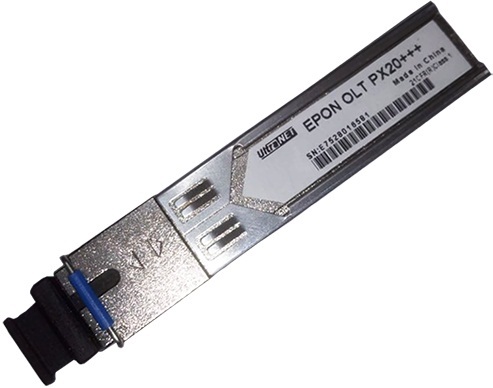
Current Kenyan market examples show the PX20+++ 7dB-class module at around KES 3,900, while a related PX20+ SFP listing is approximately KES 3,999.
Higher-output modules currently include an 8dB HIOSO version at approximately KES 4,300.
Approximate EPON OLT SFP Prices in Kenya
| Module | Current Market Example |
|---|---|
| PX20+ / Similar EPON OLT SFP | Around KES 3,999 |
| PX20+++ 7dB | Around KES 3,900 |
| Higher-Power 8dB Version | Around KES 4,300 |
| Higher-Power 9dB Version | Varies by supplier |
These are third-party market references and not fixed Fiber Optics Kenya prices.
What Affects EPON OLT PX20+++ Price?
Prices depend on:
Optical output power
Manufacturer
OLT compatibility
Receiver sensitivity
7dB, 8dB or 9dB variant
Commercial or industrial temperature rating
DDM support
Warranty
Quantity ordered
Availability
Choosing the Correct EPON OLT PX20+++ Module
Before purchasing, confirm:
OLT brand and model
EPON compatibility
Required optical power
1490nm Tx / 1310nm Rx operation
20km reach requirement
SC connector
Expected splitter ratio
Total optical budget
Commercial or industrial temperature requirement
DDM requirement
Recommended Accessories
| Accessory | Purpose |
|---|---|
| EPON PX20+++ SFP | OLT optical interface |
| EPON OLT | PON network controller |
| EPON ONU | Subscriber termination |
| PLC 1x8 Splitter | 8-way fibre distribution |
| PLC 1x16 Splitter | 16-way distribution |
| PLC 1x32 Splitter | FTTH distribution |
| PLC 1x64 Splitter | High-density deployment |
| SC Patch Cord | OLT fibre connection |
| ODF | Fibre termination |
| FAT Box | FTTH distribution |
| Fibre Closure | Outdoor fibre splicing |
| Outdoor Fibre Cable | Feeder network |
| FTTH Drop Cable | Subscriber connection |
| OTDR | Fibre testing |
| PON Power Meter | PON optical testing |
| Fusion Splicer | Fibre jointing |
Frequently Asked Questions About EPON OLT PX20+++
What is EPON OLT PX20+++?
It is an optical SFP module used in compatible EPON OLT PON ports.
What speed does PX20+++ support?
Typically approximately 1.25Gbps.
What is its transmission distance?
Typically up to approximately 20km over suitable single-mode fibre.
What is its transmit wavelength?
1490nm.
What is its receive wavelength?
1310nm.
What does 1490nm carry?
Downstream data from the OLT toward subscriber ONUs.
What does 1310nm carry?
Upstream ONU traffic toward the OLT.
Is the fibre single mode?
Yes.
How many fibre cores does it require?
One fibre strand.
Is PX20+++ BiDi?
Yes.
What connector does PX20+++ use?
Single SC is common.
Does it use LC?
Most products in this class use SC, although the exact supplied module should always be checked.
Is PX20+++ a normal Ethernet SFP?
No.
Can I use it in a normal Ethernet switch?
Not as a conventional point-to-point Ethernet transceiver.
Is it designed for an OLT?
Yes.
Can it communicate with EPON ONUs?
Yes, when installed in a compatible EPON network.
Can it communicate with GPON ONUs?
Not as a normal EPON deployment. EPON and GPON are different technologies.
Is EPON the same as GPON?
No.
What does PX20 mean?
It identifies an EPON optical class associated with approximately 20km access-network reach.
What do the three plus signs mean?
Manufacturers commonly use them to designate a higher-output PX20 variant, but exact power values should be checked on the module datasheet.
Is PX20+++ always exactly 7dBm?
No. Current manufacturers market PX20+++ variants at 7dBm and higher, so confirm the exact unit.
Are 8dB modules available?
Yes.
Are 9dB modules available?
Yes, depending on manufacturer.
Is higher output always better?
No. The correct module depends on the network optical budget.
Can excessive optical power cause issues?
Yes. Receiver overload limits must be respected.
Does PX20+++ support DDM?
Many models do.
Is it hot-swappable?
Yes.
Can it work with HIOSO OLTs?
Compatible HIOSO PX20+++ modules are currently available.
Can it work with the HIOSO HA7304?
Compatible PX20-family modules are used with HA7304 configurations, but verify the exact OLT and module specifications.
Can PX20+++ work with BDCOM?
Compatible variants may be available, but check the exact OLT module requirements.
Can PX20+++ work with VSOL?
It depends on the OLT and module compatibility.
Can it work with HSGQ?
Compatible EPON optics exist, but the exact model should be verified.
Can I use a PLC splitter?
Yes.
Can I use a 1x8 splitter?
Yes, provided the optical budget is adequate.
Can I use a 1x16 splitter?
Yes.
Can I use a 1x32 splitter?
Yes, subject to network loss calculations.
Can I use a 1x64 splitter?
Some EPON platforms support up to 1:64, but the optical budget determines whether the actual network will operate reliably.
Does a splitter reduce optical power?
Yes.
Does a larger split ratio create more loss?
Yes.
Do fibre splices create loss?
Yes.
Do connectors create loss?
Yes.
Can dirty connectors affect ONU registration?
Yes. Excessive connector loss can reduce received optical power.
Should I measure optical power?
Yes.
Which test equipment should I use?
A PON Power Meter, Optical Power Meter and OTDR can all be useful depending on the troubleshooting task.
Can an OTDR test an EPON fibre route?
Yes, but PON network topology and live-fibre testing requirements must be considered.
Is PX20+++ suitable for FTTH?
Yes.
Is it suitable for FTTB?
Yes.
Is it suitable for FTTO?
Yes.
Is it suitable for estate internet?
Yes.
Is it suitable for apartment networks?
Yes.
Is it suitable for ISP networks?
Yes.
Can it support rural broadband?
Yes, provided the optical distribution network is properly engineered.
What is the EPON OLT PX20+++ price in Kenya?
Current Kenyan examples put a 7dB-class PX20+++ at approximately KES 3,900, with higher-powered versions costing more.
How much is the 8dB version?
A current Kenyan HIOSO 8dB listing is approximately KES 4,300.
Do you supply EPON PX20+++ modules?
Yes, subject to stock availability.
Do you supply EPON OLTs?
Yes.
Do you supply EPON ONUs?
Yes.
Do you supply PLC splitters?
Yes.
Do you supply SC patch cords?
Yes.
Do you supply ODFs?
Yes.
Do you supply FAT boxes?
Yes.
Do you supply fibre closures?
Yes.
Do you supply PON Power Meters?
Yes, subject to availability.
Do you supply OTDRs?
Yes.
Can ISPs order EPON equipment in bulk?
Yes. Bulk orders are suitable for ISP, FTTH, estate, campus and telecom projects.
Do you deliver outside Nairobi?
Yes. Fiber Optics Kenya supplies fibre optic equipment throughout Kenya.
Why Buy EPON OLT PX20+++ from Fiber Optics Kenya?
| Fiber Optics Kenya Solution | Application |
|---|---|
| EPON PX20+++ SFP | OLT PON interface |
| PX20+ / PX20++ Modules | Other EPON power classes |
| 7dB / 8dB / 9dB Options | Different ODN requirements |
| EPON OLTs | FTTH network control |
| EPON ONUs | Subscriber termination |
| PLC Splitters | Passive fibre distribution |
| ODFs | Fibre termination |
| FAT Boxes | Subscriber distribution |
| SC Patch Cords | Optical connectivity |
| Outdoor Fibre Cable | Feeder/distribution networks |
| FTTH Drop Cable | Last-mile connectivity |
| Fusion Splicers | Fibre joining |
| OTDRs | Fibre troubleshooting |
| PON Power Meters | PON optical measurement |
| Bulk Supply | ISP and FTTH projects |
| Nationwide Delivery | Supply throughout Kenya |
Contact Fiber Optics Kenya
Fiber Optics Kenya
Lyric House, 7th Floor Room S9
Kimathi Street, Nairobi
Phone: +254 704 991 492
Email: info@fibreopticskenya.co.ke
The EPON OLT PX20+++ is a high-output SFP optical transceiver designed specifically for EPON OLT access networks. Typical models provide 1.25Gbps transmission, Tx1490nm/Rx1310nm operation, single-mode single-fibre BiDi connectivity, an SC connector and reach of up to approximately 20km.
PX20+++ modules are particularly suitable for FTTH, FTTB, FTTO, estate fibre, apartment networks and ISP last-mile infrastructure. Higher-output variants can provide additional headroom where networks use larger splitter ratios, longer fibre runs and multiple passive components.
Current Kenyan market examples show 7dB PX20+++ modules around KES 3,900, while an 8dB version is approximately KES 4,300. Exact pricing depends on the manufacturer, optical power class and OLT compatibility.
Contact Fiber Optics Kenya for current EPON OLT PX20+++ prices in Kenya, 7dB, 8dB and higher-power modules, EPON OLTs, ONUs, PLC splitters, ODFs, FAT boxes, PON testing equipment, bulk ISP orders and nationwide delivery.