Inline Fibre Splice Closures Price in Kenya
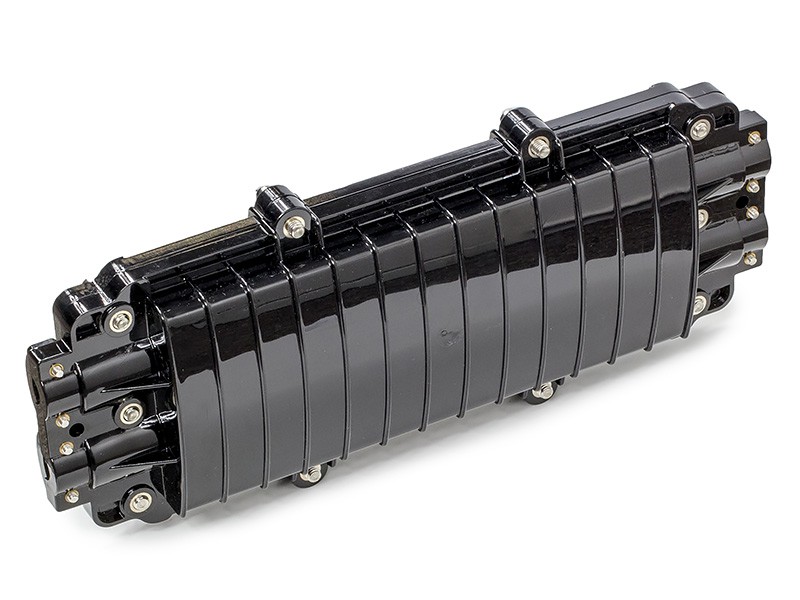
48 Core Horizontal Fibre Closure in Kenya
KSh 2,500.00
1 available
Continue shopping48 Core Horizontal Fibre Closure in Kenya
The 48 Core Horizontal Fibre Closure is a rugged fibre optic splice enclosure designed to protect fusion splices, fibre joints, cable transitions and service loops in outdoor telecommunications networks. Its horizontal or inline construction allows fibre cables to enter and exit along the same general axis, making it particularly useful for backbone, distribution and FTTH networks where two sections of fibre cable need to be joined securely.
A 48-core horizontal closure can typically accommodate up to 48 optical fibre splices, with the fibres organized inside one or more removable splice trays. Horizontal closures are widely used in aerial, wall-mounted, duct, handhole and underground installations. Professional horizontal FOSC products are designed specifically to protect fibre joints against outdoor exposure including water, UV radiation and weather.
At Fiber Optics Kenya, the 48 Core Horizontal Fibre Closure is suitable for ISPs, fibre contractors, telecommunications companies, CCTV infrastructure, campus networks, residential FTTH projects and backbone fibre installations. Matching splice sleeves, fibre cables, pigtails, fusion splicers, cleavers, strippers, OTDRs, optical power meters and other fibre accessories can also be supplied.
Key Product Specifications
| Specification | Details |
|---|---|
| Product Name | 48 Core Horizontal Fibre Closure |
| Product Type | Horizontal Fibre Optic Splice Closure |
| Also Known As | FOSC / Fibre Joint Closure / Inline Closure |
| Maximum Fibre Capacity | Up to 48 Fibres |
| Typical Splice Capacity | 48 Fusion Splices |
| Typical Tray Capacity | 12 / 24 Fibres per tray depending on model |
| Splice Method | Fusion / Mechanical depending on closure |
| Structure | Horizontal / Inline |
| Typical Cable Entries | 2 In / 2 Out or multiple ports depending on model |
| Cable Diameter Support | Model dependent |
| Typical Material | PP / ABS / PC / Engineering Plastic |
| Weather Protection | IP65 / IP67 / IP68 depending on model |
| Water Resistance | Yes on rated models |
| Dust Resistance | Yes |
| UV Resistance | Available |
| Aerial Installation | Yes |
| Wall Mounting | Yes |
| Pole Mounting | Available |
| Duct Installation | Yes |
| Handhole Installation | Yes |
| Underground Installation | Yes on suitable models |
| Fibre Slack Storage | Integrated |
| Cable Strength Member Fixing | Yes |
| Applications | FTTH, FTTx, ISP, Telecom, CATV, CCTV |
| Electrical Power Required | No |
| Professional Installation | Available |
| Delivery | Available throughout Kenya |
A current 48-core horizontal closure uses a 2-in/2-out design and is intended for outdoor FTTH and telecom networks, including aerial, wall, duct and underground deployment. Other 48-core horizontal models are available with IP68 environmental protection.
What Is a 48 Core Horizontal Fibre Closure?
A 48 Core Horizontal Fibre Closure is an outdoor enclosure used where two or more fibre optic cables need to be joined, branched or repaired.
| Internal Component | Function |
|---|---|
| Outer Housing | Protects fibre splices |
| Cable Entry Ports | Receives incoming/outgoing cables |
| Cable Clamps | Secures fibre cable |
| Strength Member Clamps | Provides mechanical anchoring |
| Splice Trays | Organizes fibre fusion joints |
| Splice Sleeves | Protects individual fusion splices |
| Fibre Routing Guides | Controls fibre routing |
| Slack Storage | Stores maintenance fibre loops |
| Sealing System | Prevents water/dust ingress |
| Closure Bolts / Clamps | Secures enclosure |
Horizontal splice closures are specifically designed to protect optical fibre joints while allowing organized cable routing and splice-tray access.
What Does 48 Core Mean?
| Term | Meaning |
|---|---|
| 48 Core | Maximum nominal capacity of 48 optical fibres |
| Horizontal | Inline enclosure layout |
| Closure | Protective outdoor splice housing |
| FOSC | Fibre Optic Splice Closure |
| Fusion Splice | Permanent fibre-to-fibre joint |
| FTTH | Fibre to the Home |
| FTTx | Fibre to various network endpoints |
The 48-core rating commonly refers to the maximum splice capacity, rather than the number of adapter ports. Unlike an ODF or FAT box, a conventional horizontal closure generally protects fibre-to-fibre splices rather than presenting multiple front-facing adapters.
How a Horizontal Fibre Closure Works
The incoming fibre cable is passed through a sealed cable-entry port and anchored inside the closure. Individual fibre cores are then routed into splice trays and fusion-spliced to the corresponding fibres of another cable.
| Stage | Function |
|---|---|
| Incoming Cable | Carries upstream fibres |
| Cable Port | Provides sealed entry |
| Cable Fixing | Prevents cable movement |
| Strength Member Anchor | Provides mechanical support |
| Buffer Tube Routing | Separates fibre groups |
| Fusion Splicing | Joins individual fibres |
| Splice Sleeve | Protects each splice |
| Splice Tray | Stores completed joints |
| Outgoing Cable | Continues network route |
| Closure Seal | Protects everything from environment |
Typical 48-Core Splice Tray Configuration
| Tray Capacity | Number of Trays for 48 Fibres |
|---|---|
| 12 Fibres | 4 Trays |
| 24 Fibres | 2 Trays |
| 48 Fibres | 1 High-Capacity Tray/System |
A 48-core horizontal closure can use multiple internal trays to keep fibre groups separate and easier to identify. Commercial horizontal enclosures support fusion and mechanical splicing while maintaining fibre bend radius and future expansion capability.
Typical Fibre Organization
| Fibre Range | Typical Group |
|---|---|
| 1–12 | Group 1 |
| 13–24 | Group 2 |
| 25–36 | Group 3 |
| 37–48 | Group 4 |
This arrangement is useful when working with conventional 12-colour fibre sequences inside loose-tube cables.
2 In / 2 Out Configuration
Many 48-core horizontal closures use a 2-in/2-out cable arrangement.
| Cable Port | Typical Function |
|---|---|
| Input 1 | Main feeder cable |
| Input 2 | Additional feeder / branch |
| Output 1 | Continuing network cable |
| Output 2 | Distribution / branch cable |
A current 48-core horizontal FOSC is specifically designed with two cable inlets and two outlets.
Multi-Port Horizontal Fibre Closures
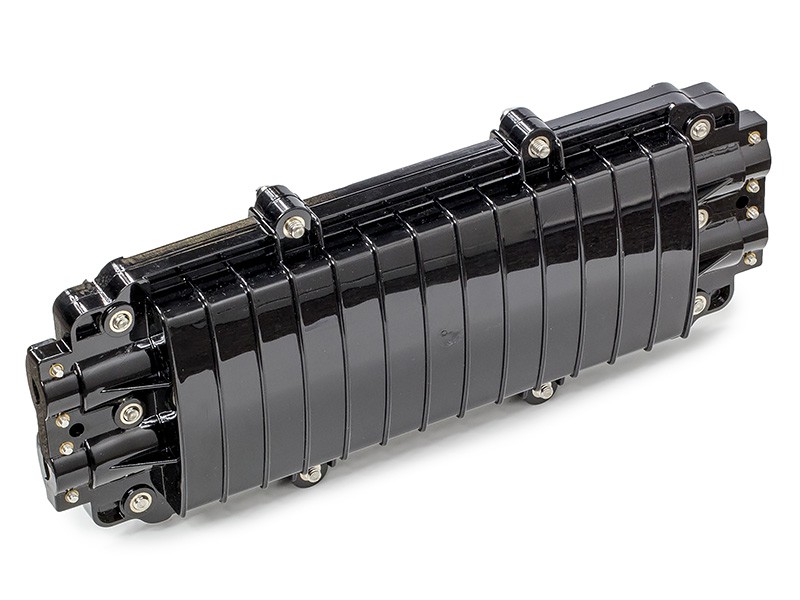
Other closures provide additional cable ports for branching.
| Configuration | Typical Application |
|---|---|
| 1 In / 1 Out | Straight cable joint |
| 2 In / 2 Out | Inline plus branching |
| 3 In / 3 Out | Larger distribution node |
| 6 Ports | Multi-branch fibre network |
48-core horizontal closures with three inputs and three outputs are commercially available, and some 48-core enclosures provide six fibre cable ports.
IP68 Horizontal Fibre Closure
Some 48-core closures are rated to IP68.
| IP68 Feature | Benefit |
|---|---|
| Dust-Tight Construction | Keeps contamination out |
| High Water Protection | Suitable for harsh outdoor environments |
| Underground Installation | Excellent on approved models |
| Handhole Installation | Excellent |
| Duct Installation | Excellent |
| Aerial Deployment | Excellent |
| Outdoor Reliability | High |
Current 48-core horizontal closures are available with IP68 protection, including models designed for aerial and FTTH applications.
IP65 vs IP68 Closure
| Feature | IP65 | IP68 |
|---|---|---|
| Dust Protection | Dust-tight | Dust-tight |
| Water Jets | Protected | Protected |
| Temporary / Defined Immersion | Not necessarily | Manufacturer-rated immersion protection |
| Outdoor Wall Installation | Excellent | Excellent |
| Underground Application | Less Preferred | Better on approved models |
| Handholes | Model dependent | Better suited |
Always confirm the specific manufacturer's environmental rating before underground or flood-prone deployment.
Horizontal vs Dome Fibre Closure
| Feature | Horizontal Closure | Dome Closure |
|---|---|---|
| Shape | Long / Inline | Vertical / Dome |
| Cable Direction | Commonly enters from ends | Commonly enters from base |
| Straight Cable Joint | Excellent | Good |
| Branching | Excellent | Excellent |
| Underground Installation | Excellent | Excellent |
| Aerial Installation | Excellent | Excellent |
| Splice Tray Access | Excellent | Excellent |
| Typical Use | Inline backbone joints | Distribution / branch joints |
The best design depends on cable routing, available installation space and network architecture.
Horizontal Closure vs Fibre Termination Box
| Feature | Horizontal Closure | Termination Box |
|---|---|---|
| Primary Function | Protect fibre-to-fibre splices | Termination and patching |
| Adapters | Usually No | Common |
| Pigtails | Not always required | Common |
| Outdoor Use | Excellent | Available |
| Underground Use | Excellent on rated models | Less Common |
| Fusion Splicing | Main Function | Yes |
| Patch Cord Access | No | Yes |
Horizontal Closure vs FAT Box
| Feature | Horizontal Closure | FAT Box |
|---|---|---|
| Fibre Joint Protection | Excellent | Good |
| Subscriber Ports | Usually No | Yes |
| PLC Splitters | Uncommon | Common |
| Underground Deployment | Common | Less Common |
| Aerial Deployment | Common | Common |
| Subscriber Activation | Not Direct | Easy |
| Backbone Cable Joining | Excellent | Less Common |
Horizontal Closure vs ODF
| Feature | Horizontal Closure | ODF |
|---|---|---|
| Typical Installation | Outdoor | Indoor Rack |
| Fusion Splicing | Excellent | Excellent |
| Patch Cord Ports | No | Yes |
| Rack Mounting | No | Yes |
| Underground Installation | Available | No |
| Weather Resistance | High | Low |
| Backbone Joint Protection | Excellent | Less Suitable |
Suitable Fibre Cable Types
| Cable Type | Compatibility |
|---|---|
| Outdoor Single Mode Cable | Excellent |
| Armoured Fibre Cable | Excellent on suitable port/gland |
| ADSS Fibre Cable | Suitable with correct anchoring |
| Loose-Tube Fibre Cable | Excellent |
| Direct Burial Fibre Cable | Excellent |
| Duct Fibre Cable | Excellent |
| FTTH Distribution Cable | Suitable |
| Multimode Outdoor Cable | Possible where required |
Horizontal splice closures are cable-management enclosures and can therefore be used with different fibre types provided the cable diameter, strength member and sealing method match the closure specification.
Key Benefits of 48 Core Horizontal Fibre Closure
48-Fibre Splice Capacity
Provides protected fibre joining for up to 48 optical fibres.
Strong Outdoor Protection
IP-rated versions protect splices against water, dust and outdoor weather.
Multiple Installation Methods
Horizontal closures can be used for aerial, wall, duct, handhole and underground installations.
Organized Splice Trays
Removable trays keep large numbers of fibre joints structured and accessible.
Fibre Slack Storage
Extra fibre can be stored for future re-splicing and maintenance.
Mechanical Cable Protection
Cable clamps and strength-member anchors prevent external cable loads from reaching fibre splices.
Re-Entry for Maintenance
Mechanical closures can be reopened when technicians need to repair or expand the fibre network.
Passive Operation
No electricity is required.
Watch 48 Core Horizontal Fibre Closure
Watch on YouTube: https://youtu.be/fc4tHkWWM7s
The 48 Core Horizontal Fibre Closure provides a secure junction point for joining high-count outdoor fibre optic cables without exposing the individual fibres or fusion splices to the surrounding environment. Inside the enclosure, incoming cable strength members are anchored, buffer tubes are routed toward splice trays and individual fibres are fusion-spliced before being protected with splice sleeves. Horizontal FOSC products are specifically designed to provide protection from water, UV exposure and general outdoor weather.
Its inline construction makes the closure particularly practical for long fibre routes where one cable section must be joined directly to another. Depending on the model, additional entry and exit ports can also support branch cables, allowing the same closure to form part of a more complex distribution network. Current 48-core products include 2-in/2-out designs as well as multi-port 3-in/3-out and six-port configurations.
For outside-plant fibre networks, environmental sealing is critical because even a technically good fusion splice can become unreliable if moisture, dirt or mechanical stress reaches the fibre joint. IP68-rated 48-core closures are available for demanding outdoor deployments. Fiber Optics Kenya can supply the 48 Core Horizontal Fibre Closure together with splice protection sleeves, fibre cables, fusion-splicing tools, cable preparation tools, optical power meters, VFLs and OTDRs for complete outdoor fibre jointing projects.
Applications of 48 Core Horizontal Fibre Closure
1. FTTH Networks
Protects feeder and distribution fibre joints in fibre-to-the-home networks.
2. FTTx Networks
Provides outdoor fibre splicing for different access-network architectures.
3. ISP Backbone Networks
Joins high-count fibre cables along network routes.
4. Telecommunications Networks
Protects outside-plant fibre splices and cable branches.
5. Aerial Fibre Networks
Can be mounted on poles or messenger systems where the model supports aerial installation.
6. Underground Fibre Networks
IP-rated closures can protect splices in chambers, handholes and underground routes.
7. Duct Fibre Networks
Suitable for inline joints along underground duct systems.
8. Campus Fibre Networks
Joins backbone cables connecting different buildings.
9. CCTV Fibre Networks
Protects outdoor fibre transmission cable joints for surveillance systems.
10. Industrial Fibre Networks
Suitable for rugged outside-plant communication infrastructure.
Typical Fibre Route Architecture
| Network Stage | Typical Component |
|---|---|
| Core / POP | ODF / Active Equipment |
| Backbone Cable | Outdoor Fibre Cable |
| Cable Joint Point | 48 Core Horizontal Closure |
| Fusion Splices | Up to 48 |
| Distribution Cable | Outdoor Fibre |
| Subscriber Distribution | FAT / FDB |
| Drop Cable | FTTH Drop Fibre |
| Final Termination | ATB / ONT |
Typical 48-Core Fibre Colour Organization
| Fibre Range | Typical Identification |
|---|---|
| 1–12 | First 12-colour sequence |
| 13–24 | Second tube / group |
| 25–36 | Third tube / group |
| 37–48 | Fourth tube / group |
Always follow the actual cable manufacturer's colour code and tube identification during fusion splicing.
Installation Process
| Step | Procedure |
|---|---|
| 1 | Select suitable closure location |
| 2 | Open closure carefully |
| 3 | Route incoming and outgoing cables |
| 4 | Prepare cable jackets |
| 5 | Secure cable strength members |
| 6 | Route loose tubes to splice tray |
| 7 | Identify fibre pairs |
| 8 | Strip and clean fibres |
| 9 | Precision cleave |
| 10 | Fusion-splice matching fibres |
| 11 | Install splice sleeves |
| 12 | Place splices in trays |
| 13 | Store fibre slack |
| 14 | Seal all cable ports |
| 15 | Close enclosure uniformly |
| 16 | Test completed fibre links |
Installation Considerations
| Installation Factor | Recommendation |
|---|---|
| Closure Capacity | Confirm 48 fibres are sufficient |
| Cable Diameter | Match cable ports |
| Cable Entry Count | Confirm branching requirements |
| IP Rating | Select according to environment |
| Strength Member Fixing | Secure correctly |
| Cable Sealing | Follow manufacturer's system |
| Splice Tray Allocation | Separate fibres clearly |
| Bend Radius | Avoid sharp fibre bends |
| Splice Sleeves | Protect every fusion joint |
| Fibre Labelling | Clearly identify all fibres |
| Closure Bolts | Tighten evenly |
| Underground Use | Select approved enclosure |
| Optical Testing | Test after installation |
| Documentation | Record cable and fibre mapping |
Recommended Accessories
| Accessory | Purpose |
|---|---|
| Fusion Splice Sleeves | Protect completed joints |
| Fibre Splice Trays | Organize fusion splices |
| Cable Sealing Tape | Supports environmental sealing |
| Cable Glands | Secures compatible cable |
| Cable Ties | Internal organization |
| Fibre Labels | Fibre identification |
| Outdoor Fibre Cable | Backbone/distribution link |
| Armoured Fibre Cable | Rugged outside-plant use |
| ADSS Fibre Cable | Aerial fibre deployment |
| Fusion Splicer | Creates permanent fibre joints |
| Fibre Cleaver | Precision fibre cutting |
| Fibre Stripper | Fibre preparation |
| Cable Slitter | Cable jacket preparation |
| Optical Power Meter | Signal-level testing |
| Visual Fault Locator | Continuity checking |
| OTDR | Tests splice and link performance |
Why Buy 48 Core Horizontal Fibre Closure from Fiber Optics Kenya?

| Why Choose Fiber Optics Kenya? | Customer Benefit |
|---|---|
| 48 Core Fibre Closures | High-capacity splice protection |
| Outdoor Fibre Cables | Complete fibre infrastructure |
| ADSS & Armoured Cables | Multiple deployment options |
| Fusion Splice Sleeves | Professional splice protection |
| Splicing Tools | Complete installation capability |
| Cable Preparation Tools | Easier outdoor cable work |
| Optical Testing Equipment | Verify completed fibre links |
| Technical Guidance | Correct closure selection |
| ISP Project Supply | Suitable for network rollouts |
| Bulk Orders | Contractor and telecom supply |
| Professional Fibre Services | Installation and splicing support |
| Nationwide Delivery | Supply throughout Kenya |
Frequently Asked Questions
What is a 48 Core Horizontal Fibre Closure?
It is an outdoor fibre splice enclosure designed to protect and organize up to 48 fibre joints inside a horizontal or inline housing. Current 48-core horizontal products are available specifically for FTTH, telecom and outside-plant deployments.
What does FOSC mean?
FOSC means Fibre Optic Splice Closure.
How many fibres can it splice?
A 48-core model is designed for up to 48 fibre splices, subject to the exact tray configuration.
Is it the same as a fibre termination box?
No. A splice closure primarily protects fibre-to-fibre joints, while a termination box commonly provides adapters and patchable interfaces.
Is it waterproof?
Outdoor models are designed for water protection, but the exact rating varies. IP67 and IP68 48-core products are available.
Are IP68 models available?
Yes. 48-core horizontal IP68 closures are commercially available.
Can it be installed underground?
Yes, where the specific closure is rated for underground deployment. Horizontal splice closures are used in underground, pipeline and handhole environments.
Can it be installed aerially?
Yes. Current 48-core horizontal closures are designed for aerial installation as well as wall, duct and underground use.
Can it be wall mounted?
Yes, compatible horizontal closures support wall installation.
Can it be installed in a duct?
Yes. Horizontal splice closures are commonly used in duct and pipeline networks.
How many cable ports does it have?
This varies. Common configurations include 2-in/2-out, 3-in/3-out and six-port designs.
Does it include splice trays?
Most complete horizontal closures include one or more splice trays, although the exact number depends on the model.
How many fibres can a splice tray hold?
Common tray capacities include 12 or 24 fibres, although designs vary.
Does it support fusion splicing?
Yes. Fusion splicing is the primary application of this type of closure. Horizontal splice enclosures can also support mechanical splicing on compatible models.
Does it require adapters?
Normally no. Unlike an ODF or FAT box, a standard horizontal splice closure mainly protects direct fibre splices.
Does it require pigtails?
Not for a straightforward fibre-to-fibre cable joint.
Can it be used with single-mode fibre?
Yes. Single-mode outside-plant fibre is a major application.
Can it be used with multimode fibre?
Yes, provided the fibre cables and splice requirements are compatible.
Can it be used with armoured fibre cable?
Yes, provided the closure's cable-entry diameter and strength-member fixing system suit the particular armoured cable.
Can it be used with ADSS cable?
Yes, with appropriate cable preparation, anchoring and closure compatibility.
Is it suitable for FTTH?
Yes. 48-core horizontal closures are used in FTTH and FTTx subscriber distribution networks.
Can it be used for ISP backbone fibre?
Yes. Horizontal closures are excellent for joining fibre cable sections along backbone routes.
Can it be reopened?
Mechanical closures are generally designed for re-entry, although installers must restore seals correctly after maintenance.
What is the difference between horizontal and dome closures?
A horizontal closure has an inline elongated shape, while a dome closure normally has cable entries concentrated at its base.
What is the difference between a 24 Core and 48 Core closure?
The 48-core version provides twice the nominal splice capacity.
What is the difference between a 48 Core and 96 Core closure?
A 96-core closure provides twice the nominal fibre splice capacity and generally requires more internal splice-tray space.
Does it need electricity?
No. The closure is entirely passive.
Why is fibre slack stored inside?
Extra fibre allows technicians to perform future re-splicing, repairs and maintenance without replacing the entire cable section.
Do you supply fusion splice sleeves?
Yes. Fiber Optics Kenya can supply splice protection sleeves for fibre jointing.
Do you supply outdoor fibre optic cable?
Yes. Outdoor, armoured, ADSS and other fibre cables can be supplied.
Do you supply fusion splicers?
Yes. Fusion splicers and related fibre installation tools can be supplied.
Do you supply fibre cleavers and strippers?
Yes. Professional fibre preparation tools are available.
Do you supply OTDRs?
Yes. OTDR equipment can be supplied for testing fibre length, events and splice performance.
Do you provide fibre splicing and installation?
Yes. Professional fibre jointing, fusion splicing, closure installation and optical testing support is available.
Do you deliver outside Nairobi?
Yes. Fiber Optics Kenya supplies fibre optic products and accessories throughout Kenya.
Contact Fiber Optics Kenya
Fiber Optics Kenya
Lyric House
7th Floor Room S9
Kimathi Street
Nairobi
Phone: +254 704 991 492
Email: info@fibreopticskenya.co.ke
The 48 Core Horizontal Fibre Closure provides a secure and durable solution for protecting up to 48 fibre optic splices in FTTH, FTTx, ISP backbone, telecommunications, CCTV and outside-plant fibre networks. Its horizontal inline design, organized splice trays and weather-resistant enclosure make it suitable for aerial, wall, duct, handhole and underground fibre installations.
Contact Fiber Optics Kenya for 48 Core Horizontal Fibre Closures, fibre cables, splice sleeves, fusion-splicing tools, optical testing equipment, bulk orders, professional installation and nationwide delivery across Kenya.