Fiber Optic Cable Prices in Kenya
48 Core ADSS Single Mode Fibre Optic Cable G652D in Kenya
KSh 268.00
1 available
Continue shopping48 Core ADSS Single Mode Fibre Optic Cable G652D in Kenya
The 48 Core ADSS Single Mode Fibre Optic Cable G652D is a high-performance outdoor aerial fibre cable designed for telecommunications, ISP backbone, FTTH distribution, CCTV, enterprise and campus network applications. With 48 individual single-mode optical fibres, it provides substantial capacity for multiple network links while leaving room for redundancy and future expansion.
ADSS means All-Dielectric Self-Supporting. This type of cable uses dielectric strength elements such as FRP and aramid yarn rather than a metallic messenger wire, enabling it to support itself between appropriately engineered poles or support structures. Commercial 48-core ADSS designs use loose-tube construction, G652D single-mode fibre, aramid reinforcement, water-blocking materials and black PE/HDPE outer jackets.
At Fiber Optics Kenya, the 48 Core ADSS G652D Cable is suitable for ISPs, telecommunications contractors, network integrators, schools, universities, hospitals, industrial sites and businesses developing aerial fibre infrastructure. Compatible suspension clamps, tension clamps, closures, ODFs, pigtails, patch cords and other accessories can also be supplied for a complete fibre installation.
Key Product Specifications
| Specification | Details |
|---|---|
| Product Name | 48 Core ADSS Single Mode Fibre Optic Cable G652D |
| Cable Type | All-Dielectric Self-Supporting |
| Abbreviation | ADSS |
| Fibre Count | 48 Cores |
| Fibre Mode | Single Mode |
| Fibre Standard | ITU-T G.652.D |
| Typical Fibre Category | OS2 |
| Typical Core/Cladding | Approx. 9/125 µm |
| Cable Construction | Stranded Loose Tube |
| Central Strength Member | FRP |
| Additional Strength Element | Aramid Yarn |
| Metallic Strength Member | None |
| Water Blocking | Gel, water-blocking tape/yarn or combination |
| Outer Jacket | PE / MDPE / HDPE depending on design |
| Typical Jacket Colour | Black |
| Common Wavelengths | 1310 nm / 1550 nm |
| Installation Method | Self-supporting aerial |
| Typical Span Options | Approximately 80 m, 100 m, 120 m and longer depending on design |
| Applications | ISP, telecom, FTTH, CCTV, enterprise and campus networks |
| Delivery | Available throughout Kenya |
| Professional Installation | Available |
One current 48-core 100 m ADSS product specifies G652D fibre, FRP central strength member, MDPE/HDPE outer jacket and hydrophobic gel/aramid moisture and strength protection.
What Does ADSS Mean?
ADSS stands for All-Dielectric Self-Supporting. It describes an aerial fibre optic cable designed to support its own weight between poles without relying on a separate metallic messenger cable.
| ADSS Feature | Benefit |
|---|---|
| All-Dielectric Construction | No conductive metallic strength member |
| Self-Supporting | No separate messenger wire normally required |
| Aerial Installation | Suitable for overhead fibre routes |
| FRP Strength Member | Provides non-metallic structural support |
| Aramid Yarn | Provides tensile reinforcement |
| Loose-Tube Design | Helps protect fibres from mechanical stress |
| Water Blocking | Protects internal fibres from moisture migration |
| PE Outer Jacket | Provides environmental protection |
| Different Span Ratings | Allows cable to be matched to pole spacing |
Commercial 48-core ADSS cables are available as single- and double-jacket configurations, with designs intended for particular aerial span requirements.
48 Core ADSS Cable Construction

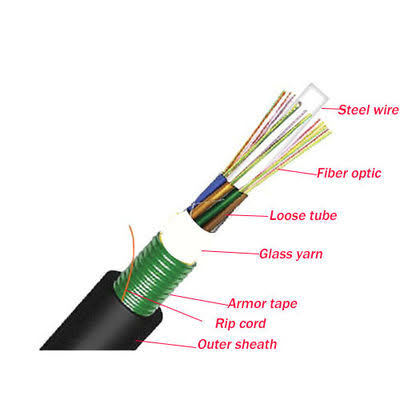
A typical 48-core ADSS cable uses multiple fibre-bearing loose tubes stranded around a non-metallic central strength element. Aramid yarn surrounding the cable core provides much of the tensile strength needed for aerial self-supporting installation.
| Cable Component | Function |
|---|---|
| G652D Optical Fibres | Carry high-speed optical signals |
| Primary Fibre Coating | Protects individual glass fibres |
| Loose Tubes | Organise and protect fibre groups |
| Tube Filling Compound | Helps protect fibres from moisture |
| Central FRP Member | Provides structural support |
| Cable Fillers | Maintain cable geometry |
| Water-Blocking Tape/Yarn | Restricts moisture migration |
| Aramid Yarn | Provides high tensile strength |
| Inner Jacket | Used on selected double-jacket models |
| Outer PE/HDPE Sheath | Protects against outdoor conditions |
| Ripcord | Assists with cable preparation |
48 Core Fibre Capacity
The 48-core capacity makes this cable suitable for significantly larger networks than basic 2-, 4-, 12- or 24-core cables.
| Example Fibre Allocation | Fibres |
|---|---|
| Primary ISP Backbone | 12 |
| FTTH Distribution | 10 |
| Enterprise Connections | 6 |
| CCTV Network | 4 |
| Backup / Redundancy | 4 |
| Future Expansion | 12 |
| Total | 48 |
With conventional duplex optical links using two fibres per connection, 48 fibres can theoretically support up to 24 duplex links. The actual allocation will depend on whether the network uses duplex, BiDi, PON, WDM or other architectures.
G652D Single Mode Fibre Characteristics
| Characteristic | Typical Description |
|---|---|
| Fibre Standard | ITU-T G.652.D |
| Fibre Mode | Single Mode |
| Typical Category | OS2 |
| Core Diameter | Approx. 8-9 µm |
| Cladding Diameter | 125 µm |
| Common Wavelengths | 1310 nm / 1550 nm |
| Transmission Distance | Long |
| Attenuation | Low |
| Bandwidth Potential | Very High |
| ISP Backbone Suitability | Excellent |
| FTTH Suitability | Excellent |
| Telecommunications | Excellent |
| Enterprise Backbone | Excellent |
A current 48-core 100 m span product lists attenuation of ≤0.35 dB/km at 1310 nm and ≤0.21 dB/km at 1550 nm. These figures are product-specific and should be confirmed against the datasheet of the exact cable supplied.
Typical ADSS Span Options
The required pole-to-pole distance is one of the most important considerations when selecting ADSS cable.
| Span Requirement | Typical Application |
|---|---|
| Up to 80 m | Urban and short aerial routes |
| Around 100 m | Standard ISP and FTTH distribution |
| Around 120 m | Medium aerial routes |
| Around 150 m | Longer distribution links |
| 200 m+ | Specially engineered ADSS |
| Very Long Span | Requires detailed mechanical design |
Current 48-core commercial examples include 80 m, 100 m and 120 m designs, while other ADSS product families are offered for substantially longer spans.
Example Mechanical Specifications
The mechanical values vary according to cable construction and span.
| Mechanical Parameter | Representative / Model-Dependent Value |
|---|---|
| Typical Structure | Loose Tube ADSS |
| Strength Member | FRP + Aramid Yarn |
| Outer Jacket | PE / HDPE |
| Typical Span | 80-120 m on common designs |
| Tensile Rating | Cable-design dependent |
| Crush Resistance | Cable-design dependent |
| Cable Diameter | Model dependent |
| Cable Weight | Model dependent |
| Minimum Bend Radius | Manufacturer dependent |
| Operating Temperature | Often broad outdoor range |
| Wind Loading | Must be considered during design |
For example, one 48-core 80 m ADSS model specifies RTS/MAT tensile values of 4,800/3,300 N, while a 100 m model from another manufacturer uses different mechanical characteristics.
Single Jacket vs Double Jacket 48 Core ADSS
| Feature | Single Jacket | Double Jacket |
|---|---|---|
| Cable Weight | Lower | Higher |
| Cable Diameter | Smaller | Larger |
| Mechanical Protection | High | Enhanced |
| Short Span | Excellent | Excellent |
| Medium Span | Excellent | Excellent |
| Longer Span | Design dependent | Often preferred |
| Installation Handling | Easier | Heavier |
| Environmental Protection | Good | Higher |
| Cost | Generally lower | Generally higher |
Single- and double-jacket 48-core G652D ADSS variants are commercially available, so the correct choice should be based on span and environmental requirements rather than fibre count alone.
Key Benefits of 48 Core ADSS G652D Fibre Optic Cable
High Network Capacity
Forty-eight fibres provide ample capacity for ISP, FTTH, enterprise, CCTV and telecommunications networks.
Long-Distance Transmission
G652D single-mode fibre offers low attenuation and is well suited to long-distance optical communications.
Self-Supporting Aerial Installation
ADSS can support itself between appropriately engineered pole structures without a separate messenger wire.
All-Dielectric Construction
The non-metallic strength system makes ADSS useful where a conductive messenger cable is undesirable.
Excellent Expansion Potential
Unused fibres can remain available for future customers, additional sites or backup connections.
Reduced Civil Works
Where suitable poles already exist, aerial installation can reduce trenching and underground duct requirements.
Suitable for Growing ISP Networks
A 48-core backbone provides considerably more expansion capacity than smaller 12- or 24-core cable routes.
Watch 48 Core ADSS Single Mode Fibre Optic Cable G652D
Watch on YouTube: https://youtu.be/81CUVvVoJPM
The 48 Core ADSS Single Mode Fibre Optic Cable G652D provides a strong balance between fibre capacity and manageable cable size for medium-to-large aerial networks. Its 48 single-mode fibres can support numerous backbone, distribution, CCTV and enterprise connections while maintaining substantial spare capacity for redundancy and network growth. Commercial G652D ADSS designs use FRP and aramid strength components to create a self-supporting aerial structure without a conventional metallic messenger.
For an ISP or telecommunications operator, the cable can be used to connect POPs, fibre distribution points, neighbourhood networks and enterprise customers over one aerial backbone. Rather than consuming all 48 fibres immediately, part of the cable can be reserved as dark fibre for future customers or additional services, helping avoid the cost and disruption of installing another backbone cable as demand grows.
Correct ADSS cable selection should nevertheless consider the span between poles, expected tension, wind conditions, sag, cable diameter and supporting hardware. An 80 m span cable and a 120 m span cable may both contain 48 G652D fibres but have different mechanical properties. Fiber Optics Kenya can help match the cable and installation hardware to the intended aerial route.
Applications of 48 Core ADSS Fibre Optic Cable
1. ISP Backbone Networks
Provides high-capacity aerial connections between POPs, distribution points and customer areas.
2. FTTH Networks
Suitable for feeder and distribution sections of aerial fibre-to-the-home infrastructure.
3. Telecommunications Networks
G652D single-mode fibre provides the long-distance transmission characteristics needed for telecom networks.
4. CCTV Surveillance Networks
Can provide a backbone between CCTV switches, surveillance zones and control centres.
5. Campus Networks
Suitable for schools, universities, hospitals and industrial compounds with several buildings.
6. Enterprise Networks
Businesses can allocate separate fibres to buildings, departments, network switches and backup connections.
7. Industrial Parks
Connect factories, warehouses, offices and security systems using one aerial fibre route.
8. Government Networks
Suitable for public institutions requiring scalable high-capacity fibre infrastructure.
9. Hotel and Resort Networks
Connect accommodation blocks, offices, CCTV systems and network distribution locations.
10. Metropolitan Access Networks
Can form part of aerial metro and access networks connecting multiple locations.
48 Core vs 24 Core ADSS
| Feature | 24 Core ADSS | 48 Core ADSS |
|---|---|---|
| Total Fibres | 24 | 48 |
| Potential Duplex Links | 12 | 24 |
| Capacity | High | Very High |
| Small ISP Network | Excellent | Excellent |
| Large Distribution Network | Good | Better |
| Expansion Capacity | High | Very High |
| Cable Diameter | Generally smaller | Generally larger |
| Cable Weight | Lower | Higher |
| Initial Cost | Lower | Higher |
| Future Scalability | Excellent | Superior |
A 48-core cable is particularly attractive where future network growth is anticipated and the additional fibre capacity can help avoid a second aerial installation.
48 Core vs 96 Core ADSS
| Feature | 48 Core | 96 Core |
|---|---|---|
| Fibres | 48 | 96 |
| Potential Duplex Links | 24 | 48 |
| Network Capacity | Very High | Extremely High |
| Medium ISP Network | Excellent | Excellent |
| Large Metro Backbone | Good | Better |
| Cable Size | Smaller | Larger |
| Splicing Workload | Lower | Higher |
| Initial Cost | Lower | Higher |
| Expansion Capacity | Very High | Superior |
ADSS vs Figure 8 Fibre Cable
| Feature | ADSS Fibre Cable | Figure 8 Fibre Cable |
|---|---|---|
| Self-Supporting | Yes | Yes |
| All-Dielectric | Yes | Not necessarily |
| Metallic Messenger | No | Often incorporated |
| Aerial Installation | Excellent | Excellent |
| Electrical Environment | Advantageous dielectric construction | Construction dependent |
| ISP Networks | Excellent | Excellent |
| Different Span Options | Available | Available |
| Mechanical Design | Aramid/FRP based | Messenger based in many designs |
Recommended ADSS Installation Accessories
| Accessory | Purpose |
|---|---|
| ADSS Suspension Clamp | Supports cable on intermediate poles |
| ADSS Tension Clamp | Anchors the cable at tension points |
| Dead-End Grip | Secures cable at route ends |
| Pole Bracket | Supports aerial hardware |
| Stainless Steel Banding | Attaches brackets to poles |
| Cable Storage Bracket | Stores spare cable |
| Vibration Damper | Helps manage vibration where required |
| Fibre Joint Closure | Protects aerial fibre splices |
| 48 Core ODF | Organises and terminates fibres |
| SC/APC Pigtails | Common FTTH/PON termination |
| SC/UPC Pigtails | Single-mode termination |
| LC Pigtails | Equipment termination |
| Fusion Splice Sleeves | Protect completed fibre splices |
| SFP/SFP+ Modules | Connect fibre links to network switches |
| OTDR | Tests fibre length, loss and faults |
Fibre Colour Identification
48-core cables normally use standard fibre colour sequences combined with loose-tube colour identification.
| Colour | Number |
|---|---|
| Blue | 1 |
| Orange | 2 |
| Green | 3 |
| Brown | 4 |
| Slate/Grey | 5 |
| White | 6 |
| Red | 7 |
| Black | 8 |
| Yellow | 9 |
| Violet | 10 |
| Rose/Pink | 11 |
| Aqua | 12 |
The sequence is repeated across different tubes to identify all 48 fibres. Technicians should always follow the exact manufacturer colour chart while splicing.
Why Buy 48 Core ADSS Fibre Optic Cable from Fiber Optics Kenya?

A reliable aerial fibre network requires the right combination of cable, span rating, supporting hardware, termination accessories and professional installation.
| Why Choose Fiber Optics Kenya? | Customer Benefit |
|---|---|
| 48 Core Capacity | Excellent for growing networks |
| G652D Single Mode | Reliable long-distance transmission |
| ADSS Cable Solutions | Designed for aerial installation |
| Span Selection Support | Match cable to pole spacing |
| Technical Guidance | Assistance choosing the right specification |
| ADSS Hardware | Suspension and tension accessories available |
| Complete Fibre Accessories | Closures, ODFs, pigtails and patch cords |
| Bulk Supply | Suitable for ISPs and contractors |
| Competitive Pricing | Cost-effective network procurement |
| Professional Installation | Installation support available |
| Fusion Splicing | Professional fibre termination |
| OTDR Testing | Helps verify network performance |
| Nationwide Delivery | Supply throughout Kenya |
Frequently Asked Questions
What is 48 Core ADSS Fibre Optic Cable?
It is an outdoor self-supporting aerial fibre cable containing 48 individual optical fibres.
What does ADSS mean?
ADSS means All-Dielectric Self-Supporting, referring to a non-metallic aerial cable designed to support itself between appropriate structures.
Is this cable G652D?
Yes. The cable uses G652D single-mode fibre, commonly selected for long-distance telecommunications and fibre backbone networks.
How many duplex links can 48 fibres provide?
A conventional duplex connection uses two fibres, so 48 fibres can theoretically support 24 duplex links.
Is 48 Core ADSS good for an ISP?
Yes. It offers ample fibre capacity for ISP backbone and distribution applications.
Can it be used for FTTH?
Yes. It can be used for aerial FTTH feeder and distribution routes.
Does ADSS require a messenger wire?
No separate messenger wire is normally needed because ADSS uses its own dielectric strength elements.
What span lengths are available?
48-core ADSS is manufactured in several span designs. Current commercial examples include approximately 80 m, 100 m and 120 m, with longer-span versions also available.
Is 100 m the maximum possible span?
No. Other ADSS designs can support longer distances. The cable should be ordered according to the actual route and mechanical requirements.
Is ADSS waterproof?
Outdoor ADSS typically incorporates hydrophobic gel, dry-block tape, water-blocking yarn or related moisture-control elements.
Is the cable suitable near electrical infrastructure?
Its all-dielectric construction can be advantageous around utility infrastructure, but clearances, electrical field conditions, jacket type and local safety requirements must be professionally assessed.
What is the difference between single- and double-jacket ADSS?
Double-jacket designs generally offer additional mechanical protection and may be appropriate for more demanding routes, while single-jacket versions can be lighter.
Do you supply ADSS clamps?
Yes. Fiber Optics Kenya can supply appropriate suspension clamps, tension clamps, dead-end grips and related installation hardware.
Do you provide fusion splicing?
Yes. Professional fibre splicing can be arranged for 48-core installations.
Do you provide OTDR testing?
Yes. Optical testing can be incorporated into professional fibre installation and commissioning.
Do you provide installation?
Yes. Professional ADSS installation, splicing, termination and testing support can be provided according to project requirements.
Do you deliver outside Nairobi?
Yes. Fiber Optics Kenya supplies fibre optic cables and accessories throughout Kenya.
Contact Fiber Optics Kenya
Fiber Optics Kenya
Lyric House
7th Floor, Room S9
Kimathi Street
Nairobi
Phone: +254 704 991 492
Email: info@fibreopticskenya.co.ke
Order 48 Core ADSS Single Mode Fibre Optic Cable G652D in Kenya
Choose Fiber Optics Kenya for reliable 48 Core ADSS G652D Fibre Optic Cable, compatible aerial accessories and professional technical support.
Contact Fiber Optics Kenya today for competitive pricing, bulk orders, installation support and nationwide delivery across Kenya.