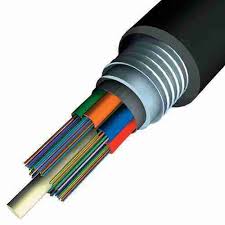
Fiber Optic Cable Prices in Kenya
24 Core Underground Armoured Fibre Optic Cable G652D in Kenya
KSh 250.00
1 available
Continue shopping24 Core Underground Armoured Fibre Optic Cable G652D in Kenya
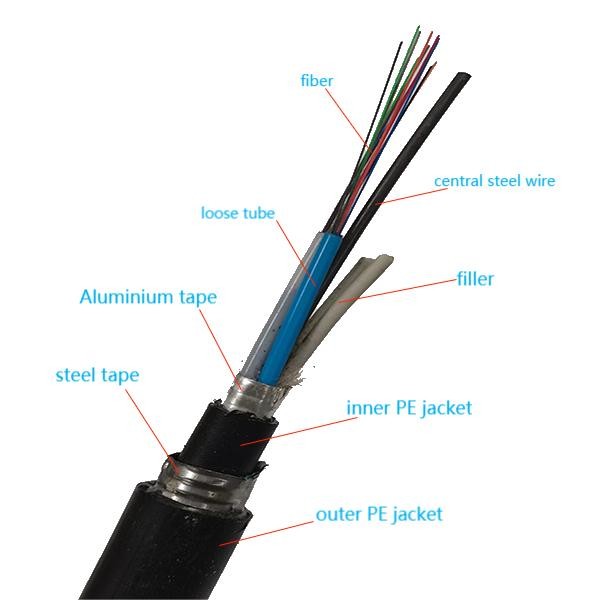
The 24 Core Underground Armoured Fibre Optic Cable G652D is a heavy-duty singlemode fibre cable designed for underground telecommunications and network infrastructure. It combines 24 low-attenuation G652D singlemode optical fibres with protective loose-tube construction, water-blocking materials and metallic armour to provide reliable performance in demanding underground environments.
The cable is particularly suitable for direct burial, underground ducts, ISP backbone networks, FTTH infrastructure, telecommunications, CCTV networks, campus connections and enterprise backbone applications. Typical armoured underground constructions use steel or corrugated steel tape to improve resistance to crushing, impact and rodent damage, while a durable polyethylene outer jacket protects the internal components from moisture and environmental exposure. Kenyan-market examples of 24-core underground armoured cable specify loose-tube construction, steel/corrugated armour, water blocking and a PE jacket for underground installation.
At Fiber Optics Kenya, we supply 24 Core Underground Armoured G652D Fibre Optic Cable alongside the fibre termination, splicing and network accessories required for complete installations. Whether you are building an ISP network, connecting buildings, expanding FTTH infrastructure or developing a large commercial backbone, this cable provides substantial capacity for both current requirements and future expansion.
Key Product Specifications
| Specification | Details |
|---|---|
| Product Name | 24 Core Underground Armoured Fibre Optic Cable G652D |
| Cable Category | Outdoor Underground Fibre Optic Cable |
| Fibre Count | 24 Cores |
| Fibre Mode | Singlemode |
| Fibre Standard | ITU-T G.652.D |
| Typical Fibre Category | OS2 |
| Core/Cladding Size | Approx. 9/125 µm |
| Primary Coating | Typically 250 µm |
| Typical Construction | Stranded Loose Tube |
| Armour | Corrugated/steel tape depending on model |
| Central Strength Member | Steel wire or equivalent depending on construction |
| Water Blocking | Gel filling, water-blocking tape/yarn or combination |
| Inner Sheath | PE on selected double-sheath constructions |
| Outer Jacket | PE / HDPE |
| Typical Jacket Colour | Black |
| Common Wavelengths | 1310 nm / 1550 nm |
| Installation | Underground |
| Direct Burial | Yes, when the supplied construction is direct-burial rated |
| Duct Installation | Yes |
| Applications | ISP, FTTH, telecom, CCTV, campus and backbone networks |
| Delivery | Available throughout Kenya |
| Installation Support | Available |
What Is G652D Singlemode Fibre?

G652D refers to an ITU-T specification for standard singlemode optical fibre. It is widely used in telecommunications, metro networks, ISP infrastructure, FTTH and long-distance backbone installations.
| G652D Characteristic | Description |
|---|---|
| Fibre Type | Singlemode |
| Typical Core Diameter | Approx. 8-9 µm |
| Cladding Diameter | 125 µm |
| Common Operating Windows | 1310 nm and 1550 nm |
| Water Peak | Reduced compared with older G652 variants |
| Transmission Distance | Long |
| Attenuation | Low |
| Bandwidth Potential | Extremely High |
| Typical Networks | Telecom, FTTH, ISP and backbone |
| WDM Compatibility | Suitable for applicable optical systems |
| Outdoor Application | Excellent when incorporated into suitable cable |
G652D is particularly attractive for modern outside-plant networks because its reduced water-peak characteristics allow useful transmission across a broad optical spectrum while maintaining low attenuation.
Why 24 Cores?
A major advantage of a 24-core cable is that the entire fibre capacity does not need to be activated immediately.
| Fibre Allocation Example | Number of Cores |
|---|---|
| Primary Backbone Links | 6 |
| FTTH Distribution | 4 |
| CCTV Backbone | 4 |
| Building Connections | 4 |
| Redundancy | 2 |
| Future Expansion | 4 |
| Total | 24 |
The exact allocation depends on network architecture. Spare fibres can be left dark until additional connections are required.
For conventional duplex optical links using two fibres per connection, a 24-core cable can theoretically provide up to 12 duplex fibre links.
24 Core Underground Armoured Cable Construction
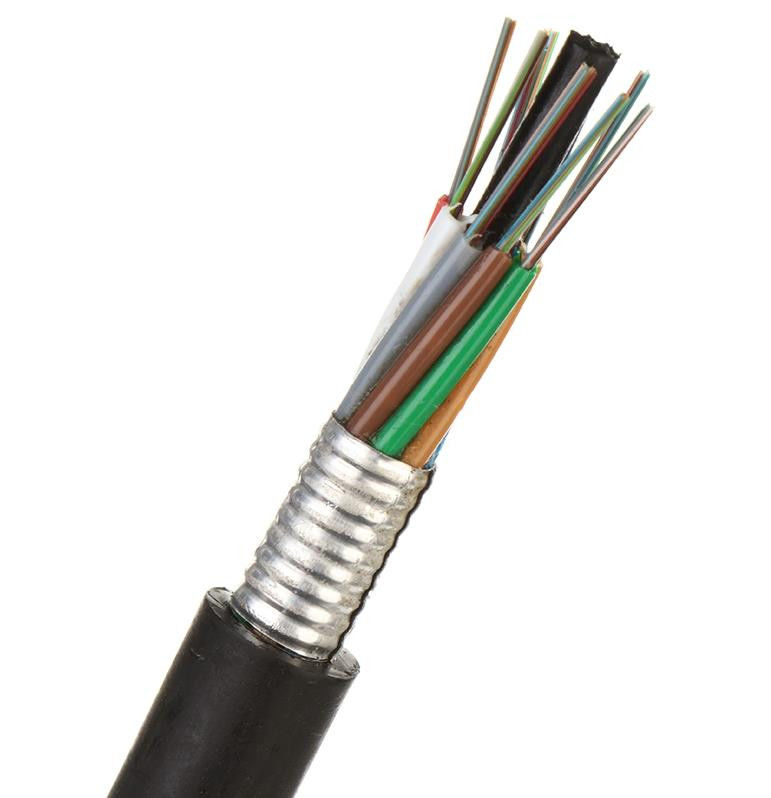
A properly designed underground armoured fibre cable incorporates several protective layers surrounding the optical fibres.
| Cable Component | Function |
|---|---|
| G652D Optical Fibres | Carry high-speed optical signals |
| Primary Fibre Coating | Protects individual glass fibres |
| Loose Tubes | Protect groups of fibres and allow controlled movement |
| Tube Filling Compound | Helps protect fibres against moisture |
| Water-Blocking Material | Restricts longitudinal water migration |
| Central Strength Member | Provides structural and tensile support |
| Cable Fillers | Maintain correct cable geometry |
| APL Moisture Barrier | Provides additional moisture protection on selected constructions |
| Inner PE Sheath | Adds structural protection |
| Corrugated Steel / Steel Tape Armour | Protects against crushing, impact and rodents |
| Outer PE Jacket | Protects the cable from soil, moisture and outdoor exposure |
| Ripcord | Helps technicians access internal cable components |
A GYTA53-style 24-core cable, for example, can incorporate central steel wire, loose tubes, aluminium tape, an inner PE jacket, steel tape armour and an outer PE jacket, a construction specifically aimed at demanding underground/direct-burial use.
GYTA53-Type Underground Cable Structure
The 24 Core Underground Armoured G652D cable is often supplied in constructions similar to GYTA53, although the exact designation should always be confirmed before ordering.
| Layer | Typical Material | Purpose |
|---|---|---|
| Optical Layer | G652D fibres | Data transmission |
| Buffer Layer | PBT loose tubes | Fibre protection |
| Core Filling | Gel / dry water block | Moisture protection |
| Strength Member | Steel wire | Tensile reinforcement |
| Moisture Barrier | Aluminium-polyethylene laminate | Water protection |
| Inner Jacket | PE | Mechanical/environmental protection |
| Armour Layer | Corrugated steel tape | Crush and rodent protection |
| Outer Jacket | PE | External protection |
Optical Characteristics of G652D Fibre
| Parameter | Typical G652D Characteristic |
|---|---|
| Fibre Mode | Singlemode |
| Core / Cladding | Approx. 9/125 µm |
| 1310 nm Operation | Excellent |
| 1550 nm Operation | Excellent |
| Low-Water-Peak Operation | Supported |
| Typical Maximum Attenuation @ 1310 nm | Around 0.35-0.40 dB/km depending on manufacturer |
| Typical Maximum Attenuation @ 1550 nm | Around 0.22-0.25 dB/km depending on manufacturer |
| Long-Distance Transmission | Excellent |
| Laser Transmission | Yes |
| Network Backbone Suitability | Excellent |
The values above are representative ranges rather than guaranteed specifications for every cable. Final design calculations should use the datasheet supplied with the exact product.
Mechanical and Environmental Performance
Armouring significantly increases the cable's suitability for demanding underground environments.
| Characteristic | Typical / Configuration-Dependent Performance |
|---|---|
| Installation Environment | Underground outdoor |
| Direct Burial | Suitable when cable is explicitly rated |
| Duct Installation | Suitable |
| Outer Sheath | PE / HDPE |
| Moisture Resistance | High |
| Armour | Steel/corrugated steel tape |
| Rodent Resistance | Improved compared with unarmoured cable |
| Crush Resistance | High |
| Tensile Strength | Model dependent |
| Minimum Bend Radius | Cable-diameter dependent |
| Operating Temperature | Commonly around -40°C to +70°C on many designs |
| UV Resistance | Outdoor-rated jacket |
| Soil Exposure | Suitable for direct-burial-rated construction |
| Cable Weight | Higher than unarmoured alternatives |
A Kenya-market 24-core armoured underground cable specifies an operating temperature of -40°C to +70°C, together with steel/corrugated armour and a moisture-resistant PE jacket.
Armoured vs Unarmoured Underground Fibre
| Feature | Armoured Fibre | Unarmoured Fibre |
|---|---|---|
| Mechanical Protection | High | Moderate |
| Crush Resistance | Higher | Lower |
| Rodent Resistance | Better with metallic armour | Limited |
| Cable Weight | Higher | Lower |
| Cable Flexibility | Generally lower | Higher |
| Direct Burial | Excellent when rated | Usually requires added protection |
| Duct Installation | Suitable | Excellent |
| Cost | Higher | Lower |
| Harsh Underground Routes | Excellent | Less suitable |
| Protected Conduits | Suitable | Excellent |
Armouring is especially valuable where the route is vulnerable to rocks, accidental digging, rodents or external mechanical forces.
Key Benefits of 24 Core Underground Armoured G652D Fibre Cable
1. Long-Distance Transmission
G652D singlemode fibre provides the low attenuation required for long-distance telecommunications and data links.
2. Heavy-Duty Armoured Protection
Steel armour provides additional resistance to crushing, impact and rodent damage.
3. High 24-Core Capacity
Twenty-four fibres provide ample capacity for multiple links, customers, buildings and network services.
4. Future Expansion
Unused fibres can remain available for expansion without requiring another excavation project.
5. Excellent Moisture Protection
Water-blocking compounds, tapes and protective sheaths help protect the optical fibres in underground environments.
6. Suitable for Direct Burial
Appropriately rated armoured constructions can be installed directly underground without an additional cable duct.
7. Excellent for ISP and FTTH Networks
G652D fibre is highly suitable for modern PON, ISP, telecommunications and access-network deployments.
8. EMI Immunity
Fibre transmits information optically, so data transmission is unaffected by electromagnetic interference.
Watch 24 Core Underground Armoured Fibre Optic Cable G652D
Watch on YouTube: https://youtu.be/xc8W4RUDoKE
The 24 Core Underground Armoured Fibre Optic Cable G652D is designed for fibre networks that require both high optical capacity and strong physical protection. Its G652D singlemode fibres offer low attenuation for long-distance transmission, while its armoured construction helps protect the cable against mechanical stress encountered in underground environments. This combination makes it particularly useful for telecommunications companies, ISPs, FTTH contractors, CCTV networks and large commercial fibre infrastructure.
Its 24 individual fibres also provide substantial flexibility when planning a network. Individual cores can be assigned to different buildings, network switches, CCTV nodes, customers or services, while others remain available as backups or for future expansion. This approach can significantly reduce future civil works because additional capacity may be activated without excavating and installing another backbone cable.
The correct underground fibre should always be selected according to the actual route. Soil conditions, duct availability, expected pulling forces, risk of crushing and whether direct burial is required all influence the cable construction needed. Fiber Optics Kenya can help customers choose the correct G652D armoured cable, closures, ODFs, pigtails and other accessories for a professional end-to-end installation.
Applications of 24 Core Underground Armoured G652D Fibre Cable
1. ISP Backbone Networks
Ideal for connecting network nodes, POP sites and distribution infrastructure through underground fibre routes.
2. FTTH Networks
Suitable for feeder and distribution sections of FTTH networks serving residential estates, apartments and commercial developments.
3. Telecommunications Networks
G652D singlemode fibre supports high-capacity and long-distance telecommunications links.
4. CCTV Surveillance Networks
The cable can connect remote CCTV switches and monitoring centres across large properties or public infrastructure.
5. Campus Networks
Connect buildings across universities, schools, hospitals, government compounds and industrial facilities.
6. Enterprise Backbone Networks
Businesses with several buildings or network zones can use underground fibre as their primary high-capacity backbone.
7. Industrial Parks
Connect warehouses, production facilities, offices and security systems across industrial developments.
8. Data Centre Connectivity
Suitable for long-distance links between data facilities and network distribution points.
9. Government Networks
Provides secure, protected underground infrastructure for government facilities and institutional networks.
10. Metropolitan Networks
Singlemode G652D fibre can form part of metro and access networks covering substantial geographic areas.
Direct Burial vs Underground Duct Installation
| Feature | Direct Burial | Duct Installation |
|---|---|---|
| Installation Method | Cable placed directly in trench | Cable installed inside conduit |
| Cable Protection Requirement | Very High | Duct provides extra protection |
| Armoured Cable | Strongly suited when rated | Can also be used |
| Future Cable Replacement | More difficult | Easier |
| Future Expansion | Requires additional civil works | Spare duct capacity can simplify expansion |
| Initial Infrastructure | Less duct infrastructure | Requires duct/conduit |
| Mechanical Exposure | Higher | Lower |
| Cable Choice | Direct-burial rated | Duct-rated outdoor cable |
G652D vs G657A Fibre
| Feature | G652D | G657A |
|---|---|---|
| Fibre Type | Standard Singlemode | Bend-Insensitive Singlemode |
| Long-Distance Backbone | Excellent | Excellent |
| FTTH Applications | Excellent | Excellent |
| Bending Performance | Standard | Better at tighter bends |
| Outside Plant Backbone | Very Common | Common |
| Indoor Drop Applications | Suitable | Often preferred |
| Compatibility | Broad | Generally compatible with G652D systems |
| Typical Strength | Long-distance network infrastructure | Access and bend-sensitive installations |
For major underground backbone routes, G652D remains an established option, while G657 fibre is particularly useful where tighter bending performance is required.
24 Core G652D vs 12 Core G652D Cable
| Feature | 12 Core | 24 Core |
|---|---|---|
| Number of Fibres | 12 | 24 |
| Maximum Conventional Duplex Pairs | 6 | 12 |
| Expansion Capacity | Moderate | High |
| Small Network | Excellent | May provide excess capacity |
| Medium Network | Excellent | Excellent |
| Large Backbone | Limited compared with 24 core | Excellent |
| Future Expansion | Good | Excellent |
| Typical Cost | Lower | Higher |
| Long-Term Scalability | Good | Very High |
For growing networks, installing 24 cores can provide valuable spare capacity at the initial civil-works stage.
Recommended Accessories
Fiber Optics Kenya can supply the cable together with complementary equipment required for the installation.
| Accessory | Purpose |
|---|---|
| Underground Fibre Joint Closure | Protects spliced fibres |
| Optical Distribution Frame (ODF) | Terminates and distributes fibre |
| SC/APC Pigtails | Common FTTH/PON termination |
| SC/UPC Pigtails | Standard singlemode termination |
| LC Pigtails | Network equipment termination |
| SC-SC Patch Cords | Fibre interconnection |
| LC-LC Patch Cords | Switch and router connections |
| LC-SC Patch Cords | Mixed connector systems |
| Fibre Adapters | Connect compatible fibre connectors |
| Fusion Splice Sleeves | Protect fusion splices |
| SFP Modules | Connect optical fibre to switches |
| SFP+ Modules | Support compatible high-speed links |
| PLC Splitters | FTTH/PON optical distribution |
| HDPE Duct | Provides additional underground protection |
| Cable Chambers | Underground access and joint locations |
| Cable Markers | Identify fibre routes |
| OTDR | Fibre testing and fault localization |
Recommended Underground Installation Practices
The cable should be installed according to the manufacturer's specified pulling tension, bend radius and crush limitations. Fibre can suffer internal damage even when the outer jacket appears intact, so excessive pulling and sharp bends should always be avoided.
For direct-burial routes, careful trench preparation can help reduce the possibility of sharp stones or other objects placing concentrated pressure on the cable. Cable markers and route documentation are also recommended to reduce accidental damage during future excavation.
Where ducts are used, adequate duct capacity, pulling rope and correctly positioned access chambers can simplify both the initial installation and future maintenance.
Why Buy from Fiber Optics Kenya?
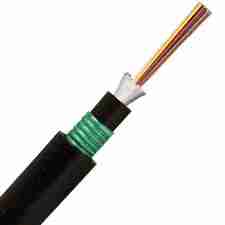
Choosing the correct underground cable requires consideration of fibre standard, distance, mechanical protection, route conditions, termination equipment and future expansion.
| Why Choose Fiber Optics Kenya? | Customer Benefit |
|---|---|
| 24 Core G652D Options | High-capacity singlemode connectivity |
| Armoured Construction | Strong underground protection |
| Direct Burial Options | Suitable solutions for demanding routes |
| Technical Guidance | Assistance selecting correct cable |
| Complete Fibre Accessories | Cable, ODFs, closures and termination products |
| ISP & FTTH Solutions | Suitable equipment for access networks |
| Bulk Supply | Ideal for contractors and major projects |
| Competitive Pricing | Cost-effective project procurement |
| Professional Installation | Installation support available |
| Fusion Splicing | Professional fibre jointing |
| OTDR Testing | Helps verify installed network performance |
| Nationwide Delivery | Supply throughout Kenya |
Frequently Asked Questions
What is a 24 Core Underground Armoured Fibre Optic Cable G652D?
It is an outdoor underground cable containing 24 G652D singlemode optical fibres protected by a heavy-duty cable structure that normally includes water blocking, PE sheathing and metallic armour.
What does G652D mean?
G652D is an ITU-T category of standard singlemode optical fibre widely used in telecommunications, ISP, FTTH and long-distance networks.
Is this cable suitable for direct burial?
Yes, provided the specific supplied construction is rated for direct burial. Underground armoured models commonly use steel tape and water-blocking construction for this purpose.
Why is the cable armoured?
Armour provides additional protection against crushing, impact, rodents and other mechanical risks associated with underground installations.
Is 24 Core Fibre suitable for an ISP?
Yes. Its high fibre count and G652D singlemode characteristics make it particularly suitable for ISP backbone and distribution networks.
Can it be used for FTTH?
Yes. It can be used in suitable feeder and distribution sections of FTTH infrastructure.
What wavelengths does G652D use?
G652D fibre is commonly used at 1310 nm and 1550 nm, among other applicable transmission windows.
Can it be installed in an underground duct?
Yes. Armoured cable can be routed through suitable telecommunications ducts as well as direct-buried when appropriately rated.
Is the cable waterproof?
Outdoor underground cables normally incorporate water-blocking components and moisture-resistant PE jackets. However, cable joints and termination points must also be properly protected.
Does the steel armour affect data transmission?
No. Data travels through the optical glass fibres rather than the surrounding armour.
How many connections can 24 fibres support?
A conventional duplex connection normally uses two fibres, meaning 24 fibres could theoretically provide 12 duplex links. Actual network architecture may allocate fibres differently.
Can some cores remain unused?
Yes. Spare fibres are commonly reserved for redundancy and future network expansion.
What is the difference between G652D and multimode fibre?
G652D is singlemode fibre intended for long-distance transmission, while multimode fibres such as OM3 and OM4 are commonly used for shorter high-speed LAN and data-centre links.
Do you supply fibre joint closures?
Yes. Fiber Optics Kenya supplies outdoor and underground fibre closures together with other fibre termination accessories.
Do you provide fusion splicing?
Yes. Professional fibre fusion splicing and testing can be provided according to project requirements.
Do you provide installation services?
Yes. Professional fibre installation can be arranged for commercial, institutional, ISP and other network projects.
Do you deliver outside Nairobi?
Yes. Fiber Optics Kenya supplies fibre optic cables and accessories to customers throughout Kenya.
Contact Fiber Optics Kenya
Fiber Optics Kenya
Lyric House
7th Floor, Room S9
Kimathi Street
Nairobi
Phone: +254 704 991 492
Email: info@fibreopticskenya.co.ke
Order 24 Core Underground Armoured Fibre Optic Cable G652D in Kenya

Choose Fiber Optics Kenya for reliable 24 Core G652D armoured underground fibre cable, compatible accessories and professional technical support.
Contact Fiber Optics Kenya today for competitive pricing, bulk orders, installation support and nationwide delivery across Kenya.