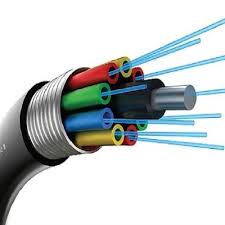
Fiber Optic Cable Prices in Kenya
24 Core Singlemode/Multimode Underground Fibre Optic Cable in Kenya
KSh 250.00
1 available
Continue shopping24 Core Singlemode/Multimode Underground Fibre Optic Cable in Kenya

The 24 Core Singlemode/Multimode Underground Fibre Optic Cable is a high-capacity outdoor fibre cable designed for underground network installations where dependable data transmission, mechanical protection and future network expansion are important. With 24 individual optical fibres, it can support multiple network links within one cable, making it suitable for ISP networks, telecommunications, FTTH distribution, CCTV backbones, campuses, data centres, industrial facilities and large enterprise networks.
The cable can be supplied with singlemode or multimode fibres depending on the required application. Singlemode versions are ideal for long-distance communications, while multimode versions are suitable for shorter high-speed links such as enterprise, campus and data-centre networks. Underground constructions commonly use loose tubes, water-blocking materials, polyethylene sheaths and, for direct-burial applications, additional armour designed to improve resistance to moisture, crushing and mechanical damage. Representative GYTA53 constructions, for example, use loose tubes, water-blocking filler, inner PE sheathing and metallic protective layers for direct-burial use.
Fiber Optics Kenya supplies 24 Core Underground Fibre Optic Cable together with compatible ODFs, pigtails, patch cords, fibre closures, splice accessories and optical networking equipment. Customers can choose the appropriate fibre type and cable construction based on transmission distance, installation route, network speed and environmental requirements.
Key Product Specifications
| Specification | Details |
|---|---|
| Product Name | 24 Core Singlemode/Multimode Underground Fibre Optic Cable |
| Cable Category | Outdoor Underground Fibre Optic Cable |
| Fibre Count | 24 Cores |
| Available Fibre Modes | Singlemode / Multimode |
| Singlemode Options | OS2 / G.652.D / other compatible grades depending on model |
| Multimode Options | OM2 / OM3 / OM4 depending on configuration |
| Singlemode Fibre Size | Approx. 8-9/125 µm |
| Multimode Fibre Size | Typically 50/125 µm for OM2, OM3 and OM4 |
| Typical Construction | Stranded or central loose tube depending on model |
| Outer Jacket | PE / HDPE depending on cable |
| Typical Jacket Colour | Black |
| Water Blocking | Yes, depending on construction |
| Armour | Armoured and non-armoured options |
| Typical Direct-Burial Armour | Steel tape / corrugated steel tape depending on model |
| Strength Member | Steel wire or FRP depending on construction |
| Installation Environment | Underground / Outdoor |
| Installation Methods | Duct, conduit or direct burial depending on cable rating |
| Applications | ISP, telecom, FTTH, CCTV, campus and backbone |
| Delivery | Nationwide across Kenya |
| Professional Installation | Available |
Singlemode vs Multimode 24 Core Underground Fibre
One of the main advantages of this product is that it can be selected according to the optical transmission requirements of the project.
| Feature | Singlemode | Multimode |
|---|---|---|
| Typical Category | OS2 | OM2 / OM3 / OM4 |
| Typical Core Diameter | Approx. 8-9 µm | 50 µm |
| Cladding Diameter | 125 µm | 125 µm |
| Typical Wavelengths | 1310 / 1550 nm | 850 / 1300 nm depending on system |
| Transmission Distance | Long | Shorter |
| Bandwidth Potential | Extremely High | High |
| ISP Networks | Excellent | Limited |
| FTTH Networks | Excellent | Not normally preferred |
| Enterprise LAN | Excellent | Excellent for shorter links |
| Campus Networks | Excellent | Excellent for suitable distances |
| Data Centres | Excellent | OM3/OM4 commonly used |
| Long-Distance Backbone | Preferred | Limited compared with singlemode |
| Future Expansion | Excellent | Excellent |
If your project involves an ISP backbone, FTTH distribution or long-distance building connections, singlemode is usually the preferred option. For shorter campus or enterprise links where compatible multimode transceivers are already deployed, multimode may provide an appropriate solution.
24 Core Underground Fibre Cable Construction
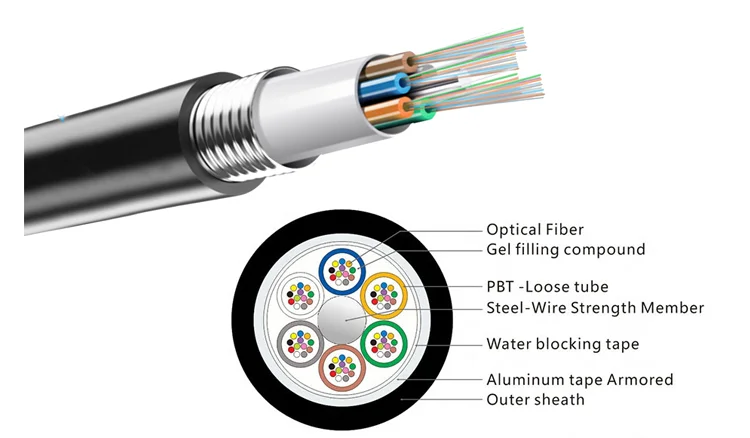
Underground cable must withstand considerably different stresses from ordinary indoor fibre. A typical direct-burial design therefore incorporates several protective layers.
| Cable Component | Purpose |
|---|---|
| Optical Fibres | Carry data as optical signals |
| Primary Fibre Coating | Protects the glass fibre |
| Loose Tubes | Protect groups of optical fibres |
| Tube Filling Compound | Provides moisture protection in selected designs |
| Water-Blocking Yarn/Tape | Helps prevent longitudinal water migration |
| Central Strength Member | Provides tensile and mechanical support |
| Cable Fillers | Maintain cable geometry |
| Inner PE Sheath | Provides additional structural protection |
| Aluminium/Steel Protective Layer | Adds moisture/mechanical protection depending on construction |
| Steel Tape Armour | Enhances resistance to crushing and external damage |
| Outer PE Sheath | Protects the cable from soil, moisture and environmental exposure |
| Ripcord | Helps technicians open the sheath during termination |
A typical GYTA53 direct-burial construction includes loose tubes around a central reinforcing member, a water-blocked cable core, an aluminium-polyethylene laminate, PE inner sheath and steel protective layer before the outer PE sheath.
Mechanical and Environmental Characteristics
Mechanical performance differs between manufacturers and underground cable designs, so final engineering should always use the datasheet of the exact cable supplied.
| Characteristic | Typical / Configuration-Dependent Description |
|---|---|
| Installation Environment | Outdoor underground |
| Duct Installation | Yes |
| Direct Burial | Yes, when specifically rated |
| Outer Sheath | PE / HDPE |
| Moisture Resistance | High with suitable water-blocked construction |
| Armour | Steel tape or other armour where specified |
| Rodent Resistance | Improved with suitable steel armour |
| Tensile Strength | Model dependent |
| Crush Resistance | Model dependent |
| Minimum Bend Radius | Specified according to cable diameter |
| Operating Temperature | Manufacturer dependent |
| Installation Temperature | Manufacturer dependent |
| Storage Temperature | Manufacturer dependent |
| Cable Weight | Construction dependent |
| Cable Diameter | Fibre count and armour dependent |
For reference, one current GYTA53 family specifies 3,000 N short-term tensile strength, 1,000 N long-term tensile strength, 3,000 N/100 mm short-term crush resistance and 1,000 N/100 mm long-term crush resistance, with an operating range of -40°C to +70°C. These figures are representative of one cable family and should not be assumed for every product.
Why Choose 24 Core Underground Fibre?
High Fibre Capacity
Twenty-four fibres provide substantial capacity for multiple links, redundancy, network segmentation and future expansion.
Suitable for Long Network Routes
Singlemode versions are particularly suitable for long-distance telecommunications, ISP, FTTH and backbone networks.
Strong Underground Protection
Armoured underground constructions can provide increased resistance to moisture, soil pressure, crushing and accidental mechanical damage.
Supports Network Expansion
Unused cores can remain available for additional services or future customers, reducing the need to excavate and install another cable later.
Immune to Electromagnetic Interference
Optical fibre transmits data using light and is unaffected by electromagnetic interference that can disrupt copper data cables.
Multiple Network Applications
A single 24-core cable can provide backbone capacity for internet, CCTV, building networks and other communications services.
Watch 24 Core Singlemode/Multimode Underground Fibre Optic Cable
Watch on YouTube: https://youtu.be/Ik4gH2kW-kE
The 24 Core Singlemode/Multimode Underground Fibre Optic Cable provides a strong foundation for underground network infrastructure where high capacity and dependable optical transmission are required. Its 24 fibres give network designers enough flexibility to allocate separate cores to buildings, customers, CCTV systems, switches or network services while preserving additional fibres for redundancy and future expansion. Underground-rated cable construction also provides the protection required when fibre is routed through external ducts, conduits or directly through the ground.
Selecting between singlemode and multimode fibre should depend on the distance and network equipment being used. Singlemode is generally recommended for long-distance ISP, telecommunications, FTTH and backbone applications, while OM2, OM3 or OM4 multimode fibre may be suitable for shorter high-speed enterprise and campus installations. Choosing the correct optical category from the beginning can help prevent compatibility problems and unnecessary infrastructure replacement later.
The underground construction is equally important. A cable intended only for an outdoor duct should not automatically be treated as a direct-burial cable. Direct-burial products normally incorporate stronger moisture barriers and mechanical protection, including steel tape armour in many designs. Fiber Optics Kenya can help customers determine the correct combination of fibre type, armour, installation method and accessories for the proposed route.
Applications of 24 Core Underground Fibre Optic Cable
1. ISP Backbone Networks
Singlemode 24-core underground fibre provides a strong backbone for internet service providers connecting distribution nodes and customer areas.
2. FTTH Networks
The cable can form part of underground feeder and distribution infrastructure serving residential estates, apartments and commercial developments.
3. Telecommunications Networks
Long-distance singlemode versions are suitable for high-capacity telecommunications infrastructure.
4. CCTV Networks
Large surveillance installations can use underground fibre to connect remote network switches and monitoring facilities.
5. Campus Networks
Connect buildings across universities, colleges, schools, hospitals and government facilities.
6. Commercial Buildings
Underground fibre can link office blocks, server rooms and network distribution points across commercial compounds.
7. Industrial Facilities
Factories, warehouses and industrial parks can use fibre for high-speed communications between facilities.
8. Data Centres
Singlemode or multimode fibre can support high-capacity links depending on distance, optical equipment and network architecture.
9. Hotels and Resorts
Connect accommodation blocks, administration buildings, CCTV systems and network infrastructure.
10. Government and County Networks
Suitable for connecting offices and facilities through protected underground communications routes.
Duct Installation vs Direct Burial
| Feature | Duct Installation | Direct Burial |
|---|---|---|
| Cable Location | Inside conduit/duct | Installed directly in ground |
| Physical Protection | Duct provides substantial protection | Cable must provide its own protection |
| Cable Armour | May not always be necessary | Often recommended/required |
| Future Replacement | Easier | More difficult |
| Expansion | New cable can potentially be pulled through duct | Requires additional excavation |
| Initial Civil Works | Higher due to duct installation | Can be lower in some projects |
| Maintenance Access | Generally easier | More difficult |
| Recommended Cable | Outdoor duct-rated fibre | Direct-burial-rated fibre |
For new installations, ducts can offer significant long-term advantages because additional cables may be installed later without reopening the entire trench.
Armoured vs Non-Armoured Underground Fibre
| Feature | Armoured Cable | Non-Armoured Cable |
|---|---|---|
| Mechanical Protection | High | Standard |
| Crush Resistance | Higher | Lower |
| Rodent Protection | Better with suitable metal armour | Limited |
| Weight | Higher | Lower |
| Flexibility | Generally lower | Higher |
| Direct Burial | Excellent when rated | Generally requires protection |
| Duct Installation | Suitable | Excellent |
| Cost | Higher | Lower |
| Recommended Environment | Harsh underground routes | Protected ducts/conduits |
Direct-burial GYFTY53-type cables, for example, are available with steel tape armour, double PE sheathing and water-blocking construction specifically intended to improve waterproofing, side-pressure resistance and mechanical strength.
Singlemode Underground Fibre Applications
| Application | Suitability |
|---|---|
| ISP Backbone | Excellent |
| FTTH Feeder Network | Excellent |
| Long-Distance Building Link | Excellent |
| Telecommunications | Excellent |
| Metro Network | Excellent |
| Large CCTV Installation | Excellent |
| Campus Backbone | Excellent |
| Long-Term Network Expansion | Excellent |
Multimode Underground Fibre Applications
| Application | Suitability |
|---|---|
| Short Campus Links | Excellent |
| Enterprise Backbone | Excellent |
| Data Centre Interconnection | Excellent when distances match standard |
| Building-to-Building LAN | Excellent within supported distances |
| CCTV Network | Excellent for suitable link lengths |
| Long-Haul ISP Backbone | Singlemode generally preferred |
Typical 24 Core Fibre Allocation
A 24-core cable does not require all fibres to be activated immediately.
| Example Allocation | Number of Fibres |
|---|---|
| Primary Network Links | 8 |
| CCTV Backbone | 4 |
| Building Connections | 4 |
| Backup / Redundancy | 4 |
| Future Expansion | 4 |
| Total | 24 |
The actual allocation should be designed according to network topology and redundancy requirements.
Underground Fibre vs Copper Cabling
| Feature | Underground Fibre | Copper Cable |
|---|---|---|
| Transmission Medium | Optical | Electrical |
| Long Distance | Excellent | Limited |
| Bandwidth Potential | Extremely High | Cable-category dependent |
| EMI Resistance | Immune | Susceptible |
| Electrical Conductivity | Optical path non-conductive | Conductive |
| Multi-Kilometre Networks | Excellent with singlemode | Not practical for standard Ethernet |
| Network Expansion | Excellent | More limited |
| Backbone Applications | Excellent | Less suitable |
| Typical Use | ISP, telecom, campus, FTTH | Local endpoint connections |
Accessories for Underground Fibre Installation
A professional fibre network requires more than just the cable.
| Accessory | Purpose |
|---|---|
| Fibre Joint Closure | Protects underground fibre splices |
| Optical Distribution Frame (ODF) | Organizes and terminates fibres |
| Fibre Patch Panel | Provides structured fibre management |
| SC/APC Pigtails | Common in FTTH/PON systems |
| SC/UPC Pigtails | Standard singlemode termination |
| LC Pigtails | Network equipment termination |
| Multimode Pigtails | Termination for OM fibre |
| Patch Cords | Connect fibre equipment |
| Fibre Adapters | Connect compatible connectors |
| Fusion Splice Sleeves | Protect fusion splices |
| SFP Modules | Connect fibre to switches |
| SFP+ Modules | Support higher-speed links |
| PLC Splitters | Used in PON distribution |
| Fibre Cable Marker | Identifies underground cable routes |
| Cable Chambers | Provide access along underground routes |
| HDPE Duct | Protects underground fibre cable |
Why Buy from Fiber Optics Kenya?

A successful underground fibre installation starts with selecting the correct cable for the route, optical distance and expected mechanical conditions. Fiber Optics Kenya can help customers source both the fibre cable and the supporting accessories needed for installation.
| Why Choose Fiber Optics Kenya? | Customer Benefit |
|---|---|
| 24 Core Options | High capacity for growing networks |
| Singlemode Options | Ideal for long-distance networks |
| Multimode Options | Suitable for shorter high-speed links |
| Armoured Cable Options | Increased underground protection |
| Technical Guidance | Assistance with correct cable selection |
| Complete Fibre Accessories | Source related equipment together |
| Competitive Pricing | Suitable for different project budgets |
| Bulk Supply | Ideal for ISPs and contractors |
| Professional Installation | Installation support available |
| Fusion Splicing | Professional fibre jointing |
| OTDR Testing | Helps verify completed installations |
| Nationwide Delivery | Supply to projects throughout Kenya |
Frequently Asked Questions
What is 24 Core Underground Fibre Optic Cable?
It is an outdoor fibre cable containing 24 individual optical fibres and designed for protected underground network installations.
Is it available in both singlemode and multimode?
Yes. Depending on the selected product, 24-core underground cable can be supplied with singlemode or multimode fibres.
Which is better, singlemode or multimode?
Neither is universally better. Singlemode is generally preferred for long-distance networks, while multimode is suitable for shorter high-speed connections.
What singlemode fibre type should I choose?
OS2/G.652.D is commonly used for outdoor and long-distance network applications.
What multimode types are available?
Depending on the manufacturer, options may include OM2, OM3 and OM4.
Can 24 Core Fibre be used for FTTH?
Yes. Singlemode 24-core fibre can be used in FTTH feeder and distribution infrastructure.
Can it be used for CCTV?
Yes. The cable can provide a high-capacity backbone for large IP CCTV networks.
Can this cable be buried directly in the soil?
Only if the exact cable is specifically rated for direct burial. Direct-burial designs use additional protection against moisture and mechanical stress.
Can it be installed inside underground ducts?
Yes. Appropriate outdoor fibre can be installed through HDPE or other telecommunications ducts.
Why choose armoured underground cable?
Armour provides additional protection against crushing, rodents and other mechanical risks.
How many duplex connections can 24 cores support?
If each conventional duplex connection uses two fibres, 24 fibres can theoretically support 12 duplex links.
Can spare fibres be left unused?
Yes. Leaving spare cores provides capacity for redundancy and future network expansion.
Do you supply underground fibre accessories?
Yes. Fiber Optics Kenya can supply ODFs, closures, pigtails, patch cords, adapters, SFP modules, splice accessories and other fibre equipment.
Do you provide fibre installation?
Yes. Professional installation, fusion splicing and testing can be arranged according to project requirements.
Do you deliver outside Nairobi?
Yes. Fiber Optics Kenya supplies fibre optic cables and accessories to customers throughout Kenya.
Contact Fiber Optics Kenya
Fiber Optics Kenya
Lyric House
7th Floor, Room S9
Kimathi Street
Nairobi
Phone: +254 704 991 492
Email: info@fibreopticskenya.co.ke
Order 24 Core Singlemode/Multimode Underground Fibre Optic Cable in Kenya

Choose Fiber Optics Kenya for reliable 24 Core Singlemode/Multimode Underground Fibre Optic Cable, compatible accessories and professional technical support.
Contact Fiber Optics Kenya today for competitive pricing, bulk orders, installation assistance and nationwide delivery across Kenya.