Fiber Optic Cable Prices in Kenya
24 Core Multimode/Singlemode Outdoor Fibre Cable in Kenya
KSh 270.00
1 available
Continue shopping24 Core Multimode/Singlemode Outdoor Fibre Cable in Kenya
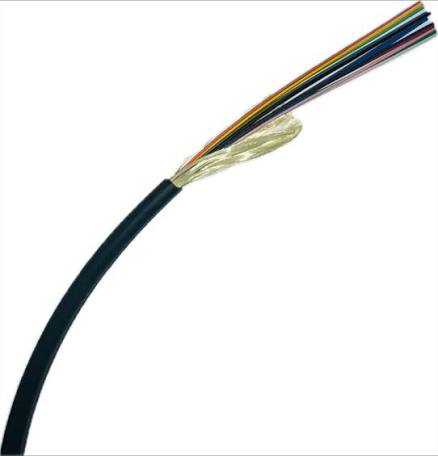
The 24 Core Multimode/Singlemode Outdoor Fibre Cable is a versatile high-capacity fibre optic cable designed for outdoor network infrastructure where multiple optical links are required within a single cable. Depending on the selected configuration, the cable can be supplied with singlemode fibres, multimode fibres, or a composite combination of both fibre types, allowing network designers to support long-distance backbone links and shorter high-speed LAN connections within the same overall cable system.
Modern 24-core outdoor fibre cables commonly use stranded loose-tube construction, water-blocking elements, durable black outdoor jackets and appropriate strength members. CommScope currently offers 24-fibre indoor/outdoor composite cables containing both singlemode and multimode fibres in a stranded loose-tube design, while Corning offers 24-fibre outdoor loose-tube singlemode cable for duct and lashed-aerial applications.
At Fiber Optics Kenya, customers can source 24 Core Multimode/Singlemode Outdoor Fibre Cable for corporate campuses, schools, hospitals, industrial facilities, CCTV networks, ISP infrastructure, data centres, government facilities and commercial properties. We can also supply compatible fibre ODFs, pigtails, patch cords, closures, adapters, SFP modules and professional fibre installation support.
Key Product Specifications
| Specification | Details |
|---|---|
| Product Name | 24 Core Multimode/Singlemode Outdoor Fibre Cable |
| Fibre Count | 24 Cores |
| Available Fibre Modes | Singlemode / Multimode / Composite SM+MM |
| Singlemode Category | Typically OS2 |
| Common Singlemode Standard | ITU-T G.652.D |
| Multimode Options | OM1 / OM2 / OM3 / OM4 depending on configuration |
| Singlemode Core/Cladding | Approx. 8-9/125 µm |
| OM2 / OM3 / OM4 | 50/125 µm |
| Typical Cable Construction | Stranded Loose Tube |
| Cable Geometry | Round |
| Water Blocking | Gel-free or gel-filled depending on cable |
| Strength Member | FRP or metallic depending on construction |
| Outer Jacket | Outdoor PE/HDPE or rated indoor/outdoor jacket |
| Typical Jacket Colour | Black |
| Armour | Armoured and non-armoured options available |
| Installation Methods | Duct, conduit, lashed aerial or other rated outdoor route |
| Direct Burial | Only when specifically rated |
| Applications | LAN, CCTV, ISP, telecom, campus and backbone |
| Professional Installation | Available |
| Delivery | Available throughout Kenya |
CommScope lists a current 24-fibre multimode/singlemode composite cable with stranded loose-tube construction and black outer jacket, demonstrating that both optical fibre types can be combined within a single 24-fibre cable design.
Singlemode vs Multimode Fibre
The most important decision when choosing this cable is whether the project requires singlemode, multimode or a composite combination.
| Feature | Singlemode | Multimode |
|---|---|---|
| Typical Category | OS2 | OM1 / OM2 / OM3 / OM4 |
| Typical Core Size | Approx. 8-9 µm | 50 µm for OM2/OM3/OM4 |
| Cladding Diameter | 125 µm | 125 µm |
| Common Wavelengths | 1310 / 1550 nm | 850 / 1300 nm |
| Transmission Distance | Long | Shorter |
| ISP Backbone | Excellent | Usually not preferred |
| FTTH | Excellent | Not typical |
| Enterprise LAN | Excellent | Excellent |
| Campus Network | Excellent | Excellent |
| Data Centre | Excellent | Excellent |
| Long-Distance Building Link | Preferred | Distance dependent |
| Short High-Speed Link | Excellent | Excellent |
| Typical Optical Modules | Singlemode SFP/SFP+ | Multimode SFP/SFP+ |
For long-distance outdoor routes, singlemode OS2 is generally preferred, while multimode is often useful for shorter campus, building and enterprise network links.
What Is a Composite Singlemode/Multimode Cable?

A composite fibre cable contains both singlemode and multimode fibres inside one cable.
| Composite Cable Benefit | Explanation |
|---|---|
| Mixed Network Support | Carries both SM and MM connections |
| Single Cable Route | Reduces the need to install separate cables |
| Long + Short Distance Services | Supports different optical requirements |
| Network Flexibility | Useful for mixed legacy and modern networks |
| Future Expansion | Spare fibres can be allocated later |
| Infrastructure Consolidation | Simplifies shared backbone routes |
CommScope currently lists 24-fibre indoor/outdoor cable configurations containing G.652.D/G.657.A1 singlemode plus multimode fibres such as OM1 or OM3, confirming that hybrid 24-fibre cable designs are commercially available.
24 Core Outdoor Fibre Cable Construction
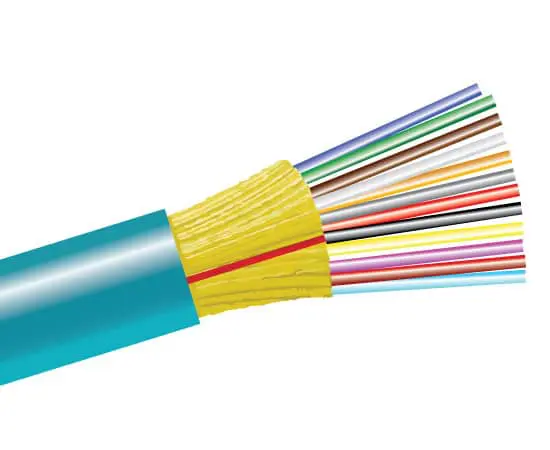
A typical 24-core outdoor fibre cable protects its optical fibres using several mechanical and environmental layers.
| Cable Component | Purpose |
|---|---|
| Optical Fibres | Carry data using light |
| Primary Fibre Coating | Protects each glass fibre |
| Loose Tubes | Organise and protect groups of fibres |
| Tube Filling / Dry Blocking | Helps control moisture |
| Central Strength Member | Adds structural support |
| Water-Blocking Yarn/Tape | Restricts longitudinal moisture migration |
| Cable Fillers | Maintain cable geometry |
| Inner Jacket | Used in selected double-jacket constructions |
| Armour | Adds mechanical protection on armoured variants |
| Outer Jacket | Protects cable from outdoor conditions |
| Ripcord | Helps technicians access internal components |
Corning's outdoor 24-fibre loose-tube cable is designed for duct and lashed aerial backbone installation, while armoured versions add corrugated metallic protection for more demanding routes.
Typical 24 Core Fibre Arrangement
A 24-core cable is commonly arranged in groups such as 2 × 12 fibres or several smaller loose-tube groups depending on the manufacturer.
| Example Arrangement | Fibre Count |
|---|---|
| Tube 1 | 12 Fibres |
| Tube 2 | 12 Fibres |
| Total | 24 Fibres |
For singlemode Corning outdoor loose-tube cable, current 24-fibre designs are available in 2 × 12 fibre arrangements.
Singlemode G652D Technical Characteristics
| Parameter | Representative G652D / OS2 Value |
|---|---|
| Fibre Type | Singlemode |
| Fibre Standard | ITU-T G.652.D |
| Core Diameter | Approx. 8.2 µm on representative product |
| Cladding Diameter | 125 µm |
| Mode Field Diameter @ 1310 nm | Approx. 9.2 µm |
| Wavelengths | 1310 / 1383 / 1550 nm |
| Maximum Attenuation @ 1310 nm | Approx. 0.36 dB/km* |
| Maximum Attenuation @ 1550 nm | Approx. 0.22 dB/km* |
| Long-Distance Capability | Excellent |
| ISP / Telecom Use | Excellent |
| Backbone Use | Excellent |
*Representative values from a current Corning 24-fibre G.652.D OS2 outdoor cable.
Multimode Fibre Options
Depending on the selected product, outdoor 24-core cable can be supplied with several multimode categories.
| Fibre Category | Core / Cladding | Typical Positioning |
|---|---|---|
| OM1 | 62.5/125 µm | Legacy multimode networks |
| OM2 | 50/125 µm | Standard multimode LAN |
| OM3 | 50/125 µm | Laser-optimized high-speed LAN |
| OM4 | 50/125 µm | Higher-bandwidth enterprise/data centre |
Corning and CommScope both currently list loose-tube indoor/outdoor cables with multimode options including OM2, OM3 and OM4, while CommScope also offers composite singlemode/multimode designs.
OM2 vs OM3 vs OM4
| Feature | OM2 | OM3 | OM4 |
|---|---|---|---|
| Core / Cladding | 50/125 µm | 50/125 µm | 50/125 µm |
| Laser Optimized | Limited compared with OM3/OM4 | Yes | Yes |
| Network Performance | Good | High | Very High |
| 10GbE Suitability | Shorter distances | Excellent | Excellent |
| 40G/100G Short Reach | Limited | Supported with suitable optics | Better reach/headroom |
| Enterprise Network | Good | Excellent | Excellent |
| Data Centre | Legacy/moderate | Excellent | Excellent |
| Upgrade Potential | Moderate | High | Very High |
For a new multimode network requiring high-speed Ethernet, OM3 or OM4 will generally provide more upgrade headroom than OM2.
24 Core Fibre Capacity
A 24-core cable can support several network links while retaining spare fibres.
| Example Allocation | Number of Fibres |
|---|---|
| Primary Backbone | 4 |
| Secondary Building Link | 4 |
| CCTV Network | 4 |
| Data / LAN Services | 4 |
| Backup / Redundancy | 4 |
| Future Expansion | 4 |
| Total | 24 |
If a traditional duplex connection uses two fibres, 24 fibres can theoretically provide up to 12 duplex links.
Composite installations may instead dedicate certain fibres to singlemode services and others to multimode services.
Key Benefits of 24 Core Multimode/Singlemode Outdoor Fibre Cable
Flexible Fibre Options
The cable can be selected with singlemode, multimode or mixed fibre types depending on network requirements.
High 24-Core Capacity
Twenty-four fibres provide enough capacity for multiple buildings, switches, network services and spare connections.
Outdoor Protection
Loose-tube construction, moisture blocking and durable outer jackets help protect fibres in outdoor environments.
Suitable for Multiple Network Types
One cable family can support campus, enterprise, ISP, CCTV and telecommunications applications.
Future Expansion
Unused fibres can be retained for network growth, redundancy or additional services.
Consolidated Network Infrastructure
Composite versions can carry both long-distance singlemode links and shorter multimode connections along the same cable route.
Watch 24 Core Multimode/Singlemode Outdoor Fibre Cable
Watch on YouTube: https://youtu.be/DOqs0frlE4M
The 24 Core Multimode/Singlemode Outdoor Fibre Cable is a practical choice for network projects requiring flexibility across different optical transmission requirements. Singlemode fibres can serve long-distance links between buildings, network nodes or telecommunications facilities, while multimode fibres can support shorter high-speed enterprise and campus connections. Composite 24-fibre cables that combine both fibre modes are commercially available, helping organisations consolidate different network services into one cable route.
Its 24-core capacity provides room for multiple network services as well as spare fibres for redundancy and future expansion. For example, some fibres can be allocated to CCTV infrastructure, others to building LAN connections and additional fibres retained for future upgrades. This can be more economical than repeatedly installing additional cable whenever the network grows.
The physical construction should be selected according to the actual installation route. Outdoor duct, aerial, armoured and direct-burial cables have different mechanical requirements, and the term "outdoor" alone does not mean every cable is suitable for every route. Fiber Optics Kenya can help customers select the correct combination of fibre type, cable construction, ODFs, pigtails, closures and optical transceivers for the project.
Applications of 24 Core Multimode/Singlemode Outdoor Fibre Cable
1. Campus Networks
Connect several school, university, hospital or corporate buildings over one high-capacity backbone.
2. Enterprise Networks
Provide fibre connections between server rooms, switches, telecommunications rooms and remote buildings.
3. CCTV Networks
Use optical fibre to connect distributed CCTV switches and surveillance zones to central monitoring systems.
4. ISP Infrastructure
Singlemode versions can provide access and backbone connectivity over longer outdoor routes.
5. Building-to-Building Networks
Connect nearby or distant buildings according to the selected fibre type and optics.
6. Industrial Facilities
Fibre provides high-speed communications while remaining immune to electromagnetic interference.
7. Data Centres
Multimode OM3/OM4 or singlemode OS2 can support data-centre connectivity depending on architecture.
8. Hotels and Resorts
Connect accommodation blocks, CCTV infrastructure, Wi-Fi systems and administration facilities.
9. Government Facilities
Suitable for high-capacity network infrastructure connecting several offices or buildings.
10. Hospitals
Provide backbone connectivity between departments, server rooms, diagnostic facilities and buildings.
Singlemode vs Multimode for Building-to-Building Networks
| Requirement | Recommended Fibre |
|---|---|
| Short Building Link | Multimode or Singlemode |
| Medium Distance | Often Singlemode |
| Long Distance | Singlemode |
| Existing OM Infrastructure | Match existing multimode |
| New High-Speed LAN | OM3 / OM4 or OS2 |
| ISP / Telecom Link | Singlemode |
| Data Centre Extension | OM3 / OM4 or OS2 depending on design |
Armoured vs Non-Armoured Outdoor Cable
| Feature | Armoured | Non-Armoured |
|---|---|---|
| Mechanical Protection | Higher | Standard |
| Crush Resistance | Higher | Lower |
| Rodent Protection | Improved with suitable armour | Limited |
| Cable Weight | Higher | Lower |
| Flexibility | Generally lower | Higher |
| Duct Installation | Suitable | Excellent |
| Direct Burial | When specifically rated | Only if specifically rated |
| Harsh Outdoor Routes | Excellent | Less suitable |
| Cost | Generally higher | Lower |
Corning's 24-fibre armoured loose-tube design uses corrugated armour around the cable core, while non-armoured outdoor cable families use lighter dielectric constructions.
Outdoor Duct vs Aerial vs Direct Burial
| Installation | Cable Requirement |
|---|---|
| Outdoor Duct | Outdoor-rated duct cable |
| Lashed Aerial | Cable rated for lashed aerial use |
| Self-Supporting Aerial | ADSS or Figure-8 type cable |
| Direct Burial | Direct-burial-rated armoured construction |
| Indoor/Outdoor Transition | Dual-rated cable where appropriate |
The specific cable rating should always be verified before installation.
Compatible Fibre Optic Accessories
| Accessory | Purpose |
|---|---|
| 24 Core ODF | Terminates and organises all fibres |
| Fibre Patch Panel | Rack-mounted fibre management |
| Singlemode Pigtails | Termination of OS2 fibres |
| Multimode Pigtails | Termination of OM fibres |
| SC/APC Pigtails | Common PON/FTTH termination |
| SC/UPC Pigtails | Standard singlemode termination |
| LC Pigtails | Network equipment termination |
| LC-LC Patch Cords | Switch and equipment connections |
| SC-SC Patch Cords | Structured fibre connections |
| Fibre Adapters | Join compatible connectors |
| Fibre Joint Closure | Protect outdoor fibre splices |
| Fusion Splice Sleeves | Protect completed splices |
| SFP/SFP+ Modules | Connect fibre to switches |
| Media Converters | Copper-to-fibre conversion |
| OTDR | Test fibre links and locate faults |
Why Buy from Fiber Optics Kenya?
Selecting between multimode and singlemode fibre requires careful consideration of network distance, speed, existing transceivers, installation environment and future expansion.
| Why Choose Fiber Optics Kenya? | Customer Benefit |
|---|---|
| 24 Core Solutions | High-capacity outdoor networking |
| Singlemode Options | Excellent for long-distance links |
| Multimode Options | Ideal for compatible LAN applications |
| Composite Options | Combine fibre modes where required |
| Technical Guidance | Assistance selecting the correct fibre |
| Outdoor Cable Options | Duct, aerial and armoured solutions |
| Complete Accessories | ODFs, pigtails, patch cords and closures |
| Bulk Supply | Suitable for contractors and institutions |
| Competitive Pricing | Cost-effective network procurement |
| Professional Installation | Installation assistance available |
| Fusion Splicing | Professional fibre termination |
| OTDR Testing | Verify installed fibre performance |
| Nationwide Delivery | Supply across Kenya |
Frequently Asked Questions
What is a 24 Core Multimode/Singlemode Outdoor Fibre Cable?
It is an outdoor cable containing 24 optical fibres that can be configured as singlemode, multimode or, on suitable composite products, a mixture of both fibre types.
Can one cable contain both singlemode and multimode fibres?
Yes. Commercial 24-fibre composite cables containing both singlemode and multimode fibres are available.
Which is better, singlemode or multimode?
Neither is universally better. Singlemode is preferred for long-distance connections, while multimode is commonly used for shorter LAN and data-centre links.
What singlemode fibre is commonly used?
OS2 fibre compliant with ITU-T G.652.D is commonly used in outdoor backbone installations.
Which multimode types can be used?
Depending on cable manufacturer and construction, multimode options can include OM1, OM2, OM3 and OM4.
How many duplex links can 24 fibres provide?
With conventional two-fibre duplex links, 24 fibres can theoretically provide 12 duplex connections.
Can it be used for CCTV?
Yes. Singlemode or multimode fibre can be used as a CCTV backbone, depending on distance and optical equipment.
Can it be used for an ISP?
Yes. Singlemode configurations are especially suitable for ISP access and backbone networks.
Can it connect two buildings?
Yes. The correct fibre type should be selected based on distance, network speed and transceivers.
Is this cable waterproof?
Outdoor cable commonly incorporates gel or dry water-blocking components, but the precise protection depends on the particular construction.
Can it be installed underground?
Yes, in a suitable duct. Direct burial requires a cable specifically rated for direct burial.
Can it be installed aerially?
Yes, when the particular cable is rated for aerial installation. Corning's outdoor loose-tube family, for example, supports lashed aerial and duct installation.
Is armoured cable available?
Yes. Armoured 24-fibre outdoor cable is available for applications requiring increased mechanical protection.
Do you provide fibre splicing?
Yes. Professional fusion splicing and termination can be provided according to project requirements.
Do you provide testing?
Yes. Fibre testing and OTDR services can be incorporated into professional installations.
Do you deliver outside Nairobi?
Yes. Fiber Optics Kenya supplies fibre optic products and accessories throughout Kenya.
Contact Fiber Optics Kenya
Fiber Optics Kenya
Lyric House
7th Floor, Room S9
Kimathi Street
Nairobi
Phone: +254 704 991 492
Email: info@fibreopticskenya.co.ke
Order 24 Core Multimode/Singlemode Outdoor Fibre Cable in Kenya

Choose Fiber Optics Kenya for reliable 24 Core Multimode/Singlemode Outdoor Fibre Cable, compatible accessories and professional technical support.
Contact Fiber Optics Kenya today for competitive pricing, bulk orders, installation support and nationwide delivery across Kenya.