Fibre Termination Boxes Price in Kenya
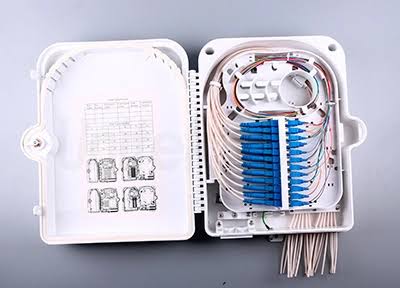
24 Core Fibre Distribution/Termination Box FTB in Kenya
KSh 6,800.00
1 available
Continue shopping24 Core Fibre Distribution/Termination Box FTB in Kenya

The 24 Core Fibre Distribution/Termination Box FTB is a compact fibre optic enclosure designed for the termination, fusion splicing, distribution, protection and management of up to 24 optical fibres. It provides a centralized point where incoming feeder or distribution cables can be connected to pigtails, adapters, splitters and outgoing drop fibres.
In FTTH and FTTx networks, the FTB can act as the transition point between a feeder fibre cable and multiple subscriber drop cables. Depending on the particular model, it can accommodate up to 24 SC simplex connections or as many as 48 fibres when using higher-density LC configurations. Some 24-core boxes also provide dedicated mounting positions for PLC splitters, allowing splitting, splicing and distribution to take place within the same enclosure.
At Fiber Optics Kenya, the 24 Core Fibre Distribution/Termination Box FTB is suitable for ISPs, fibre installers, telecommunications contractors, apartments, commercial buildings, offices, campuses and residential FTTH projects. It can be supplied alongside compatible adapters, pigtails, patch cords, PLC splitters, FTTH drop cables, splice sleeves and fibre installation accessories.
Key Product Specifications
| Specification | Details |
|---|---|
| Product Name | 24 Core Fibre Distribution/Termination Box FTB |
| Product Category | Fibre Distribution / Termination Box |
| Abbreviation | FTB |
| Maximum Fibre Capacity | Up to 24 fibres |
| Typical SC Capacity | Up to 24 SC simplex |
| Possible LC Capacity | Up to 48 fibres on compatible models |
| SC/APC Compatible | Yes |
| SC/UPC Compatible | Yes |
| LC Compatible | Yes on compatible models |
| FC/ST Compatibility | Model dependent |
| Fusion Splicing | Supported |
| Mechanical Splicing | Model dependent |
| Pigtail Termination | Supported |
| PLC Splitter Support | Available |
| Typical Splitter Options | 1×16 or multiple 1×8 depending on model |
| Splice Tray | Integrated |
| Fibre Slack Storage | Yes |
| Drop Cable Management | Yes |
| Typical Housing Material | ABS / PC+ABS |
| Indoor Use | Yes |
| Outdoor Use | Yes on outdoor-rated models |
| Wall Mounting | Yes |
| Pole Mounting | Available on compatible models |
| Typical Protection | Up to IP65/IP66 depending on model |
| Electrical Power Required | No |
| Applications | FTTH, FTTB, FTTx, GPON, EPON, LAN, CATV |
| Delivery | Available throughout Kenya |
One current 24-core distribution box uses PC+ABS construction, supports 24 SC or 48 LC connections, provides PLC splitter mounting and reaches IP66 protection.
What Is a 24 Core Fibre Distribution/Termination Box?
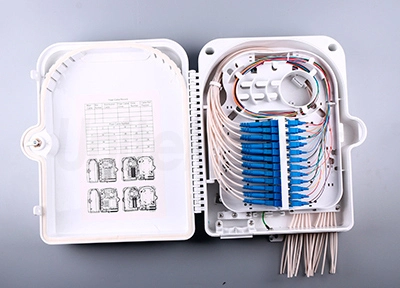
A 24 Core FTB is essentially a protected fibre-management point where optical fibres can be spliced, terminated and distributed.
| Internal Component | Purpose |
|---|---|
| FTB Enclosure | Protects internal fibre components |
| Feeder Cable Entry | Receives incoming cable |
| Cable Clamp | Secures incoming fibre cable |
| Strength Member Fixing | Provides mechanical support |
| Splice Tray | Organizes fusion splices |
| Adapter Panel | Holds optical adapters |
| Pigtails | Provides connectorized termination |
| PLC Splitter Position | Allows passive signal splitting |
| Fibre Routing Guides | Controls fibre routing |
| Slack Storage | Stores excess fibre |
| Drop Cable Ports | Routes downstream connections |
| Protective Cover | Prevents accidental damage |
A 24-core FTB can therefore perform splicing, splitting and distribution within a single enclosure, reducing the number of separate fibre-management components required at the distribution point.
What Does FTB Mean?
FTB commonly means Fibre Terminal Box or Fiber Termination Box.
| Term | Meaning |
|---|---|
| FTB | Fibre/Fiber Termination Box |
| 24 Core | Capacity for up to 24 fibres |
| FTTH | Fibre to the Home |
| FTTB | Fibre to the Building |
| FTTx | Fibre to various endpoints |
| PON | Passive Optical Network |
| GPON | Gigabit Passive Optical Network |
| EPON | Ethernet Passive Optical Network |
| PLC | Planar Lightwave Circuit |
| ODF | Optical Distribution Frame |
How a 24 Core FTB Works
The FTB creates an organized transition between the incoming network cable and downstream fibre connections.
| Stage | Function |
|---|---|
| Incoming Fibre Cable | Carries network signal |
| Cable Entry | Routes cable into FTB |
| Cable Fixing | Provides mechanical protection |
| Individual Fibres | Separated and identified |
| Fusion Splicing | Joins fibres to pigtails |
| Splice Sleeves | Protect completed joints |
| Splice Tray | Organizes fibre splices |
| Pigtails | Route signals to adapters |
| Adapters | Provide connectorized interfaces |
| Patch/Drop Cables | Continue network connection |
24 Core Fibre Capacity
A standard 24-core box can provide up to 24 individual single-fibre termination positions.
| Port Group | Fibre Allocation |
|---|---|
| Ports 1–6 | Fibres 1–6 |
| Ports 7–12 | Fibres 7–12 |
| Ports 13–18 | Fibres 13–18 |
| Ports 19–24 | Fibres 19–24 |
One commercial FTB0224B configuration provides 24-core single-fibre capacity, a 24-SC-simplex adapter panel, two input ports and 24 output ports.
SC Adapter Configuration
SC connectors are among the most common interfaces used with 24-core FTBs.
| Specification | Typical Configuration |
|---|---|
| Adapter Type | SC Simplex |
| Maximum Positions | 24 |
| SC/UPC | Supported |
| SC/APC | Supported |
| Single Mode | Supported |
| Multimode | Supported with correct components |
| FTTH | Excellent |
| Telecom Networks | Excellent |
The standard adapter panel on one current 24-core FTB accommodates 24 SC simplex ports.
SC/UPC Configuration
| Feature | SC/UPC |
|---|---|
| Typical Colour | Blue |
| Polish | Ultra Physical Contact |
| Connector Format | SC |
| Single Mode | Common |
| FTTH Use | Supported |
| Enterprise Networks | Excellent |
| Patchability | Excellent |
SC/APC Configuration
| Feature | SC/APC |
|---|---|
| Typical Colour | Green |
| Polish | Angled Physical Contact |
| Connector Format | SC |
| Single Mode | Common |
| GPON | Excellent |
| FTTH | Excellent |
| CATV | Excellent |
SC/APC vs SC/UPC
| Feature | SC/APC | SC/UPC |
|---|---|---|
| Typical Colour | Green | Blue |
| Polish | Angled | Ultra Physical Contact |
| Back Reflection | Lower | Low |
| FTTH / GPON | Very Common | Supported |
| CATV | Excellent | Less Preferred |
| Enterprise LAN | Application dependent | Excellent |
| Direct APC/UPC Mating | No | No |
The polish type should remain consistent across adapters, pigtails and patch cords.
LC Adapter Configuration
LC connectors provide greater fibre density than SC.
| Feature | LC |
|---|---|
| Connector Size | Compact |
| Port Density | High |
| Single Mode | Supported |
| Multimode | Supported |
| Duplex Connections | Common |
| Enterprise Networks | Excellent |
| Data Networks | Excellent |
A 24-core FTB design can support 24 SC or up to 48 LC connections, depending on its adapter-panel configuration.
Fibre Splicing Inside the FTB
Fusion splicing is one of the primary functions of the box.
| Step | Procedure |
|---|---|
| 1 | Open FTB |
| 2 | Route incoming fibre cable |
| 3 | Secure cable |
| 4 | Prepare cable sheath |
| 5 | Identify individual fibres |
| 6 | Strip fibre coating |
| 7 | Cleave fibre |
| 8 | Fusion splice to pigtail |
| 9 | Install splice protection sleeve |
| 10 | Store splice in tray |
| 11 | Route pigtail |
| 12 | Connect pigtail to adapter |
| 13 | Label port |
| 14 | Test optical performance |
24 Core Splice Tray
The splice tray provides protected storage for fusion joints.
| Splice Tray Feature | Benefit |
|---|---|
| 24-Fibre Capacity | Matches FTB capacity |
| Splice Sleeve Holders | Secures completed splices |
| Routing Channels | Organizes fibres |
| Bend Radius Control | Reduces fibre damage |
| Hinged Design | Easier maintenance |
| Numbered Positions | Simplifies identification |
Some compact FTB designs come pre-installed with a single 24-core splice tray.
PLC Splitter Compatibility
Many 24-core fibre distribution boxes can accommodate PLC splitters.
| Splitter Configuration | Number of Outputs |
|---|---|
| 1×2 | 2 |
| 1×4 | 4 |
| 1×8 | 8 |
| 1×16 | 16 |
| 2 × 1×8 | 16 |
| 3 × 1×8 | 24 |
A commercial 24-core FTB supports one 1×16 PLC splitter or two 1×8 steel-tube splitters, while another larger 24-core design supports one 1×16 or three 1×8 splitters.
FTB with PLC Splitter vs Standard FTB
| Feature | Standard FTB | Splitter-Equipped FTB |
|---|---|---|
| Fibre Splicing | Yes | Yes |
| Termination | Yes | Yes |
| Adapters | Yes | Yes |
| Signal Splitting | No | Yes |
| FTTH Distribution | Good | Excellent |
| Point-to-Point Networks | Excellent | Application dependent |
| PON Networks | Good | Excellent |
Empty vs Loaded 24 Core FTB
| Feature | Empty FTB | Loaded FTB |
|---|---|---|
| Enclosure | Included | Included |
| Splice Tray | Usually Included | Included |
| Adapters | Usually Separate | Included |
| Pigtails | Usually Separate | Included |
| PLC Splitter | Separate | May Be Included |
| Customization | Excellent | Moderate |
| Installation Speed | Slower | Faster |
| Field Assembly | Higher | Lower |
Some FTB-24 products are intentionally sold without adapters, pigtails or splitters so installers can configure them for their particular network.
Indoor vs Outdoor 24 Core FTB
| Feature | Indoor FTB | Outdoor FTB |
|---|---|---|
| Weather Protection | Basic | Higher |
| Dust Protection | Moderate | High |
| Water Resistance | Limited | IP-rated |
| UV Resistance | Less Important | Important |
| Wall Mounting | Common | Common |
| Pole Mounting | Less Common | Available |
| FTTH Building Use | Excellent | Excellent |
| Outside Plant Use | No | Excellent |
IP65/IP66 Outdoor 24 Core FTB
Outdoor versions provide greater protection against environmental exposure.
| Feature | Benefit |
|---|---|
| Sealed Housing | Protects internal components |
| Dust Resistance | Improves reliability |
| Water Resistance | Suitable for outdoor networks |
| UV-Resistant Material | Improves outdoor durability |
| Cable Seals | Reduce water ingress |
| Lockable Cover | Improves security |
| Pole Mounting | Flexible deployment |
One current 24-core distribution box uses a fully enclosed PC+ABS housing with protection up to IP66, while other 24-port models use IP65 housings.
Wall-Mounted 24 Core FTB
Wall mounting is common in apartment corridors, telecom rooms, offices and building exteriors.
| Benefit | Description |
|---|---|
| Space Saving | Does not require a rack |
| Accessible | Easy technician access |
| Compact | Suitable for corridors |
| Secure | Lockable models available |
| Flexible | Indoor/outdoor models available |
| Organized | Centralized fibre management |
Pole-Mounted 24 Core FTB
Outdoor FTBs can also be installed on telecommunications poles.
A 24-core FTB with both wall-mounted and pole-mounted installation options is useful for aerial FTTH networks where the fibre distribution point needs to be positioned close to subscriber clusters.
24 Core FTB vs 16 Core FTB
| Feature | 16 Core | 24 Core |
|---|---|---|
| Fibre Capacity | 16 | 24 |
| Relative Capacity | Lower | 50% Higher |
| Small FTTH Cluster | Excellent | Excellent |
| Apartment Building | Good | Excellent |
| ISP Distribution | Good | Excellent |
| Expansion Capacity | Moderate | Higher |
24 Core FTB vs 48 Core FTB
| Feature | 24 Core | 48 Core |
|---|---|---|
| Fibre Capacity | 24 | 48 |
| Physical Size | Smaller | Larger |
| Fibre Management | Simpler | More Complex |
| Medium Distribution Point | Excellent | Good |
| Large ISP Node | Good | Excellent |
| Expansion Capacity | Good | Higher |
24 Core FTB vs ODF
| Feature | 24 Core FTB | Optical Distribution Frame |
|---|---|---|
| Typical Mounting | Wall / Pole | Rack / Wall |
| Capacity | Small to Medium | Medium to High |
| Outdoor Models | Common | Less Common |
| Fusion Splicing | Yes | Yes |
| Adapters | Yes | Yes |
| PLC Splitter Support | Common | Possible |
| FTTH Last-Mile Distribution | Excellent | Good |
| Data Centre Use | Limited | Excellent |
A 24-core rack-mount ODF is typically designed around a 19-inch rack format, whereas an FTB is generally a compact standalone enclosure.
24 Core FTB vs FAT Box
| Feature | FTB | FAT Box |
|---|---|---|
| Termination | Primary Function | Yes |
| Fusion Splicing | Yes | Yes |
| Distribution | Yes | Primary Function |
| Subscriber Drop Ports | Available | Common |
| PLC Splitters | Optional | Very Common |
| FTTH Networks | Excellent | Excellent |
| Enterprise Fibre | Excellent | Less Common |
In practice, manufacturers sometimes use FTB, FAT, FDB and fibre distribution box for products with overlapping functions.
Key Benefits of a 24 Core Fibre Distribution/Termination Box
Up to 24 Fibre Connections
The enclosure provides a compact centralized location for managing up to 24 fibres.
Splicing and Distribution in One Box
Fusion splicing, termination and downstream distribution can all be performed within the same enclosure.
PLC Splitter Compatibility
Compatible designs can accommodate passive splitters for FTTH and PON networks.
Flexible Connector Options
SC/APC, SC/UPC and LC configurations can be supported depending on the adapter panel.
Better Fibre Protection
Splice trays and routing guides protect delicate fibres and fusion joints.
Easier Troubleshooting
Clearly labelled ports make individual connections easier to trace.
Indoor and Outdoor Options
FTBs are available for building interiors as well as outdoor wall and pole installations.
Passive Operation
No electrical power is required.
Watch 24 Core Fibre Distribution/Termination Box FTB
Watch on YouTube: https://youtu.be/dgc2zvoreeM
The 24 Core Fibre Distribution/Termination Box FTB combines several important fibre-management functions within one compact enclosure. Incoming feeder or distribution fibres can be secured, fusion-spliced and organized within the splice tray before being routed through pigtails to the adapter panel. Depending on its configuration, the same enclosure can also accommodate PLC splitters and outgoing FTTH drop cables, making it suitable for both point-to-point fibre networks and passive optical distribution.
The 24-core capacity makes the FTB particularly practical for medium-sized FTTH distribution points, apartment buildings, commercial properties, office networks and ISP access nodes. A standard design can accommodate 24 SC simplex connections, while higher-density configurations can support as many as 48 LC fibres. Installers can therefore configure the enclosure around SC/APC, SC/UPC or LC connectivity depending on the architecture of the network.
Outdoor versions further expand the applications of the 24 Core FTB. Weather-resistant models can provide IP65 or IP66 protection together with sealed cable entries and wall- or pole-mounting options. Fiber Optics Kenya can supply the 24 Core Fibre Distribution/Termination Box FTB together with fibre adapters, pigtails, patch cords, PLC splitters, FTTH drop cables, splice sleeves, fusion-splicing tools and optical testing equipment for complete fibre installations.
Applications of 24 Core Fibre Distribution/Termination Box FTB
1. FTTH Networks
Provides centralized fibre termination and subscriber distribution.
2. FTTB Networks
Suitable for fibre distribution inside apartment and commercial buildings.
3. GPON Networks
Can accommodate passive splitters and subscriber connections.
4. EPON Networks
Supports compatible passive optical distribution architectures.
5. Apartment Buildings
Provides a convenient distribution point for multiple apartments.
6. Residential Estates
Suitable for distributing fibre to clusters of homes.
7. ISP Networks
Creates structured fibre distribution points throughout access networks.
8. Office Networks
Provides fibre termination between backbone and downstream connections.
9. CCTV Fibre Networks
Can organize optical connections for fibre-based surveillance infrastructure.
10. Telecommunications Networks
Provides protected fibre splicing and distribution.
Typical FTTH Network Architecture
| Network Stage | Typical Component |
|---|---|
| OLT | Service Provider Equipment |
| Feeder Network | Single Mode Fibre |
| Distribution Cable | Multi-Core Fibre |
| Distribution Point | 24 Core FTB |
| PLC Splitter | Optional |
| Adapters | SC/APC / SC/UPC / LC |
| Drop Cable | FTTH Subscriber Fibre |
| Customer Termination | ATB |
| Subscriber Equipment | ONT / ONU |
Typical Installation Procedure

| Step | Installation Activity |
|---|---|
| 1 | Select suitable mounting location |
| 2 | Secure FTB to wall or pole |
| 3 | Route incoming cable |
| 4 | Fix cable strength member |
| 5 | Prepare individual fibres |
| 6 | Install pigtails |
| 7 | Fusion splice fibres |
| 8 | Protect splices |
| 9 | Store splices in tray |
| 10 | Connect pigtails to adapters |
| 11 | Install splitter if required |
| 12 | Route outgoing drop fibres |
| 13 | Label all ports |
| 14 | Test optical connections |
| 15 | Close and secure enclosure |
Recommended Accessories
| Accessory | Purpose |
|---|---|
| SC/APC Adapter | APC fibre coupling |
| SC/UPC Adapter | UPC fibre coupling |
| LC Adapter | High-density connectivity |
| SC/APC Pigtail | GPON/FTTH termination |
| SC/UPC Pigtail | UPC termination |
| LC Pigtail | LC termination |
| Fibre Patch Cord | Optical interconnection |
| 1×8 PLC Splitter | Eight-way optical distribution |
| 1×16 PLC Splitter | Sixteen-way distribution |
| FTTH Drop Cable | Subscriber connection |
| Fusion Splice Sleeve | Protects fibre joints |
| Fibre Cleaver | Precision fibre preparation |
| Fibre Stripper | Removes fibre coating |
| Fusion Splicer | Creates permanent joints |
| Optical Power Meter | Measures optical power |
| VFL | Checks fibre continuity |
| PON Power Meter | Tests PON signals |
| OTDR | Diagnoses fibre links |
Why Buy 24 Core FTB from Fiber Optics Kenya?

| Why Choose Fiber Optics Kenya? | Customer Benefit |
|---|---|
| 24 Core FTB Boxes | Professional fibre management |
| Empty & Loaded Options | Flexible project configuration |
| SC/APC Adapters | FTTH and GPON connectivity |
| SC/UPC Adapters | Telecom and data connectivity |
| LC Components | High-density installations |
| Fibre Pigtails | Professional termination |
| PLC Splitters | Passive fibre distribution |
| FTTH Drop Cables | Complete subscriber links |
| Fusion-Splicing Accessories | Professional installation |
| Testing Equipment | Verify network performance |
| Bulk Supply | Suitable for ISPs and contractors |
| Nationwide Delivery | Supply throughout Kenya |
Frequently Asked Questions
What is a 24 Core Fibre Distribution/Termination Box FTB?
It is a fibre enclosure used to terminate, splice, protect and distribute up to 24 optical fibres. In FTTx networks, it can connect feeder cables to downstream or subscriber drop cables.
What does FTB mean?
FTB means Fibre Termination Box or Fiber Termination Box.
How many fibres can a 24 Core FTB handle?
It typically supports up to 24 individual optical fibres.
How many SC adapters can it hold?
A common configuration provides 24 SC simplex adapter positions.
Can it use SC/APC adapters?
Yes. SC/APC adapters can be used where supported by the adapter panel.
Can it use SC/UPC adapters?
Yes. SC/UPC is another common configuration.
Can it use LC adapters?
Yes. Some models can accommodate up to 48 LC connections because of LC's smaller form factor.
Does it support fusion splicing?
Yes. Fibre splicing is one of the primary functions of an FTB.
Does it have a splice tray?
Yes. Typical 24-core FTBs provide a splice tray for organizing and protecting fusion splices.
Can pigtails be installed?
Yes. Pigtails can be fusion-spliced to incoming fibres and connected to adapters.
Can a PLC splitter be installed?
Yes, on compatible models. Configurations such as 1×16 and multiple 1×8 PLC splitters are supported by some 24-core boxes.
Is the box suitable for FTTH?
Yes. 24-core FTBs are widely designed for FTTH access and distribution networks.
Can it be used for GPON?
Yes. Splitter-equipped versions are particularly suitable for GPON distribution.
Can it be used for EPON?
Yes. It can support compatible EPON network architectures.
Can it be installed indoors?
Yes. Indoor 24-core FTBs are available.
Can it be installed outdoors?
Yes, provided an outdoor-rated enclosure is selected.
Are IP65 models available?
Yes. Outdoor 24-core boxes with IP65 protection are available.
Are IP66 models available?
Yes. Some PC+ABS 24-core fibre distribution boxes provide protection up to IP66.
Can the FTB be wall mounted?
Yes. Wall mounting is widely supported.
Can it be pole mounted?
Yes. Outdoor 24-core designs can support pole mounting.
What material is commonly used?
ABS and PC+ABS engineering plastics are common materials.
Is it suitable for single-mode fibre?
Yes. It can be populated with compatible single-mode adapters and pigtails.
Can it handle multimode fibre?
Yes, provided the correct multimode adapters, pigtails and patch cords are installed.
What is the difference between an empty and loaded FTB?
An empty FTB generally requires adapters, pigtails and splitters to be added separately. A loaded FTB comes with some or all of these components already installed.
What is the difference between an FTB and FAT box?
Their functions overlap. An FTB emphasizes termination and splicing, while a FAT generally emphasizes subscriber access and optical distribution.
What is the difference between an FTB and ODF?
An FTB is typically a compact wall- or pole-mounted enclosure, while an ODF is often designed for larger rack-based fibre management.
Does the FTB require electricity?
No. It is a passive fibre-management component.
Can unused ports remain empty?
Yes. Unused positions can be reserved for future network expansion.
Do you supply SC/APC adapters?
Yes. Fiber Optics Kenya can supply compatible SC/APC adapters.
Do you supply SC/UPC adapters?
Yes. SC/UPC adapters can also be supplied.
Do you supply fibre pigtails?
Yes. Compatible SC, LC and other fibre pigtails can be supplied.
Do you supply PLC splitters?
Yes. Bare and connectorized PLC splitters in different split ratios can be supplied.
Do you supply FTTH drop cable?
Yes. Indoor and outdoor FTTH drop cables are available.
Do you supply fusion-splicing tools?
Yes. Fusion splicers, fibre cleavers, strippers, splice sleeves and related accessories can be supplied.
Do you supply fibre testing equipment?
Yes. Optical power meters, PON power meters, VFLs and OTDRs can be supplied.
Do you provide professional fibre installation?
Yes. Professional fibre installation, fusion splicing, termination and testing support is available.
Do you deliver outside Nairobi?
Yes. Fiber Optics Kenya supplies fibre optic products and accessories throughout Kenya.
Contact Fiber Optics Kenya
Fiber Optics Kenya
Lyric House
7th Floor Room S9
Kimathi Street
Nairobi
Phone: +254 704 991 492
Email: info@fibreopticskenya.co.ke
The 24 Core Fibre Distribution/Termination Box FTB provides a compact and flexible solution for terminating, splicing, protecting and distributing up to 24 optical fibres. With support for multiple adapter types, pigtails, splice trays and optional PLC splitters, it is ideal for FTTH, FTTB, GPON, EPON, ISP, telecom and enterprise fibre networks.
Contact Fiber Optics Kenya for 24 Core FTB boxes, SC/APC and SC/UPC adapters, pigtails.