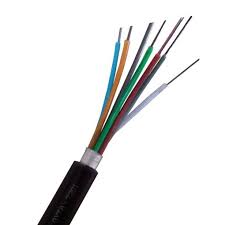
Fiber Optic Cable Prices in Kenya
2-24 Core Multimode Fibre Optic Cable Outdoor in Kenya
KSh 200.00
1 available
Continue shopping2-24 Core Multimode Fibre Optic Cable Outdoor in Kenya

The 2-24 Core Multimode Fibre Optic Cable Outdoor is a high-performance fibre cabling solution designed for reliable data transmission in outdoor network installations. Available in different fibre counts from 2 Core to 24 Core, it provides flexible capacity for small point-to-point connections as well as larger enterprise, campus, CCTV and institutional fibre backbone networks.
Outdoor multimode fibre cable is manufactured with protective construction that helps shield the optical fibres against installation stresses and outdoor environmental conditions. Loose-tube outdoor cable designs isolate the fibres from mechanical and environmental stresses, helping maintain stable transmission performance. Outdoor versions can also incorporate water-blocking components, PE jackets and additional armour depending on the particular cable construction.
At Fiber Optics Kenya, customers can source outdoor multimode fibre optic cables for offices, schools, universities, hospitals, hotels, factories, data centres, commercial buildings, CCTV installations and other structured network projects. We also provide compatible fibre accessories and technical assistance to help customers build complete fibre networks.
Key Specifications
| Specification | Details |
|---|---|
| Product Name | 2-24 Core Multimode Fibre Optic Cable Outdoor |
| Cable Category | Outdoor Fibre Optic Cable |
| Fibre Type | Multimode |
| Available Fibre Categories | OM2 / OM3 / OM4 depending on configuration |
| Fibre Size | 50/125 µm for OM2, OM3 and OM4 |
| Core Range | 2-24 Cores |
| Common Core Counts | 2, 4, 6, 8, 12, 16, 18, 20 and 24 Core |
| Typical Construction | Loose Tube |
| Outer Jacket | Outdoor-grade PE depending on model |
| Typical Jacket Colour | Black for many outdoor PE constructions |
| Water Protection | Water-blocking design depending on model |
| Armour | Armoured and non-armoured configurations available |
| Strength Member | FRP/GRP or metallic depending on construction |
| Installation Environment | Outdoor |
| Installation Methods | Duct, conduit, aerial or direct burial depending on cable rating |
| Applications | LAN, CCTV, backbone, campus and enterprise networks |
| Compatible Connectors | LC, SC, ST and other multimode connectors |
| Supply Length | Cut length or standard reel/drum depending on availability |
| Installation Support | Available |
| Delivery | Nationwide across Kenya |
Outdoor multimode cable specifications vary considerably between constructions. For example, outdoor cables are available in OM1, OM2, OM3 and OM4 configurations, while armoured direct-burial versions can have substantially different mechanical properties from lighter duct cables.
Available Core Counts
The 2-24 Core Multimode Fibre Optic Cable Outdoor allows network designers to select a fibre count according to the number of required connections, redundancy requirements and expected future growth.
| Core Count | Network Capacity | Typical Application | Recommended For |
|---|---|---|---|
| 2 Core | Basic | Single duplex fibre link | Small offices and point-to-point links |
| 4 Core | Basic + Spare | Primary connection with spare fibres | SMEs and CCTV networks |
| 6 Core | Medium | Several fibre connections | Schools and offices |
| 8 Core | Medium | Growing network infrastructure | Commercial buildings |
| 12 Core | Medium-High | Multiple fibre links | Campuses, hotels and hospitals |
| 16 Core | High | Large network distribution | Enterprises and factories |
| 18 Core | High | Multi-service backbone | Institutions |
| 20 Core | High | High-capacity distribution | Large commercial facilities |
| 24 Core | Very High | Extensive fibre backbone | Campuses, data centres and enterprises |
A network may require only two fibres today, but installing additional spare fibres can provide valuable capacity for future connections, redundancy or expansion without having to install another backbone cable.
OM2 vs OM3 vs OM4 Multimode Fibre
Selecting the correct multimode category is just as important as selecting the number of cores.
| Feature | OM2 | OM3 | OM4 |
|---|---|---|---|
| Core/Cladding Diameter | 50/125 µm | 50/125 µm | 50/125 µm |
| Typical Indoor Identification | Orange | Aqua | Aqua/Violet |
| Laser Optimized | Not like OM3/OM4 | Yes | Yes |
| OFL Bandwidth @ 850 nm | 500 MHz·km | 1,500 MHz·km | 3,500 MHz·km |
| Effective Modal Bandwidth @ 850 nm | — | 2,000 MHz·km | 4,700 MHz·km |
| Performance Level | Standard | High | Very High |
| Best For | Existing/legacy installations | Modern enterprise networks | High-performance networks |
| Future Expansion | Moderate | High | Very High |
OM2, OM3 and OM4 all commonly use 50/125 µm fibre, while their bandwidth capabilities differ. Commercial outdoor cable families are available with OM2, OM3 and OM4 fibre options.
Outdoor Multimode Fibre Cable Construction

The construction of outdoor fibre cable is designed to protect the delicate optical fibres inside.
| Component | Function |
|---|---|
| Optical Fibres | Carry data using light signals |
| Fibre Coating | Provides initial protection to the glass fibre |
| Loose Tube | Houses and protects individual fibres |
| Water-Blocking Material | Helps restrict moisture migration |
| Central Strength Member | Provides mechanical support |
| Fillers | Help maintain cable geometry |
| Binding Material | Holds internal cable components together |
| Water-Blocking Tape/Yarn | Provides additional moisture protection |
| Armour | Provides enhanced mechanical protection where specified |
| Outer Sheath | Protects internal components from the outdoor environment |
Loose-tube construction is particularly useful outdoors because it helps isolate optical fibres from installation and environmental stresses. Corning, for example, describes this construction as providing stable transmission parameters in outdoor duct, campus and backbone environments.
Mechanical and Environmental Characteristics
| Characteristic | Typical Description |
|---|---|
| Environment | Outdoor |
| Cable Geometry | Typically Round |
| Outer Jacket | PE commonly used for outdoor cable |
| Water Resistance | Water-blocking options available |
| UV Resistance | Available with outdoor-rated jackets |
| Armour | Optional depending on construction |
| Rodent Protection | Enhanced with appropriate armoured designs |
| Crush Resistance | Cable-model dependent |
| Tensile Strength | Cable-model dependent |
| Installation Bend Radius | Commonly specified as a multiple of cable OD |
| Operating Bend Radius | Cable-model dependent |
| Operating Temperature | Manufacturer/model dependent |
| Installation Temperature | Manufacturer/model dependent |
| Direct Burial | Only when specifically rated |
| Aerial Installation | Suitable constructions available |
| Duct Installation | Suitable constructions available |
As an example of why the exact cable datasheet matters, one outdoor armoured cable family specifies 3,000 N short-term tensile strength, 1,000 N long-term tensile strength, 20× OD installation bend radius and 10× OD operating bend radius. These values should not automatically be applied to every outdoor multimode cable.
Key Benefits of 2-24 Core Multimode Fibre Optic Cable Outdoor
High-Speed Data Transmission
Multimode fibre provides the bandwidth required for high-speed Ethernet and other data-intensive network applications over appropriate multimode distances.
Flexible 2-24 Core Capacity
Projects can be designed around current requirements while incorporating spare fibre cores for future expansion.
Resistant to Electromagnetic Interference
Optical fibre transmits information using light rather than electrical signals, making it immune to electromagnetic interference affecting conventional copper communications cables.
Suitable for Outdoor Networks
Outdoor cable constructions provide additional environmental and mechanical protection compared with ordinary indoor fibre cables.
Ideal for Network Backbones
The cable can connect network switches, communications rooms, buildings, CCTV distribution points and other network infrastructure.
Scalable Network Infrastructure
Unused fibre cores can provide capacity for additional network connections without necessarily installing another backbone cable.
Watch the 2-24 Core Multimode Fibre Optic Cable Outdoor Video
Watch 2-24 Core Multimode Fibre Optic Cable Outdoor on YouTube
The 2-24 Core Multimode Fibre Optic Cable Outdoor provides a dependable way of extending high-speed network connectivity between buildings, server rooms, communications cabinets, CCTV distribution points and other network infrastructure. Its outdoor construction provides greater environmental protection than ordinary indoor fibre, while loose-tube configurations help isolate the optical fibres from installation and environmental stresses. This makes it particularly useful for campus, institutional, commercial and industrial network backbones.
The availability of multiple fibre counts provides considerable flexibility during network design. A 2-core or 4-core cable can be appropriate for a simple point-to-point connection, while 8-core, 12-core or 24-core cable gives larger installations additional capacity for multiple network services, redundancy and future expansion. This can reduce the need to install additional backbone cables whenever the network grows.
Choosing between OM2, OM3 and OM4 should be based on the required network speed, transmission distance, optical transceivers and existing infrastructure. Fiber Optics Kenya can assist customers in selecting the appropriate fibre category, core count, cable construction and compatible termination accessories for their network project.
Applications
1. Enterprise Network Backbones
Connect network switches, server rooms, telecommunications rooms and network cabinets throughout corporate premises.
2. Building-to-Building Connections
Outdoor multimode fibre can provide high-speed connections between buildings within commercial compounds and campuses where the link distance and optical equipment are appropriate.
3. CCTV Surveillance Networks
Fibre provides a high-capacity backbone for connecting remotely positioned CCTV network switches to central monitoring infrastructure.
4. Schools and Universities
Connect administration blocks, classrooms, laboratories, libraries, ICT centres and other buildings across a campus.
5. Hospitals
Suitable for connecting network infrastructure between departments, buildings, server rooms and surveillance systems.
6. Hotels and Resorts
Deploy fibre links between network cabinets, CCTV infrastructure, Wi-Fi systems and administration buildings.
7. Industrial Networks
Optical fibre is particularly useful where electrical interference could affect conventional copper data transmission.
8. Data Centres
OM3 and OM4 multimode fibres are commonly used in high-speed data-centre and enterprise network environments.
9. Commercial Buildings
Connect network distribution rooms, telecommunications cabinets and different sections of large commercial facilities.
10. Government Institutions
Create scalable backbone infrastructure for offices, campuses and institutional facilities.
How to Choose the Right Core Count
| Requirement | Recommended Starting Point |
|---|---|
| One duplex fibre connection | 2 Core |
| One link + spare fibres | 4 Core |
| Small multi-service network | 6 Core |
| Growing commercial network | 8 Core |
| Medium campus backbone | 12 Core |
| Large distribution network | 16 Core |
| High-capacity infrastructure | 18-20 Core |
| Large backbone + expansion | 24 Core |
For important network infrastructure, it is advisable to consider future expansion and spare fibres rather than selecting a cable based only on today's minimum requirements.
Armoured vs Non-Armoured Outdoor Multimode Fibre
| Feature | Armoured | Non-Armoured |
|---|---|---|
| Mechanical Protection | Higher | Standard |
| Rodent Protection | Better with suitable armour | Limited |
| Cable Weight | Higher | Lower |
| Flexibility | Generally lower | Generally higher |
| Duct Installation | Yes, depending on design | Yes |
| Direct Burial | When specifically rated | Only when specifically rated |
| Protected Conduit | Yes | Ideal |
| Cost | Generally higher | Generally lower |
| Best Application | Harsh/exposed cable routes | Protected ducts and conduits |
Direct-burial cable should be specifically designed for the application. Some outdoor armoured constructions, for example, are explicitly designed with enhanced armour and waterproofing for direct burial.
Multimode Fibre vs Copper Network Cable
| Feature | Multimode Fibre | Copper Ethernet |
|---|---|---|
| Transmission Medium | Light | Electrical signals |
| Bandwidth Potential | Very High | Category dependent |
| EMI Resistance | Immune | Susceptible |
| Electrical Conductivity | Non-conductive optical path | Conductive |
| Backbone Applications | Excellent | More distance-limited |
| Multiple Links | Multiple fibres in one cable | Usually separate copper cables |
| Network Expansion | Excellent | Good |
| Termination | Splicing/connectors | RJ45/patch panels |
| Installation Skills | Specialist fibre skills | Standard networking skills |
| Typical Use | Backbone/high-speed links | Endpoint/horizontal links |
Compatible Fibre Optic Accessories
Fiber Optics Kenya can supply the cable together with accessories needed to complete the installation.
| Accessory | Purpose |
|---|---|
| Optical Distribution Frame (ODF) | Fibre termination and distribution |
| Fibre Patch Panel | Organizes fibre connections |
| LC Pigtails | LC fibre termination |
| SC Pigtails | SC fibre termination |
| LC-LC Patch Cords | Equipment interconnection |
| SC-SC Patch Cords | Equipment interconnection |
| LC-SC Patch Cords | Mixed connector installations |
| Fibre Adapters | Connect compatible fibre connectors |
| Splice Protection Sleeves | Protect fusion-spliced fibres |
| Fibre Joint Closures | Protect outdoor fibre joints |
| SFP Modules | Connect fibre to compatible switches |
| SFP+ Modules | High-speed optical network connections |
| Media Converters | Convert copper Ethernet to fibre |
| Fibre Termination Boxes | Organize fibre termination points |
| Cable Management Accessories | Maintain proper cable routing |
Why Buy from Fiber Optics Kenya?
Selecting the right fibre cable requires more than choosing a core count. The fibre category, network speed, distance, transceiver, installation method and future capacity should all be considered.
Fiber Optics Kenya provides outdoor multimode fibre cables together with the accessories and technical support required to create complete fibre network solutions.
| Why Choose Fiber Optics Kenya? | Customer Benefit |
|---|---|
| Wide Core Selection | Choose from 2-24 Core configurations |
| OM2, OM3 & OM4 Options | Match cable performance to your network |
| Technical Guidance | Assistance selecting suitable fibre |
| Complete Fibre Solutions | Source cables and accessories together |
| Competitive Pricing | Solutions for different project budgets |
| Bulk Orders | Suitable for contractors and large projects |
| Professional Installation | Installation support available |
| Fusion Splicing | Professional fibre termination |
| Fibre Testing | Verify installed network performance |
| Project Support | Assistance with different project sizes |
| Nationwide Delivery | Supply throughout Kenya |
Frequently Asked Questions
What is 2-24 Core Multimode Fibre Optic Cable?
It is an optical cable containing between 2 and 24 multimode fibres, allowing several fibre connections to be carried through one cable.
What core counts are available?
Common options include 2, 4, 6, 8, 12, 16, 18, 20 and 24 cores.
Is the cable suitable for outdoor installation?
Yes, when supplied in an outdoor-rated construction designed for environmental exposure.
Is it available in OM2, OM3 and OM4?
Yes. Outdoor loose-tube cable families can be supplied with OM2, OM3 and OM4 multimode fibres.
What is the difference between OM2, OM3 and OM4?
They are different performance categories of multimode fibre. OM3 and OM4 offer greater modal bandwidth than OM2 and are generally preferred for newer high-performance multimode networks.
Should I choose OM3 or OM4?
OM3 provides strong performance for many modern enterprise applications, while OM4 offers additional bandwidth and distance capability for certain high-speed applications.
Can this fibre cable connect two buildings?
Yes, provided the distance, selected multimode category and optical transceivers are compatible.
Can multimode fibre be used for CCTV?
Yes. It can provide a high-speed backbone between IP CCTV network switches and monitoring infrastructure.
Can the cable be buried directly underground?
Only if the particular cable construction is explicitly rated for direct burial. Otherwise, use an appropriate underground duct or conduit.
Is armoured multimode fibre available?
Yes. Armoured outdoor multimode cables are available for installations requiring greater mechanical protection.
Is 24 Core better than 2 Core?
Not necessarily. A 24-core cable offers substantially more capacity, but a small network may only require two or four fibres. The best option depends on present and future requirements.
Do you supply fibre accessories?
Yes. Fiber Optics Kenya supplies compatible ODFs, patch panels, pigtails, patch cords, adapters, closures, SFP modules and other fibre networking accessories.
Do you provide installation and splicing?
Professional installation, termination, fusion splicing and testing can be arranged according to the project requirements.
Do you deliver outside Nairobi?
Yes. Fiber Optics Kenya supplies fibre optic products to customers and projects across Kenya.
Contact Fiber Optics Kenya
Fiber Optics Kenya
Lyric House
7th Floor, Room S9
Kimathi Street
Nairobi
Phone: +254 704 991 492
Email: info@fibreopticskenya.co.ke
Order 2-24 Core Multimode Fibre Optic Cable Outdoor in Kenya
Choose Fiber Optics Kenya for quality 2-24 Core Multimode Fibre Optic Cable, compatible accessories, technical guidance and professional fibre installation solutions.
Contact Fiber Optics Kenya today for pricing, availability, bulk orders and nationwide delivery across Kenya.