Visual Fault Locators Price in Kenya
10mW Visual Fault Locator Cable Tester Price in Kenya
KSh 3,500.00
1 available
Continue shopping10mW Visual Fault Locator Cable Tester Price in Kenya

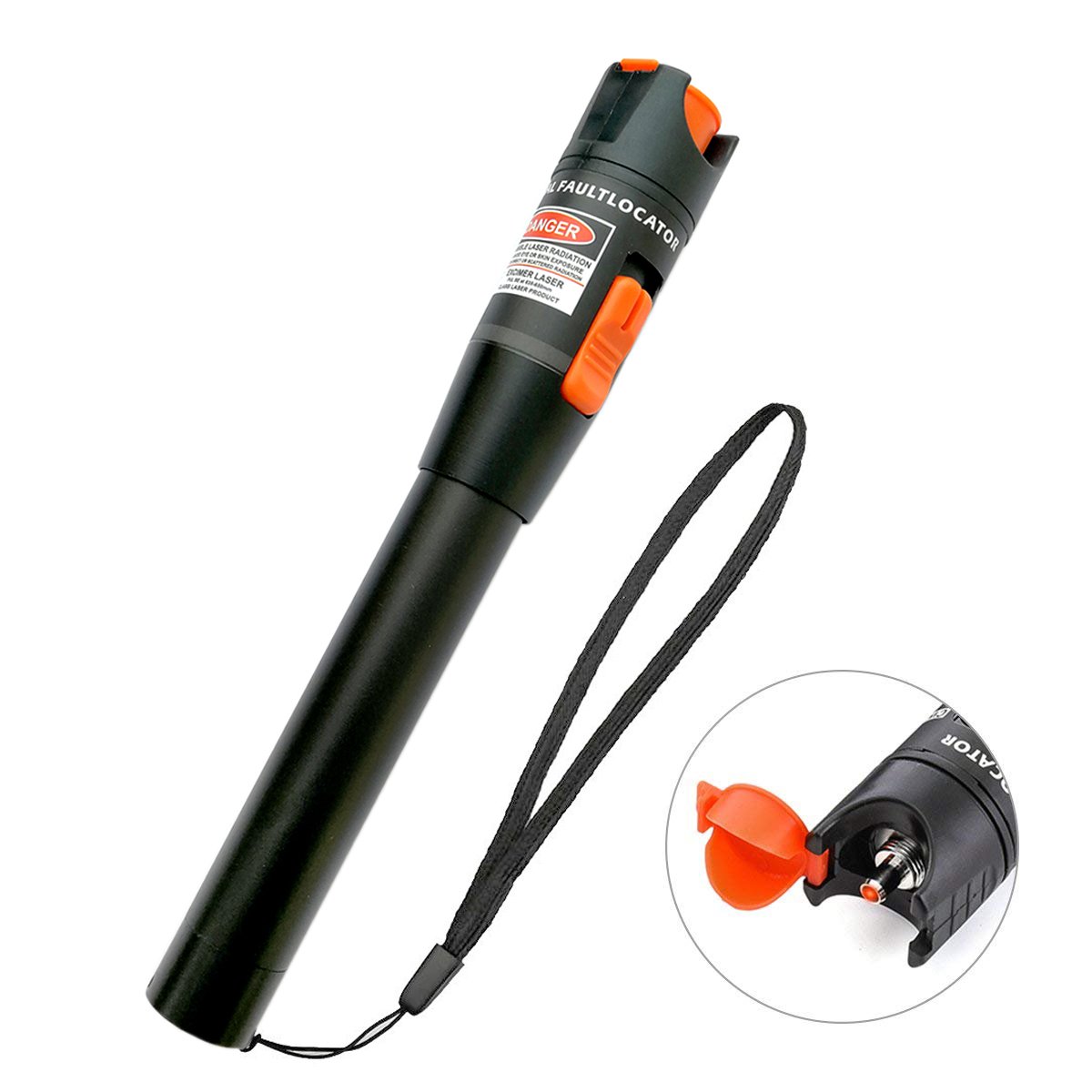
A 10mW Visual Fault Locator Cable Tester, commonly known as a VFL, is a portable fibre optic testing tool designed to help technicians identify fibre breaks, excessive bends, damaged connectors, poor terminations and continuity problems.
The tester injects a bright visible red laser into the optical fibre. When the fibre has a break, severe bend or other physical defect that allows light to escape, the red light can become visible around the affected location.
Typical 10mW pen-style VFLs operate at approximately 650nm, support both continuous and flashing modes, and are commonly rated for fibre tracing up to approximately 10km under suitable conditions.
This makes the 10mW Visual Fault Locator particularly useful for:
FTTH installations
ISP fibre networks
Fibre patch cords
Pigtails
ODFs
FAT boxes
Fibre closures
CCTV fibre networks
Data centres
Enterprise fibre networks
Fibre maintenance and repairs
10mW Visual Fault Locator Specifications
| Specification | Typical Details |
|---|---|
| Product | 10mW Visual Fault Locator Cable Tester |
| Tool Type | Fibre Optic VFL |
| Output Power | 10mW |
| Wavelength | Approx. 650nm |
| Light Colour | Visible Red |
| Nominal Testing Range | Up to approximately 10km |
| Operating Modes | Continuous / Pulsed |
| Typical Pulse Mode | 2Hz |
| Fibre Support | Single Mode / Multimode |
| Connector Interface | 2.5mm Universal |
| SC Connectors | Supported |
| FC Connectors | Supported |
| ST Connectors | Supported |
| LC Connectors | Via 1.25mm adapter where supplied |
| Power | Commonly 2 × AA batteries |
| Design | Portable Pen Type |
| Application | Fibre tracing and fault detection |
These are typical specifications for this class of 10mW VFL rather than guaranteed specifications for every manufacturer. For example, Optix's VFL-10 specifies >10mW output, 650nm ±20nm wavelength, >10km range, CW/2Hz modes and 2.5mm plus 1.25mm interfaces.
What Is a 10mW Visual Fault Locator?
A Visual Fault Locator is essentially a visible optical source designed specifically for fibre troubleshooting.
Its basic operating principle is:
VFL → Fibre Connector → Optical Fibre → Visible Red Light → Fault Identification
Unlike the infrared wavelengths normally carrying data through telecom fibre, the approximately 650nm wavelength produced by the VFL is visible to the human eye.
This allows technicians to visually trace certain physical problems along the fibre.
What Can a 10mW VFL Detect?
A Visual Fault Locator can help identify:
Broken fibre
Excessive fibre bends
Macro-bending
Cracked fibre
Poor connector termination
Damaged patch cords
Damaged pigtails
Mechanical splice problems
Fibre continuity
Incorrect fibre routing
VFLs are also particularly useful for finding faults that may fall within an OTDR dead zone.
650nm Visible Red Laser
Typical 10mW VFLs use a laser wavelength around:
650nm
This produces the distinctive bright red light used for visual fibre tracing.
| Optical Wavelength | Visible to Human Eye? | Common Purpose |
|---|---|---|
| 650nm | Yes – Red | VFL testing |
| 850nm | No | Multimode transmission/testing |
| 1310nm | No | Single-mode transmission |
| 1490nm | No | PON downstream |
| 1550nm | No | Telecom / PON applications |
The visibility of 650nm light is what makes a VFL useful for physical troubleshooting.
10mW Output Power
Higher optical output can make red light easier to identify through certain faults and allows manufacturers to give these testers longer nominal tracing ranges.
Typical pen-style VFL categories include:
| VFL | Typical Nominal Category |
|---|---|
| 1mW | Short-distance testing |
| 5mW | Medium-distance testing |
| 10mW | Up to approximately 10km |
| 20mW | Higher-output applications |
A 10mW VFL is commonly marketed for distances up to approximately 10km, although actual useful visible-fault range depends heavily on the fibre link and fault conditions.
Up to 10KM Fibre Testing
A typical 10mW VFL is rated for approximately 10km of fibre.
However, this should be understood as a nominal manufacturer rating, not a guarantee that every fault on a 10km fibre will be visually detectable.
Actual performance depends on:
Fibre type
Fibre attenuation
Connectors
Splices
Splitters
Number of bends
Cable jacket
Fault severity
Ambient lighting
Connector cleanliness
For precise long-distance fault location, an OTDR should be used.
Continuous and Pulsed Modes
A 10mW Visual Fault Locator commonly provides two operating modes.
Continuous Mode – CW
The laser remains continuously illuminated.
This is useful for:
Continuity checks
Finding breaks
Inspecting bends
Testing patch cords
Pulsed Mode
The red light flashes, commonly at around 2Hz on many models.
Flashing mode can make it easier to distinguish the fibre being tested from surrounding fibres.
2.5mm Universal Fibre Connector
Most pen-style 10mW VFLs use a 2.5mm universal optical interface.
This commonly supports:
SC
FC
ST
| Fibre Connector | Compatibility |
|---|---|
| SC/UPC | Yes |
| SC/APC | Yes, with compatible 2.5mm interface |
| FC/UPC | Yes |
| FC/APC | Interface dependent |
| ST | Yes |
| LC/UPC | Requires 1.25mm adapter |
| LC/APC | Requires suitable 1.25mm adapter |
Some VFL kits include a 1.25mm adapter for LC and MU connectors, while others require it to be purchased separately.
Single-Mode Fibre Testing

The 10mW Visual Fault Locator can be used with single-mode fibre.
Typical applications include:
G.652 fibre
G.657 fibre
FTTH drop cable
Single-mode patch cords
Pigtails
Feeder fibre
Distribution fibre
Multimode Fibre Testing
VFLs can also be used with multimode fibre.
A 10mW VFL specification from Optcore explicitly supports both single-mode and multimode fibre.
This makes the tester useful for both telecom and enterprise fibre environments.
Watch 10mW Visual Fault Locator Cable Tester
The supplied video is specifically titled “Visual Fault Locator 10mw | Visual Fault locator fiber optic cable tester,” making it directly relevant to this product page.
A VFL is particularly useful during field troubleshooting because it provides technicians with an immediate visual indication of certain physical fibre problems. For simple patch-cord, pigtail, drop-cable and continuity checks, technicians can often perform an initial diagnosis without setting up a more complex OTDR.
For professional fibre maintenance, however, the VFL works best as part of a broader testing toolkit. An Optical Power Meter measures signal strength, while an OTDR determines fibre length, event locations and the approximate distance to faults.
10mW VFL for FTTH Installation
A typical FTTH network may follow this path:
OLT → ODF → Feeder Fibre → PLC Splitter → FAT Box → Drop Cable → ATB → Patch Cord → ONU
A VFL can help technicians troubleshoot several sections of this path.
For example:
FAT → Drop Cable → ATB
If the subscriber has no connection, a technician can use the VFL to check whether the drop fibre is physically continuous.
Testing FTTH Drop Cable
A 10mW VFL is particularly useful for subscriber drop cables.
It can help reveal:
Broken drop fibre
Excessively tight cable bends
Damage around cable clips
Faults near the ATB
Faults near the FAT
Poor connector installation
This makes the tool useful during both installation and maintenance.
Testing Fibre Patch Cords
Patch cords are frequently handled, disconnected, moved and bent.
Common faults include:
Broken fibre near the boot
Excessive bending
Connector damage
Internal fibre breakage
A VFL provides a quick way to check continuity before replacing the patch cord.
Testing Fibre Pigtails
Fibre pigtails are commonly installed inside:
ODFs
FAT boxes
Fibre closures
Termination boxes
Patch panels
A VFL can help technicians verify continuity and identify specific pigtails.
Testing Fibre Connectors
The VFL can also help troubleshoot:
SC/UPC
SC/APC
FC
ST
LC with adapter
However, it does not measure connector insertion loss.
For quantitative optical-loss measurements, technicians need an Optical Power Meter or suitable fibre loss-testing equipment.
VFL for ODF Testing
Inside an Optical Distribution Frame, many pigtails and patch cords may be installed together.
A VFL can help:
Identify specific fibres
Verify fibre mapping
Trace pigtails
Test patch cords
Confirm continuity
Find physical faults
Flashing mode is especially convenient when several fibres are being traced.
VFL for FAT Box Troubleshooting
The VFL can be connected to a subscriber fibre to help identify its corresponding path at the FAT box.
This is useful for:
New customer installations
Subscriber troubleshooting
Fibre identification
Drop-cable replacement
Port verification
VFL for Fibre Closures
Visual Fault Locators can also assist during fibre closure installation and maintenance.
Technicians can use them to verify fibres before or after:
Fusion splicing
Mechanical splicing
Fibre routing
Tray organization
Closure sealing
VFL vs OTDR
| Feature | 10mW VFL | OTDR |
|---|---|---|
| Visible Red Laser | Yes | No |
| Continuity Testing | Yes | Yes |
| Visual Break Detection | Yes | No |
| Exact Distance to Fault | No | Yes |
| Fibre Length Measurement | No | Yes |
| Splice Analysis | No | Yes |
| Connector Event Analysis | No | Yes |
| OTDR Trace | No | Yes |
| Ease of Use | Very Easy | More Technical |
A VFL is ideal for quick physical troubleshooting, while an OTDR provides detailed fibre-link analysis.
VFL vs Optical Power Meter
| Feature | VFL | OPM |
|---|---|---|
| Visible Red Light | Yes | No |
| Measures dBm | No | Yes |
| Finds Visible Breaks | Yes | No |
| Checks Continuity | Yes | Yes |
| Measures Signal Level | No | Yes |
| Fibre Identification | Excellent | Limited |
VFL vs PON Power Meter
| Tool | Main Purpose |
|---|---|
| 10mW VFL | Visual fault tracing |
| Optical Power Meter | Optical power measurement |
| PON Power Meter | PON wavelength measurement |
| OTDR | Distance and event analysis |
| Optical Light Source | Test-signal generation |
10mW VFL vs 20mW VFL
| Feature | 10mW VFL | 20mW VFL |
|---|---|---|
| Output Power | 10mW | 20mW |
| Typical Nominal Range | ~10km | ~20km |
| FTTH Drop Testing | Excellent | Excellent |
| Patch Cord Testing | Excellent | Excellent |
| Fibre Identification | Excellent | Excellent |
| Output Strength | High | Higher |
| Eye Safety Requirements | Strict | Strict |
A 10mW unit is already powerful enough for many routine FTTH and ISP troubleshooting applications.
How to Use a 10mW Visual Fault Locator
Disconnect or isolate the fibre as appropriate.
Inspect and clean the connector.
Remove the VFL dust cap.
Connect the fibre.
Switch on the VFL.
Select continuous or pulsed mode.
Trace the fibre.
Inspect connectors and bends.
Look for visible red-light leakage.
Identify the suspected fault.
Switch off the tester.
Disconnect the fibre.
Replace the protective cap.
Visual Fault Locator Safety
A 10mW VFL is a laser instrument and must be handled correctly.
Never:
Look directly into the laser aperture.
Look into the end of a connected fibre.
Point the laser toward another person's eyes.
Inspect an active fibre through magnification.
Allow untrained users to treat it as an ordinary laser pointer.
The visible nature of the light does not mean it is safe to view directly.
Why Use a 10mW VFL?
A 10mW VFL offers several practical benefits:
Compact size
Simple operation
Strong visible output
Low equipment cost
Fast fault checks
Portable pen design
Single-mode compatibility
Multimode compatibility
Continuous mode
Pulsed mode
Common connector support
These features make it one of the most practical tools for everyday fibre technicians.
10mW Visual Fault Locator Cable Tester Price in Kenya
The 10mW Visual Fault Locator Cable Tester price in Kenya depends on:
Brand
Build quality
Output rating
Connector adapters
Battery configuration
Rechargeable or replaceable batteries
Carrying case
Warranty
Accessories
Customers should also confirm whether the VFL includes a 1.25mm LC adapter, as many basic models only provide the standard 2.5mm interface.
Recommended Accessories
| Accessory | Purpose |
|---|---|
| 1.25mm LC Adapter | LC connector testing |
| Optical Power Meter | Signal-level measurement |
| PON Power Meter | GPON/EPON testing |
| OTDR | Advanced fibre diagnostics |
| Fibre Cleaver | Precision fibre preparation |
| Fusion Splicer | Fibre joining |
| Fibre Stripper | Coating removal |
| Fibre Cleaning Kit | Connector maintenance |
| SC/APC Patch Cord | Fibre interconnection |
| SC/UPC Patch Cord | Fibre interconnection |
Frequently Asked Questions
What is a 10mW Visual Fault Locator?
It is a portable fibre tester that injects visible red laser light into optical fibre to assist with continuity checks, fibre tracing and visual fault identification.
What wavelength does a 10mW VFL use?
Typical models use approximately 650nm visible red light.
What does 10mW mean?
It refers to the nominal optical output power of the laser.
How far can a 10mW Visual Fault Locator test?
Many 10mW models are marketed for approximately 10km, although actual useful range varies considerably with the fibre and fault conditions.
Can it locate fibre breaks?
Yes. Visible light can escape from some fibre breaks, making them easier to locate.
Can it find fibre bends?
Yes. Severe macro-bends can produce visible red-light leakage.
Can it test fibre continuity?
Yes.
Can it identify a fibre?
Yes. This is one of the common applications of a VFL.
Can it test single-mode fibre?
Yes.
Can it test multimode fibre?
Yes.
Can it test FTTH drop cable?
Yes.
Can it test patch cords?
Yes.
Can it test pigtails?
Yes.
Does it support SC connectors?
Yes. A typical 2.5mm universal VFL interface supports SC connectors.
Does it support SC/APC?
A compatible 2.5mm interface can physically accept SC ferrules, but connector and adapter compatibility should always be confirmed for the specific tester.
Does it support SC/UPC?
Yes, on typical universal 2.5mm models.
Can it test FC connectors?
Yes.
Can it test ST connectors?
Yes.
Can it test LC connectors?
A 1.25mm adapter is normally required. Some VFL kits include one.
Does it have continuous mode?
Yes. Typical models provide continuous-wave operation.
Does it have flashing mode?
Yes. Many use approximately 2Hz pulsed operation.
What batteries does it use?
Many pen-style 10mW VFLs use two AA batteries, although rechargeable models are also available.
Are rechargeable VFLs available?
Yes. Rechargeable 10mW models with lithium-ion batteries and USB-C charging are available.
Can a VFL measure optical power?
No. Use an Optical Power Meter.
Can it measure dBm?
No.
Can it measure fibre length?
No.
Can it tell the exact distance to a fibre break?
No. Use an OTDR.
Can it measure splice loss?
No. An OTDR or loss-test setup should be used.
Can it replace an OTDR?
No. A VFL complements an OTDR rather than replacing it.
Can it replace an Optical Power Meter?
No.
Can I use a VFL inside an ODF?
Yes.
Can I use it inside a FAT box?
Yes.
Can it be used with fibre closures?
Yes.
Is it suitable for FTTH installers?
Yes.
Is it suitable for ISP technicians?
Yes.
Is it suitable for CCTV fibre networks?
Yes.
Can I look directly into the VFL?
No. Never look directly into the laser output or an attached fibre end.
Is a 10mW VFL more powerful than a 5mW VFL?
Yes.
Is 10mW suitable for everyday fibre installation?
Yes. It provides useful output for many FTTH, patch-cord and general fibre troubleshooting tasks.
What is the 10mW Visual Fault Locator Cable Tester price in Kenya?
Pricing depends on brand, accessories, battery type and supplier. Contact Fiber Optics Kenya for the current price.
Do you supply 10mW Visual Fault Locators?
Yes. Fiber Optics Kenya can supply VFL cable testers and related fibre-testing equipment.
Do you supply 20KM Visual Fault Locators?
Yes, subject to availability.
Do you supply OTDRs?
Yes.
Do you supply Optical Power Meters?
Yes.
Do you supply PON Power Meters?
Yes.
Do you supply fusion splicing machines?
Yes.
Do you supply fibre cleavers?
Yes.
Do you deliver outside Nairobi?
Yes. Fiber Optics Kenya supplies fibre optic equipment throughout Kenya.
Why Buy a 10mW Visual Fault Locator from Fiber Optics Kenya?

| Fiber Optics Kenya Solution | Application |
|---|---|
| 10mW Visual Fault Locator | Fibre tracing |
| 20KM VFL | Higher-output fibre tracing |
| ZS-1000A OTDR | Advanced fibre diagnostics |
| Optical Power Meter | Signal measurement |
| PON Power Meter | PON testing |
| Fusion Splicing Machine | Fibre joining |
| Fibre Cleaver | Precision fibre preparation |
| Fibre Stripper | Fibre preparation |
| Fibre Cleaning Tools | Connector maintenance |
| Patch Cords | Fibre connections |
| Pigtails | Fibre termination |
| ODFs | Fibre distribution |
| FAT Boxes | FTTH distribution |
| Fibre Closures | Splice protection |
| Nationwide Delivery | Supply across Kenya |
Contact Fiber Optics Kenya
Fiber Optics Kenya
Lyric House, 7th Floor Room S9
Kimathi Street, Nairobi
Phone: +254 704 991 492
Email: info@fibreopticskenya.co.ke
The 10mW Visual Fault Locator Cable Tester is an essential portable tool for FTTH installers, ISP technicians, fibre contractors and network maintenance teams. Typical units combine a 10mW 650nm visible red laser, approximately 10km nominal range, continuous and pulsed operating modes, and a universal 2.5mm connector for common SC, FC and ST interfaces.
It is particularly useful for identifying fibre breaks, macro-bends, damaged patch cords, faulty pigtails, continuity problems and fibre routing. Its small pen-style design makes it easy to carry alongside a fusion splicer, fibre cleaver, Optical Power Meter and OTDR.
Contact Fiber Optics Kenya for 10mW Visual Fault Locator Cable Tester prices in Kenya, VFLs, ZS-1000A OTDRs, Optical Power Meters, PON Power Meters, fusion splicers, fibre cleavers, complete FTTH testing kits, bulk orders and nationwide delivery.