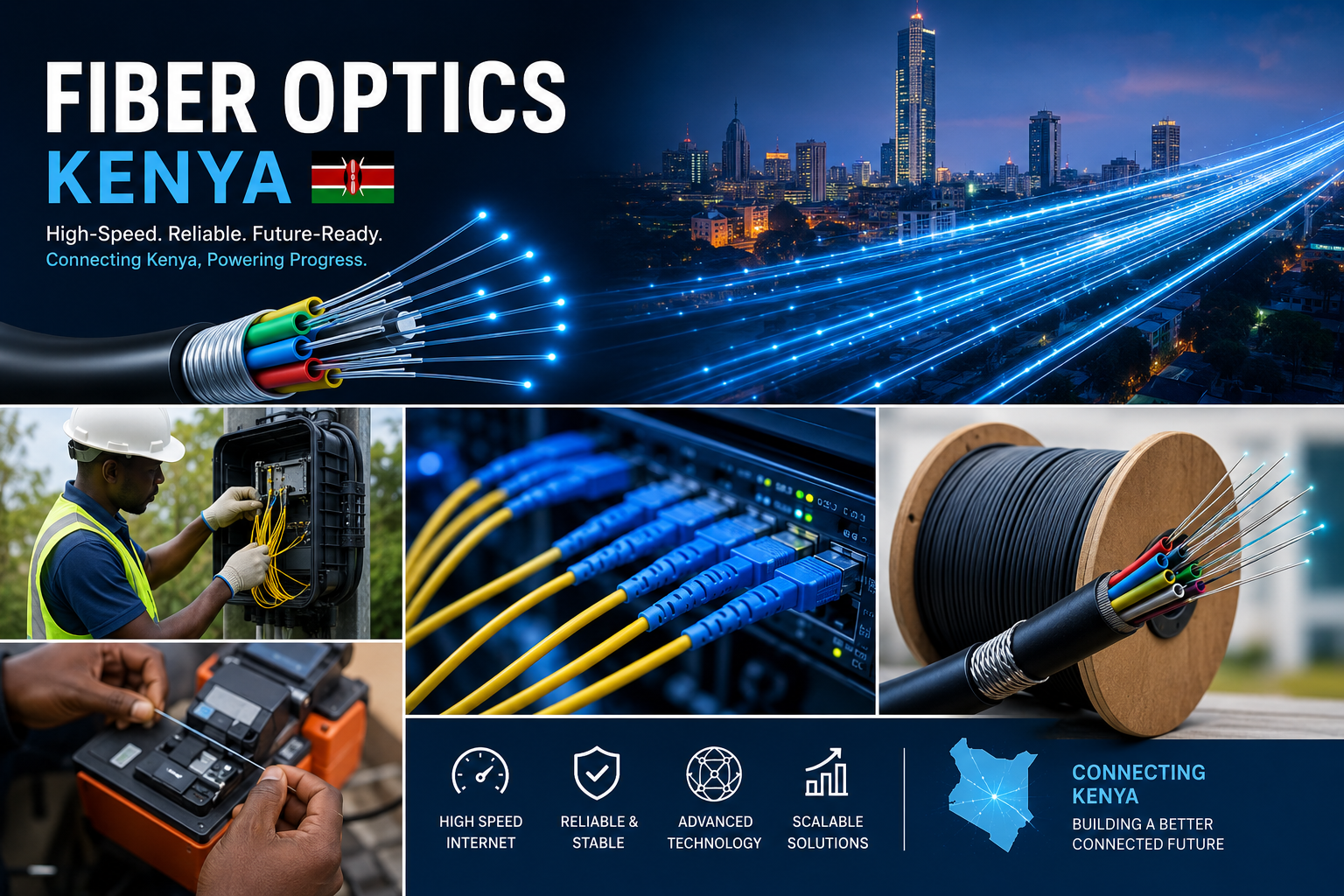
How to Choose the Best Fiber Optic Installation Company in Kenya: A Buyer's Guide
 Image 1 shot list: A technician in branded workwear testing a live fiber connection at a utility box or building entry point — conveys hands-on expertise and real fieldwork.
Every year, more Kenyan households and businesses switch from mobile data or basic DSL to fiber internet, drawn by faster speeds and steadier connections. But there's a detail many people overlook until it's too late: the quality of your internet experience depends less on which ISP you sign up with, and far more on who physically installs the fiber line into your home or office.
A rushed, careless installation can quietly cap your speeds, cause random disconnections, and leave you troubleshooting a "slow internet" problem for months — when the real issue was a bad splice or a badly routed cable from day one. That's why choosing the best fiber optic installation company in Kenya deserves the same scrutiny you'd give to hiring an electrician or a contractor, not just a quick search-and-call decision.
This guide breaks down exactly what to evaluate before you hire an installer, using the same criteria industry professionals use to judge each other's work — and shows where Fiber Optics Kenya fits against that standard.
Why the Installer Matters More Than the ISP Plan
It's a common misconception that upgrading to a faster ISP package automatically means faster internet. In reality, your connection is only as good as its weakest physical link. A 500 Mbps plan running through a poorly spliced joint or a cable bent tighter than its minimum bend radius will perform far below its rated speed — sometimes barely better than the plan you had before.
This is why fiber installation is a specialized skill, not a generic "cabling" job. The person running your cable and fusing your splices has more influence over your day-to-day internet experience than almost anyone else in the process.
7 Criteria for Judging a Fiber Optic Installation Company
1. Technical Certification and Equipment
Ask directly: does the company use fusion splicers, or mechanical splices done by hand? Do they test every link with an OTDR (Optical Time-Domain Reflectometer) before calling the job done? These aren't optional extras — they're the baseline tools of the trade. A company that can't answer these questions confidently probably isn't equipped to do the job properly.
 Image 2 shot list: Macro shot of a fusion splicer mid-operation, glowing arc visible, fiber strands aligned — signals precision and professional-grade equipment.
2. Range of Services Offered
The strongest installers don't just pull cable — they design the network. Look for a provider that covers:
- Site survey and cable route planning
- Fiber splicing and termination
- Structured cabling for offices (Cat6/Cat6a plus fiber backbone)
- OTDR testing and certification
- CCTV and access-control integration
- Post-installation maintenance and support
A company offering only one or two of these is fine for a very simple job, but for anything beyond a basic home connection, you want a partner who can scale the project without bringing in a second contractor.
3. Experience Across Property Types
Ask for examples of past work in a property similar to yours. A technician who's mostly done small residential drops may not have the experience to properly design cabling for a five-floor office building, and vice versa — an enterprise-focused installer might over-engineer a simple home job (and overcharge for it).
 Image 3 shot list: Wide shot of a neat server rack with color-coded, labeled cabling — communicates order, professionalism, and enterprise capability.
4. Coverage Area
Confirm the company actually services your location before you get quotes. Nairobi has no shortage of installers, but coverage thins out in secondary towns and rural counties — even though <cite index="3-1">national fiber backbone projects are actively expanding into nineteen counties</cite>, the ability to mobilize a qualified technician to your specific address still varies a lot by provider.
5. Transparent, Itemized Pricing
A trustworthy quote breaks down labor, materials (cable length, connectors, patch panels, conduit), and any equipment costs separately — not just one lump figure. This transparency also makes it much easier to compare quotes apples-to-apples between companies.
6. Verifiable Reviews and References
Star ratings alone don't tell you much. Ask for a recent client you can actually contact, or project photos showing completed cable routing and cable management — sloppy, exposed wiring in a "finished" photo is a red flag regardless of how polished the company's marketing looks.
7. Warranty and Ongoing Support
Fiber lines get nicked during renovations, connectors work loose, and equipment eventually needs replacing. Ask what happens after installation day: is there a workmanship warranty? A support number? A response-time commitment for faults? The best companies treat installation as the start of a relationship, not the end of the transaction.
Underground and Aerial Installation: What to Expect
For properties without existing fiber access nearby, installation may involve trenching (underground) or pole-mounted aerial cabling, particularly in newer estates and business parks still being connected to the national grid.
 Image 4 shot list: Overhead or street-level shot of a marked trench with conduit and fiber cable being laid, safety cones visible — shows infrastructure-level capability, not just indoor cabling.
Good installers will:
- Coordinate with local authorities or estate management before digging
- Use proper conduit to protect the cable from future accidental damage
- Mark cable routes clearly for future reference
- Weatherproof all outdoor splice points and junction boxes
If a company glosses over these details or seems unfamiliar with local permitting requirements, treat it as a warning sign.
What a Finished Installation Should Look Like
By the time a job is done, you should have:
- A clean, properly terminated fiber line entering your home or office
- A router and/or ONT positioned for good coverage, not shoved wherever was most convenient for the technician
- No exposed, unprotected cable runs across floors or through doorways
- Test results (or at least a verbal confirmation) showing acceptable signal loss
- A brief walkthrough explaining what was installed and how to reach support if something goes wrong
 Image 5 shot list: Interior shot of a tidy home setup — router mounted or shelved neatly, cable run along a skirting board rather than draped across the floor — shows installation quality from the client's point of view.
If any of these are missing, don't hesitate to ask the installer to correct it before considering the job complete — a reputable company will expect and welcome that follow-up.
How Fiber Optics Kenya Measures Up
Running through the checklist above, Fiber Optics Kenya was built around these exact standards:
- Certified technicians using fusion splicing and OTDR testing on every job, not spot checks
- Full-scope services, from site survey through structured cabling, CCTV integration, and post-installation support
- Cross-property experience, covering homes, offices, and ISP infrastructure/last-mile projects
- Growing regional coverage, extending beyond Nairobi as demand rises in other towns
- Itemized quotes so clients know exactly what they're paying for before work begins
- Warranty-backed workmanship with maintenance support available after handover
If you're comparing installers, this is the checklist to run every company through — not just the one you feel most reassured by after a single phone call.
Fiber Optic Installation vs. ISP Activation: Don't Confuse the Two
A lot of confusion in Kenya's broadband market comes from mixing up two separate things: who installs your physical fiber line, and who provides your internet service (ISP). In many cases, the ISP subcontracts installation to a third-party team, which means the quality of your physical cabling can vary wildly even between customers of the same provider.
| Installation Company | Internet Service Provider (ISP) | |
|---|---|---|
| Responsible for | Physical cable, splicing, routing, testing | Bandwidth, IP address, monthly billing |
| Fixes signal loss / bad splices | Yes | No — will usually refer you back to the installer |
| Fixes "my plan is slow" issues | Sometimes (if it's a cabling issue) | Yes (if it's a bandwidth/plan issue) |
| You choose them directly | Often, especially for businesses | Yes, based on plans and pricing |
Knowing this distinction matters because if your internet is consistently underperforming, calling your ISP's customer care line may not fix the actual problem if the fault lies in the physical installation. This is one more reason to choose your installer carefully upfront — a good installation reduces the number of times you'll need to make that call at all.
Common Mistakes People Make When Choosing an Installer
Going with the cheapest quote without asking what's excluded. A low price sometimes means thinner cable, no OTDR testing, or no warranty — costs that resurface later as poor performance or repeat callout fees.
Not confirming coverage before requesting a quote. Some companies will still send a technician out even if your area is a stretch for them logistically, leading to delays or a rushed job.
Skipping the site survey. A phone-only estimate without an actual site visit or building plan review often results in inaccurate cable-length estimates and unexpected costs once work begins.
Assuming all "fiber" installations are equal. FTTH (fiber-to-the-home) and FTTO (fiber-to-the-office) have different bandwidth and reliability requirements — an installer unfamiliar with the difference may under-spec a business installation.
Not asking about post-installation support until something breaks. By then, you're negotiating from a weaker position. Confirm the support process before signing anything.
A Quick Glossary for Non-Technical Buyers
- ONT (Optical Network Terminal): The device that converts the incoming fiber light signal into a standard internet connection your router can use.
- Fusion Splicing: Permanently joining two fiber strands by melting them together with precision equipment — the industry standard for low signal loss.
- OTDR (Optical Time-Domain Reflectometer): A testing device that measures signal loss and pinpoints faults along a fiber line.
- FTTH / FTTO: Fiber-to-the-Home and Fiber-to-the-Office — the two most common fiber connection categories for end users.
- Structured Cabling: An organized, standardized cabling system (fiber and copper) designed to support a building's full network needs, not just a single connection.
- Bend Radius: The minimum radius a fiber cable can be curved without risking damage or signal loss — a common point of failure in careless installations.
Knowing these terms doesn't just help you sound informed on the phone with an installer — it gives you the vocabulary to ask sharper questions and spot vague or evasive answers.
A Simple Pre-Hire Checklist
Before signing off on any fiber optic installation company in Kenya, run through this list:
- [ ] Do they use fusion splicing and OTDR testing on every job?
- [ ] Can they show examples of past work on a property similar to mine?
- [ ] Do they service my specific location?
- [ ] Is the quote itemized (labor, materials, equipment separately)?
- [ ] Do they offer a workmanship warranty?
- [ ] Is there a clear process for post-installation support or repairs?
- [ ] Did they conduct an actual site survey, not just a phone estimate?
If a company checks every box, you're very likely looking at one of the better options in the market — not just for this installation, but for the years of support that follow it.
Frequently Asked Questions
How do I know if my installer is actually certified? Ask directly what fusion splicing and testing equipment they use, and request to see OTDR test results for your specific installation once complete. A legitimate company will have no hesitation sharing this.
Is it worth paying more for a better installer? Almost always, yes. The cost difference between a good and a mediocre installation is usually small relative to the total project, but the performance difference — and the cost of fixing a bad job later — can be significant.
Can I switch installers if I'm unhappy with a previous installation? Yes. A new installer can typically inspect and, if needed, re-splice or re-route an existing installation, though this may cost more than a first-time setup depending on the condition of the existing cabling.
Should I get multiple quotes before choosing a company? Yes — and use the itemized-pricing criterion above to compare them properly rather than just picking the lowest number, since a suspiciously cheap quote often means corners are being cut on materials or testing.
Does installation quality affect my monthly internet bill? Not directly, but poor installation can make you pay for internet speeds you never actually receive, which is effectively the same as overpaying every month.
What Drives Installation Costs (And Why the Cheapest Quote Isn't Always the Best Deal)
Once you've narrowed down a shortlist of installers using the criteria above, price naturally becomes the deciding factor. But comparing quotes only makes sense once you understand what's actually driving the number.
Distance from the nearest access point. If your home or office sits far from existing fiber infrastructure, the installer has to run — and pay for — more cable, and possibly arrange trenching or aerial pole access. This is usually the single biggest cost driver, and it's also the one most likely to be underestimated in a phone-only quote.
Indoor complexity. A single-story home with easy wall access is far simpler than a multi-tenant building with shared risers, false ceilings, or strict building-management requirements around where cabling can run.
Number of connection points. Wiring one router in a small apartment is a very different job from running fiber and Cat6 to fifteen desks, a server room, and a reception CCTV system.
Materials quality. Cable jacket rating, connector brand, and patch panel quality all vary, and cheaper materials can shave a noticeable amount off a quote — at the cost of long-term durability.
Testing and documentation. Some installers price OTDR testing and post-installation documentation into every job as standard; others treat it as an optional add-on, which is worth clarifying before you compare two quotes that look similar on the surface.
Support and warranty terms. A quote that includes a workmanship warranty and a defined support process is, in effect, cheaper over the life of the installation than a lower quote with no such coverage — even if the sticker price looks higher upfront.
The takeaway: when two quotes differ significantly, don't assume the lower one is the better deal. Ask what's included, what's excluded, and what happens if something needs fixing six months down the line. That conversation alone often tells you more about an installer's quality than the number on the page.
Final Word
The best fiber optic installation company in Kenya isn't necessarily the one with the flashiest ads or the cheapest quote — it's the one that can show, not just tell you, that they follow proper splicing, testing, and cabling standards on every job. Run any installer you're considering through the seven criteria above, ask the direct questions, and don't settle for vague answers about equipment or testing.
For a company that's built its process around exactly these standards, get in touch with Fiber Optics Kenya for a site survey and a transparent, itemized quote.
Production note: The five image placeholders above include a shot list describing exactly what each image should show. Since these can't be sourced from copyrighted web images, use your own project photography where possible, or license equivalent images from Unsplash/Pexels using the descriptive terms in each shot list. Compress final images to under 200KB each and use the suggested filenames (with keyword-relevant alt text) for on-page SEO.